
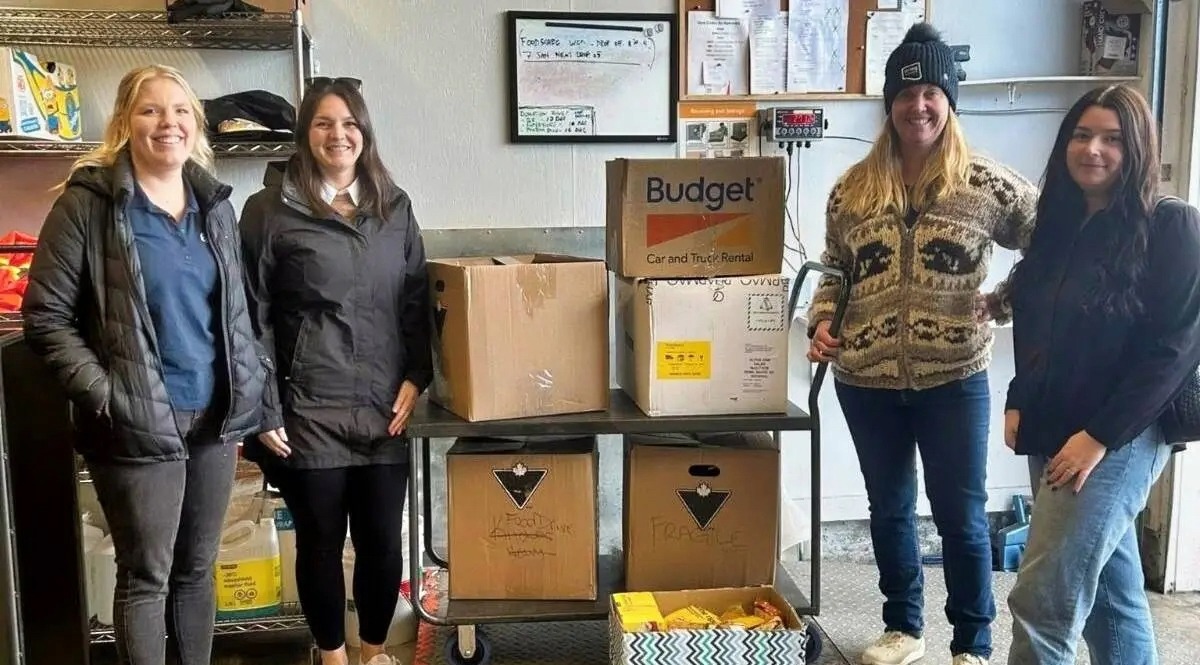
A record food drive highlights how young professionals in BC’s salmon farming sector are connecting food security, community responsibility, and the future of aquaculture.
By Fabian Dawson and Samantha McLeod
SeaWestNews
The Young Salmon Farmers of British Columbia closed out the year in their usual fashion, showing their deep commitment to sustainability, community, and the future by feeding their neighbours.
Their food drive brought together companies across the value chain, with donation boxes placed at multiple worksites.
Over the past few weeks, the organisation completed its second annual Holiday Food Drive, collecting more than 1,000 pounds of non-perishable food for the Campbell River Food Bank. That total more than doubled last year’s 400 pounds, a tangible sign of growing engagement from young professionals working across BC’s salmon farming sector.
“The Young Salmon Farmers of BC partnered with Grieg Seafood, Cermaq, Seawise Innovative Packaging, and Mowi to place donation boxes at each location,” said Randi Robinson of Seawise Innovative Packaging.
“Thanks to the generosity of our colleagues, we were able to donate over 1,000 pounds of food to our local food bank. Food insecurity affects many in our community, and we’re grateful for the opportunity to support those in need.”
The food drive was a local initiative, but it echoes a much larger global conversation now underway about youth, food security, and the future of fisheries and aquaculture.
In a recent statement marking its 80th anniversary, the Food and Agriculture Organization of the United Nations (FAO) underscored a growing concern across aquatic food systems worldwide. Fisheries and aquaculture remain essential to food security, employment, and economic stability, yet the sector faces an aging workforce and a persistent challenge in attracting and retaining younger generations.
FAO has been clear that generational renewal is no longer optional. Without stronger youth participation, rising global demand for aquatic foods risks outpacing the sector’s ability to operate sustainably, innovate, and remain competitive.
The Young Salmon Farmers of BC represent early-career professionals working throughout the salmon farming value chain. Their backgrounds span biology, environmental monitoring, fish health, hatchery operations, communications, logistics, and regulatory compliance.
That diversity mirrors what FAO says the modern sector now requires. Digital skills, environmental science, food safety, processing, trade, and community engagement are no longer peripheral, they represent the core of the aquaculture industry.
Those themes were echoed during a recent episode of the Salmon Farming Inside and Out podcast, hosted by Ian Roberts, which brought together young aquaculture professionals from Canada, Norway, and the UK to reflect on the future of the sector.
Michelle Franz, the co-founder of the Young Salmon Farmers of BC, spoke about how working in coastal communities shapes her understanding of food systems and responsibility.

“The opportunity that aquaculture provides to these rural communities, is what really made me fall in love with it,” Franz said on the podcast.
That perspective was reinforced by Janika Eckhoff, a Norwegian aquaculture communicator, who said younger generations are drawn to the sector precisely because of its complexity and relevance.
“We want to participate. We want to be a part of something,” Eckhoff said adding, “and the aquaculture industry is a great place where you can apply your skills and interests and knowledge to do that.”
Transparency and trust are also central to whether young professionals stay engaged in the sector. Franz noted that salmon farming already operates under a high level of public reporting, but that reality is often lost in public debate.
“Everything that we do is publicly reported, whether it’s mortality, sea lice counts, antibiotic use,” she said. “But I don’t think we get enough credit for how transparent we are.”
Andrew Richardson, a UK-based aquaculture professional, argued that trust is built less through spreadsheets and more through local relationships.
“Where the sector could improve isn’t really data transparency,” Richardson said. “It’s transparency with our communities. Once you have the community on side, the rest will follow.”
According to the FAO, farmed production now accounts for more than half of all aquatic food consumed globally, with growth far outpacing wild capture fisheries. As global demand for protein rises and wild stocks remain constrained, aquaculture has become a cornerstone of future food systems.
A joint report by the World Bank and the World Wildlife Fund estimates aquaculture could generate up to 22 million new jobs by 2050, alongside a $1.5 trillion investment opportunity over the same period. The report positions aquaculture as one of the most promising pathways for youth to build a more sustainable, resilient food system over the next 25 years.
In British Columbia, ocean-raised salmon remains the province’s most valuable agri-food export, contributing about $1.17 billion annually to the provincial economy and supporting more than 4,500 full-time jobs. Every salmon farm in the province operates through formal partnerships with First Nations.
This BC sector has the youngest workforce of any agricultural activity in Canada, offering stable employment, competitive wages, career mobility, and the chance to work at the intersection of food security, environmental stewardship, and coastal economies.
Main image – The second annual Holiday Food Drive by the Young Salmon Farmers of BC collected more than 1,000 pounds of non-perishable food for the Campbell River Food Bank.