
“Canada’s aquaculture production is a national economic treasure, but it has been seriously weakened by irresponsible government policies,” Timothy Kennedy, CAIA President and CEO.
By Fabian Dawson
SeaWestNews
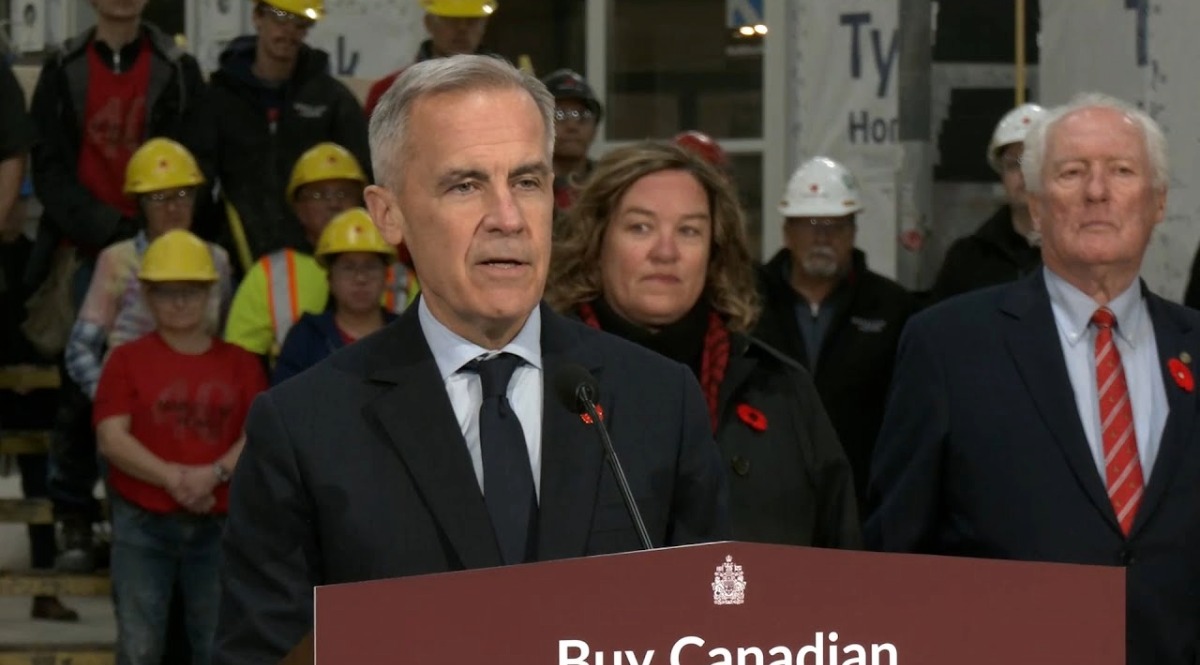
As Prime Minister Mark Carney urges Europe and Asia to “Buy Canadian” the nation’s seafood farmers say Ottawa’s aquaculture policies are doing the opposite at home, pushing Canadians to buy more imports, especially salmon.
A newly released economic report from the Canadian Aquaculture Industry Alliance (CAIA) shows British Columbia’s farm-raised salmon output has fallen by more than 40 per cent since 2015, while Canada’s salmon imports have more than doubled over the same period, reaching roughly $700 million annually.
The report argues that declining salmon production in B.C. is eroding Canada’s food security and sovereignty and undermining the federal government’s “Buy Canadian” messaging at a time when Canadians are already facing affordability pressures and supply chain uncertainty.
“Canada’s aquaculture production is a national economic treasure, but it has been seriously weakened by irresponsible government policies,” said Timothy Kennedy, CAIA President and CEO.
“Once a world leader in seafood, Canada now underperforms against global competitors, jeopardizing Canada’s independence and food security at this time of increasing global tensions.”
The CAIA report, along with a parallel media release from the BC Salmon Farmers Association (BCSFA), points to a widening imbalance as demand for farm-raised salmon remains strong nationally and internationally, while supply from B.C. continues to shrink.
“Salmon remains Canada’s most consumed seafood,” said Brian Kingzett, Executive Director of the BCSFA. “The data clearly shows demand is strong. With long-term regulatory certainty, Canada has a real opportunity to produce more of this food at home.”
The industry groups say Canada is increasingly turning to suppliers in Chile and Norway to fill the gap, despite the ability to grow more salmon domestically. They also argue that greater reliance on imports runs counter to Canada’s climate goals, since imported salmon often travels longer distances by ship or air, producing higher emissions than locally grown seafood.
CAIA’s 2024 Aquaculture Industry Data Snapshot describes Canada’s seafood farming sector as a major economic contributor, but one that has lost momentum.
In 2024, the report says the industry generated an economic footprint of $6 billion and supported 18,074 full-time jobs, driven by $1.36 billion in primary revenues.
The Snapshot estimates 13,242 full-time equivalent jobs in salmon farming and processing in 2024, and total labour income of $1.1 billion across the industry.
Kennedy said the sector’s decline is tied directly to unscientific activist-induced federal decisions during the Trudeau-era that have created uncertainty and chilled salmon aquaculture investment in B.C.

The BC Salmon Farmers Association said farm-raised salmon remains a cornerstone of the province’s coastal economy, generating about $1.2 billion in annual economic output and supporting 4,051 well-paid full-time jobs, including more than 500 Indigenous positions.
All salmon farming in British Columbia now operates through formal partnerships with First Nations, based on long-standing agreements that emphasize consent, stewardship, scientific oversight, and self-determination.
With renewed regulatory certainty and improved investment confidence, the sector has the potential to generate up to $2.5 billion in annual economic output and approximately 9,000 jobs by 2030, and as much as $4.2 billion in annual output and more than 16,000 jobs by 2040, said Kingzett.
While B.C. salmon production remains far below historic levels, the CAIA report notes stronger growth in Atlantic Canada. In Atlantic Canada, farmed salmon production increased 17.7 per cent to 55,232 tonnes in 2024. Nationally, Canadian farmed salmon production increased 12.5 per cent to 109,048 tonnes, driven by gains in the east.
Overall farmed seafood production in Canada reached 160,318 tonnes in 2024, a 9.8 per cent increase over 2023, but still well below the peak of 200,804 tonnes in 2016, CAIA said.
CAIA called on Ottawa to change course, saying a quick aquaculture policy reset could restore investment confidence and strengthen Canada’s ability to feed itself.
The alliance is urging Ottawa to move quickly on four immediate priorities:
- Reverse the plan to ban ocean salmon farming in B.C. by 2029 and establish a “smart plan” for the sector in the province.
- Provide crisis support and modernize federal management for Canada’s shellfish sector.
- Designate Agriculture and Agri-Food Canada as the federal development lead for aquaculture.
- Withdraw the proposed National Marine Conservation Area on Newfoundland’s south coast, which CAIA says jeopardizes seafood production in the region.
“With the longest coastline in the world, Canada’s seafood farming sector has massive, largely untapped potential,” Kennedy said. “We are using only about 1 per cent of Canada’s potential.”
CAIA’s economic snapshot landed as Prime Minister Mark Carney headed to Europe and China this week to pitch his “Buy Canadian” mantra and market the country’s strengths in natural resources, agriculture, energy, and advanced technologies.
Kennedy and Kingzett stressed that Canada has an unparalleled opportunity to once again be a global leader in sustainable seafood production. They said the risk is that Canada sidelines itself just as aquaculture becomes one of the world’s fastest-growing food industries.
The global aquaculture market was valued at US$311.1 billion in 2023 and is projected to reach US$573.7 billion by 2035, growing at a 5.2 per cent CAGR from 2024 to 2035, according to new data provided by Allied Market Research.
Main image from a YouTube video screenshot shows Prime Minister promoting his “Buy Canadian” policy