
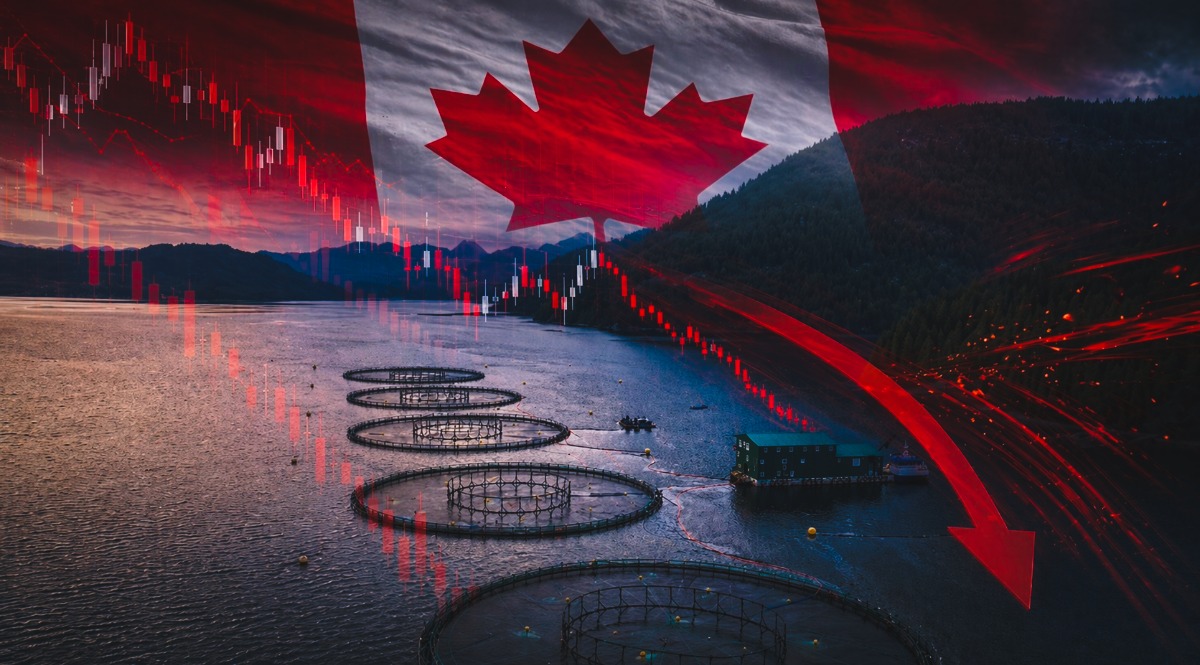
A new RBC report is saying Canada needs more investment, more food production and more confidence from capital markets. What Ottawa is doing in British Columbia is the exact opposite, says the salmon farming sector.
By Fabian Dawson
SeaWestNews
Canada needs a major new wave of investment in agriculture and food processing if it wants to boost productivity, strengthen food security and recover lost export ground, according to a new RBC Thought Leadership report.
RBC says more than $1 trillion in investment left Canada between 2015 and 2024, the biggest capital exodus in the country’s history, with $2 leaving for every $1 in foreign direct investment coming in.
It warns that Canada’s problem is not a shortage of capital, but an investment climate undermined by regulatory drag, shifting policy signals and uncertainty that pushes money elsewhere.
In Canada’s aquaculture sector, especially salmon farming in British Columbia, that warning is already playing out.
Since 2015, B.C. farm-raised salmon production has fallen by more than 40%, while annual production capacity has dropped from more than 90,000 tonnes to less than 50,000 tonnes over the past six years. The contraction has already cost more than $770 million in annual economic output, $286 million in GDP, 3,000 jobs and $170 million in family income, an economic analysis shows.
That decline is largely the result of a science-deficit, activist-driven Trudeau-era policy to ban ocean salmon farming in British Columbia by 2029, a decision that has already driven away investment, stalled innovation and handed market share to foreign producers.
The policy was announced in 2024 despite repeated scientific findings from the federal government’s own experts that B.C. salmon farms pose no more than a minimal risk to migrating wild Pacific salmon.
If the current Mark Carney administration does not reverse this policy, the full phaseout would eliminate British Columbia’s remaining 50,000 tonnes of farmed salmon production and trigger losses of $1.17 billion in annual economic activity across Canada, $435 million in GDP, 4,560 jobs and about $259 million in family income. Taxpayers could also be left with a bill of at least $9 billion through compensation and subsidization costs tied to the transition.
Nationally, the Canadian Aquaculture Industry Alliance (CAIA) says the federal plan has already chilled investment across Canada, while domestic shortfalls have been met by rising imports from foreign producers.
Industry data shows Chile shipped 6,838 tonnes of salmonids worth US$84 million to Canada in the first nine months of 2024, up 34% in volume and 31% in value from a year earlier, while Norwegian farmed salmon exports to Canada rose 35% in value in the first half of 2024. CAIA said Canada’s salmon imports have more than doubled since 2015, reaching about $700 million annually.
“The Trudeau government’s decisions, including its unscientific 2024 ban of open-net pen salmon farming in British Columbia, have created a chill on investment in the aquaculture sector across Canada and undermined Canadian food independence, restricting Canadian shoppers to buy non-Canadian products,” CAIA said in a statement.
“The RBC report is saying Canada needs more investment, more food production and more confidence from capital markets. What Ottawa is doing in B.C. salmon farming is the exact opposite,” said an industry official.
“We had real production, real jobs, real Indigenous partnerships and real private investment ready to go, and instead of building on that strength, the federal government has kept B.C.’s salmon farming sector trapped in uncertainty. Capital does not wait around for political indecision. It leaves.”
The effects of that uncertainty are no longer abstract.
Mowi, the world’s largest salmon farmer, says it is expanding in major seafood-producing regions backed by regulatory certainty, while its British Columbia business remains constrained by a federal policy framework tilted against aquaculture growth.

The company’s latest annual report describes its Canada West operations as having “highly uncertain future prospects,” even as Mowi grows in Chile, Scotland and Iceland.
An economic analysis by the B.C. Salmon Farmers Association (BCSFA) points to equally direct consequences at home.
Browns Bay Packing near Campbell River was forced to cancel plans for a new seafood processing facility with local First Nations and later laid off more than 70 full-time employees as farmed salmon volumes fell.
Aquatrans Distributors, a major seafood transporter, has shelved plans for a depot in Campbell River, while more than 70 companies tied to the sector have warned that federal aquaculture policy is pushing Vancouver Island communities toward an economic breaking point.
Njord Marine Service, a Campbell River-based company which provides aquaculture support services for BC’s salmon farmers, has sent four of its ships to Norway to be sold, saying it is being forced to downsize because of business uncertainty.
Skretting North America, the continent’s largest salmon feed supplier, has warned that without longer-term licences and clearer guidelines, investor confidence in B.C.’s aquaculture industry will keep eroding.
“A lack of confidence results in reduced spending on ingredients and services from our Canadian suppliers. Ultimately, we may be forced to explore opportunities in other, more progressive aquaculture sectors,” a company official has said.
The RBC also notes that Canada’s new financial playbook must include Indigenous economic partnerships, which not only helps to secure project approvals, but can accelerate project timelines.
“Partnerships work best when they are embedded early and aligned with community needs,” it said.
In British Columbia, all farmed salmon is produced under agreements with Rights Holder First Nations, and the sector directly and indirectly employs more than 1,000 Indigenous people while generating about $134 million in annual economic benefits for First Nations communities.
B.C. salmon farmers and their First Nations partners say that if Ottawa replaces the proposed 2029 phaseout with a science-backed, Indigenous-led framework that provides regulatory certainty, the sector could generate $2.5 billion in economic output and support 9,000 jobs by 2030.