
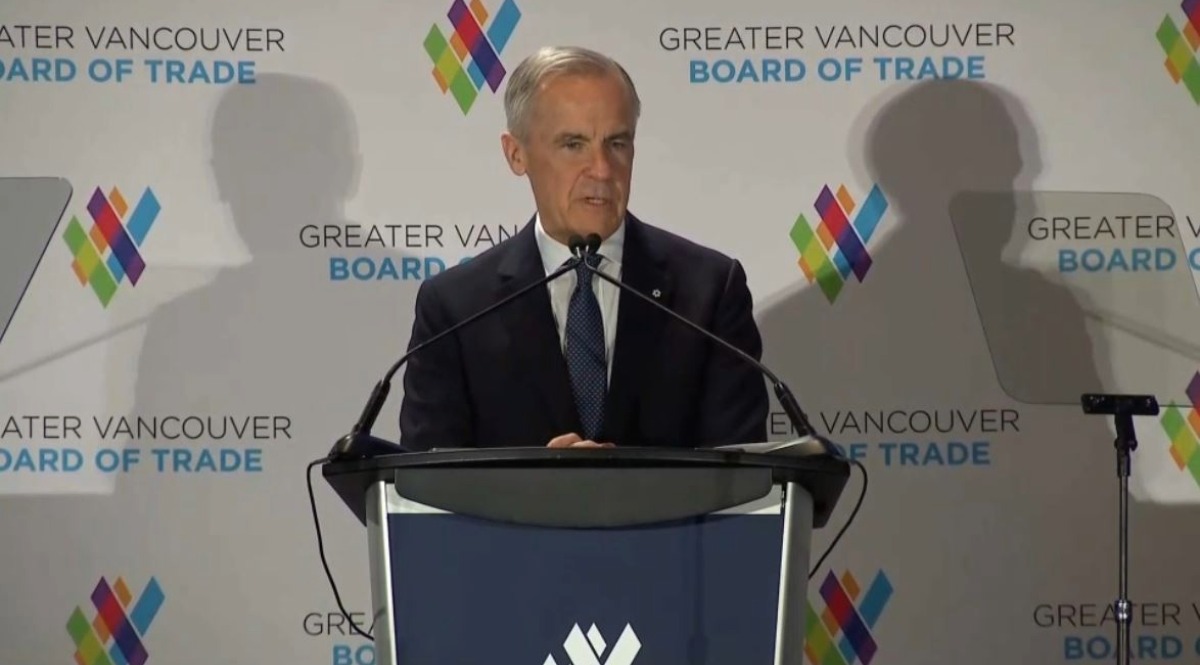
“We don’t want to hear what people are against. We want to hear what they’re for,” Prime Minister Mark Carney told the Greater Vancouver Board of Trade, in remarks that strike at the heart of the fight over salmon aquaculture in British Columbia.
Commentary
By Fabian Dawson
SeaWestNews
Prime Minister Mark Carney was in Vancouver this week to talk about the global energy crisis, saying Canada must move with urgency to produce more, trade more, build faster and become a reliable partner in a world that is “anything but” stable.
It was a speech about critical minerals, ports, power, trade corridors and nation-building projects.
But buried in his remarks to the Greater Vancouver Board of Trade was a message that lands hard in another resource fight now facing his government, Ottawa’s plan to ban ocean salmon farming in British Columbia.
“We don’t want to hear what people are against,” Carney told the room. “We want to hear what they’re for. And if you’re for something, we will get behind this.”
That line cuts to the centre of the activist-driven Trudeau-era policy to end ocean salmon farming in B.C. in 2029 and gut a $1.17-billion food-production sector that supports about 4,560 full-time jobs.
For years, anti-salmon farming activists in B.C. have built their campaigns almost entirely around what they don’t want. They oppose ocean farms. They oppose salmon farmers. They oppose the companies that operate them. They oppose the First Nations partnerships that now underpin every salmon farming operation in B.C.
They have padded their coffers with ideological claims that have been repeatedly challenged by government scientists, peer-reviewed research and decades of monitoring showing B.C. salmon farms pose minimal risk to wild salmon populations.
And their core claim – removing marine salmon farms will somehow rebuild wild stocks – has been repeatedly debunked by fisheries scientists who have studied the fluctuating Pacific Northwest salmon populations.
What the activists have never offered is a credible plan to replace the broader coastal footprint the ban would destroy, including about 7,000 jobs and more than 70 companies that keep British Columbia’s salmon farming sector running.
On the other hand, coastal First Nations in partnership with salmon farmers have put forward a real plan to protect wild salmon, strengthen Indigenous ownership, fund science, create youth employment and keep producing healthy Canadian seafood in their traditional waters.

They are not asking Ottawa to choose between wild salmon and farmed salmon. They are asking Ottawa to back a model where food production, Indigenous rights, science and stewardship work together.
That plan unveiled recently in Ottawa by the Coalition of First Nations for Finfish Stewardship (FNFFS), would;
- Put First Nations in charge of aquaculture licensing and permitting in their traditional waters, replacing Ottawa’s activist-driven ban with Indigenous-led science, stewardship, investment and food production.
- Transform the Campbell River-based BC Centre for Aquatic Health Sciences into an Indigenous Centre for Aquatic Health Sciences and Stewardship (ICAHSS), giving First Nations a stronger science base to monitor fish health, wild salmon and ocean conditions.
- Require salmon farming companies to pay a levy into a permanent Indigenous-led science fund through ICAHSS, giving coastal First Nations dedicated money for wild salmon research, conservation and long-term stewardship.
- Give First Nations a larger ownership stake across salmon farming, seafood processing and supply-chain businesses, so more jobs, training and economic benefits stay in B.C.’s coastal communities.
- Keep producing Canadian salmon, reduce reliance on imported fish and unlock new investment instead of driving companies, jobs and food production out of B.C.
“The investment is on the table…The plan is ready…The only thing standing in the way is federal policy,” states the coalition which has launched a new campaign called Keep Food Affordable.
B.C. salmon farmers say that if Ottawa repeals the proposed 2029 phase-out and replaces it with a science-backed, Indigenous-led framework that provides regulatory certainty, the sector could generate $2.5 billion in economic output and support 9,000 jobs by 2030.
Coastal First Nations and their salmon farming partners have shown Canada what they want to build.
Now Carney has to decide whether his Vancouver words will propel a First Nations-led aquaculture future for B.C. or preserve the destructive coastal NIMBYism of anti-salmon farming activists.
(Main image shows Prime Minister Mark Carney speaking at the Greater Vancouver Board of Trade)