
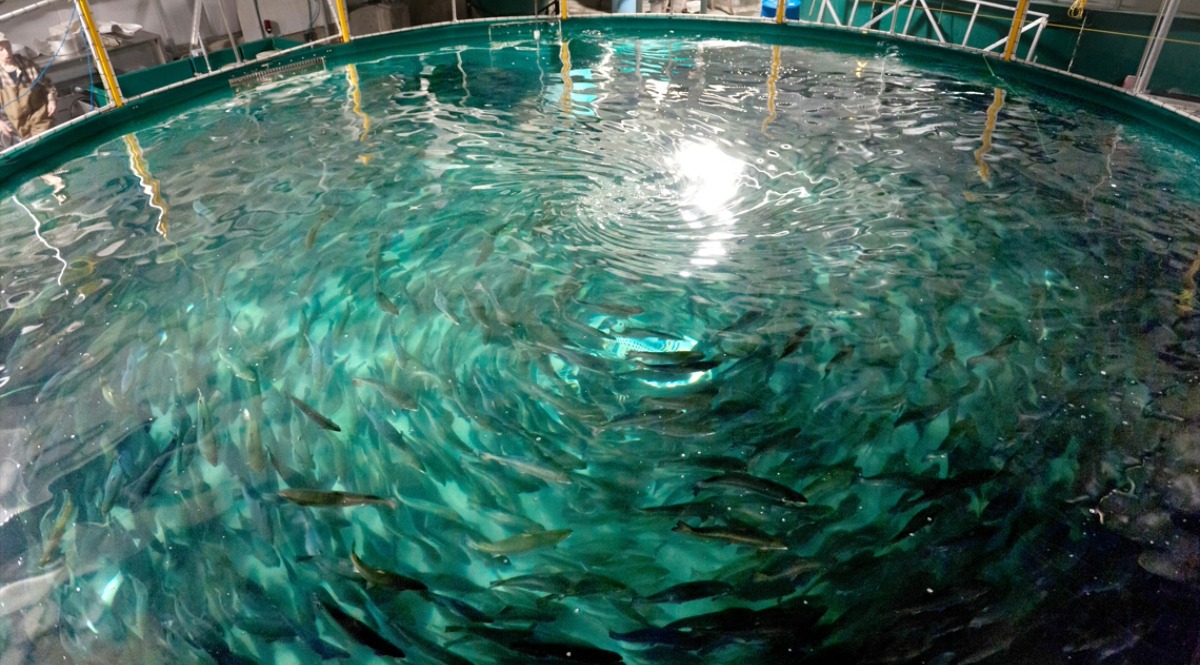
Calls by the Pacific Salmon Foundation to eliminate B.C.’s ocean salmon farms rely on land-based replacement technologies struggling with bankruptcies, high costs, production failures and investor losses.
Commentary
By Fabian Dawson
SeaWestNews
In the world of land-based salmon farming, some of the loudest claims that the nascent technology can replace conventional ocean farming in B.C. come from people who have never had to make it work.
You can now add Pacific Salmon Foundation president and CEO Michael Meneer to that list.
In a National Newswatch commentary, Meneer writes Ottawa must keep its 2029 deadline for ending ocean salmon farming in B.C. because the transition and eventual ban will create the certainty needed to attract investment into land-based alternatives.
Meneer essentially argues that Ottawa should eliminate an established B.C. industry supporting 4,560 full-time jobs, more than 1,000 Indigenous workers and significant First Nations economic activity, then hope an expensive and still commercially uncertain technology can replace it.
That is where his advocacy collides with operating reality.
It is easy to argue that billions of dollars should flow into land-based salmon farms. It is much harder to build one, keep the fish alive, produce consistently, control costs and make money.
The growing trail of bankruptcies, abandoned projects, investor losses and missed production targets shows the difference between advocating for land-based salmon farming and actually making it work.
Here are some of the more recent ones:
- Nordic Aquafarms abandoned its California project after seven years and had previously walked away from a proposed salmon farm in Maine. Its investors suffered major write-downs.
- Sustainable Blue in Nova Scotia entered receivership after a filtration failure killed 96,000 market-ready salmon worth about $5 million in roughly 12 hours.
- AquaBounty Technologies ceased fish-farming operations in 2024 after being unable to raise enough capital to continue.
- LocalCoho in New York closed in 2025 after almost six years amid high operating costs and market pressures.
- Salmo Terra in Norway went bankrupt before its planned 8,000-tonne salmon farm was built, while Gaia Salmon filed for bankruptcy in 2025 after production and financing problems.
- Atlantic Sapphire, long promoted as the flagship of large-scale land-based salmon farming, has endured repeated biological problems, production shortfalls and financial rescues. It has burned through hundreds of millions of dollars and been forced into a creditor-led restructuring simply to survive.
Closer to home, Kuterra, launched with $6 million in federal funding, missed its production targets, failed to attract the capital needed to grow and ultimately abandoned Atlantic salmon. It is now a small steelhead operation, with capacity of around 300 tonnes a year for the local market.
Unlike Meneer and his activist allies, the people who have actually tried to make land-based fish farming work are warning that B.C. is nowhere near ready to use it as a replacement for conventional ocean farms.
They include some of B.C.’s most experienced land-based aquaculture operators and specialists. Among them are Kuterra general manager Cody Smith, Gold River Aquafarms president Robert Walker, RAS pioneer Steve Atkinson and veteran aquaculture veterinarian Dr. Brad Hicks.
Their message is remarkably consistent: land-based aquaculture may have a future, but B.C. is not ready to use it as a wholesale replacement for conventional ocean salmon farming.
Then there are the federal and provincial assessments that have identified many of the same barriers raised by the operators themselves, including high capital costs, major power and water requirements, limited suitable land, waste-management challenges and the difficulty of scaling land-based systems to replace current marine production.
The B.C. Salmon Farmers Association has consistently argued that land-based and closed-containment technologies should be part of the sector’s future, but not as a government-mandated replacement for existing ocean farms.
Its position is that innovation should be encouraged where it is technically and economically viable, while marine salmon farming continues to operate under strict regulation and with ongoing improvements in fish health, containment and environmental performance.
Meneer’s opinion piece promotes an ideology detached from the commercial and operational realities of land-based salmon farming.
He is asking Ottawa to destroy an established industry first and place its faith in a replacement that has yet to prove it can work at the scale B.C. would need.
That is not a transition plan. It is advocacy asking policy to outrun evidence, experience and economics.
Main file image of a land-based fish farm operation courtesy of Kuterra