
The BC Assembly of First Nations’ resolution on salmon aquaculture collides with the very principle of Indigenous self-determination it claims to defend.
Commentary
By Fabian Dawson
SeaWestNews
The BC Assembly of First Nations’ 22nd Special Chiefs Assembly in Penticton last week was filled with powerful language about inherent rights, territorial authority and Indigenous self-determination.
Chiefs and leaders repeatedly emphasized the protection of traditional territories, the sovereignty of lands and waters, and the importance of free, prior and informed consent, the cornerstone principle of the United Nations Declaration on the Rights of Indigenous Peoples, commonly known as UNDRIP.
Yet within the same gathering, a resolution was advanced calling for the immediate removal of all ocean-based salmon farms from the coast of British Columbia. In that moment, the strong rhetoric about Indigenous jurisdiction began to appear selective, if not contradictory.
The resolution ignores an inconvenient reality. Many First Nations whose territories actually host salmon farms support those marine operations. Their support is not offered as a concession to industry, nor is it the result of coercion. Rather, it reflects deliberate sovereign decisions made by Indigenous governments that have concluded salmon aquaculture can provide jobs, stable revenue and long-term economic opportunity in communities that have historically been excluded from major development.
In other words, those nations have exercised precisely the rights the Chiefs Assembly claims to defend.
Consider the Kitasoo Xai’xais Nation in Klemtu, situated in the heart of the Great Bear Rainforest. In this remote and rugged coastal community, salmon farming has become the largest employer. The nation has said repeatedly that the industry has helped transform its local economy while strengthening Indigenous stewardship of the marine environment. That stewardship was recognized internationally when the region received the prestigious Blue Park Award for exceptional marine biodiversity conservation, the first such designation in Canada.
Other nations have reached similar conclusions about the economic value of aquaculture partnerships. The Ahousaht and Tlowitsis Nations, for example, maintain agreements connected to salmon farming that contribute funding toward housing, education and community programs.
Across British Columbia, salmon farms now operate in partnership with First Nations and collectively generate roughly $1.17 billion in annual economic activity while supporting approximately 4,560 full time jobs. More than 500 of those positions are held by Indigenous workers in coastal communities.
Despite these realities, the resolution introduced at the assembly largely sidestepped the existence of those partnerships. Instead, the debate reflected the growing influence of activist campaigns determined to eliminate ocean-based salmon farming altogether.
In doing so, some critics risk adopting the very approach they frequently condemn, effectively dictating which economic paths other Indigenous nations should or should not pursue within their own territories.
The resolution also repeats familiar claims that salmon farms threaten wild Pacific salmon through disease transfer, sea lice and broader ecological impacts. What remains largely absent from that argument is the extensive body of research, monitoring and Traditional Ecological Knowledge suggesting that both wild and farmed salmon can coexist within British Columbia’s regulated aquaculture system.
Globally, salmon aquaculture continues to expand, and coastal First Nations in British Columbia are positioned to play a central role in that growing sector. The BC Coalition of First Nations for Finfish Stewardship (FNFFS), working in partnership with the BC Salmon Farmers Association, argues that a stable federal and provincial aquaculture policy framework could allow the sector to expand significantly. Their projections suggest such growth could generate as much as $2.5 billion in annual economic activity, contribute $930 million to Canada’s GDP and support roughly 9,000 jobs nationwide.
One might expect a gathering dedicated to the defence of Indigenous rights to welcome discussions about economic opportunity within First Nations territories. Instead, the resolution implies that Indigenous self-determination is acceptable only when it aligns with the preferred narrative of activists and some of their allies within the BCAFN.
Perhaps the most significant flaw in the debate is the assumption that First Nations speak with a single voice on salmon aquaculture. In reality, they do not. Some nations oppose salmon farming in their territories while others support it, and both positions represent legitimate expressions of Indigenous governance.
That diversity of perspectives is precisely what Indigenous self-determination looks like in practice. Attempting to impose a blanket coast-wide ban on salmon farming ignores that complexity and risks undermining the very principles of jurisdiction and autonomy that the assembly repeatedly invoked.
Regional Chief Terry Teegee captured the spirit of the gathering when he said, “Above all, we honour and uphold our inherent rights and title to our territories, as they are the foundation of our identity, strength and well-being.”
Those words carry considerable weight. Yet they ring hollow if they are not applied equally to the First Nations who have chosen salmon farming as part of their economic future.
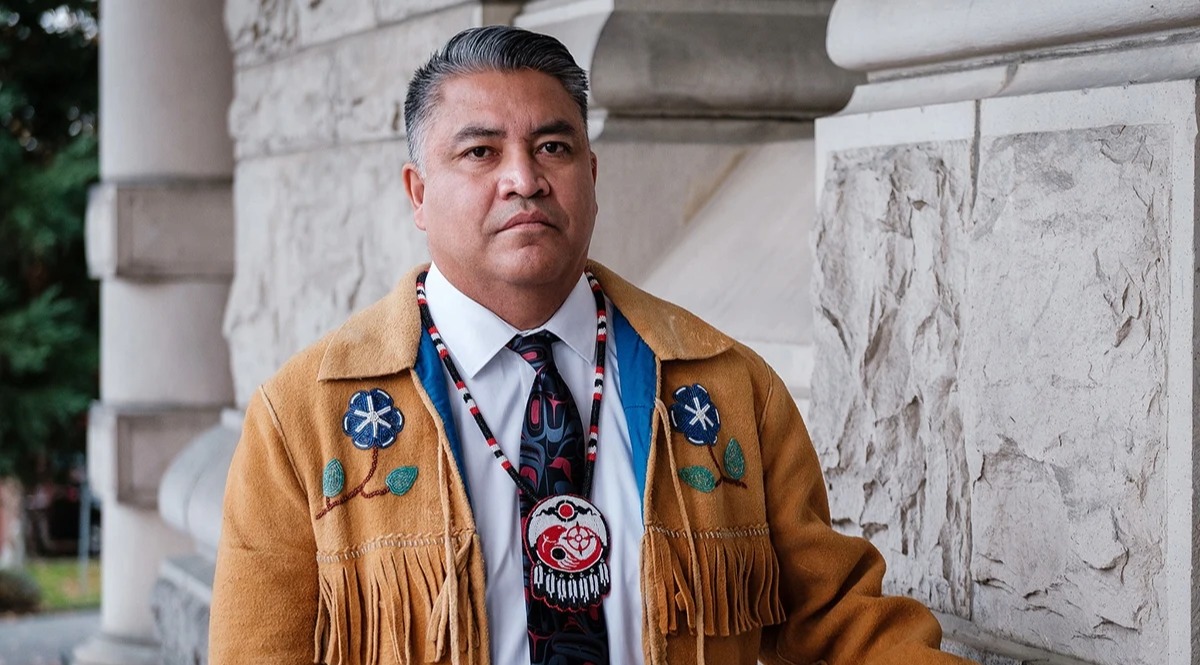
(Main image shows BC AFN Regional Chief Terry Teegee Photo via the BC Government Flickr.)