
Canada’s seafood growers are recognized as farmers under tax law but remain shut out of major federally funded and cost-shared agriculture programs that pump billions into domestic food production.
By Fabian Dawson
SeaWestNews
Canada’s seafood farmers are urging federal and provincial agriculture ministers to stop treating aquaculture as an exception in the nation’s farm policy framework as they push to strengthen domestic food production.
In an open letter ahead of the Federal Provincial Territorial ministers of agriculture meeting in Halifax, the aquaculture sector said it is recognized as a farming activity under the Income Tax Act but remain excluded from key agricultural support programs.
Currently under the Canadian Agriculture Partnership (S-CAP) program, aquaculture has access to the AgriMarketing and AgriAssurance programs, but is explicitly excluded from other federally funded, cost-shared and business risk management programs.
“It is those other programs that are so critical for our operations and identity as farmers,” states the Canadian Aquaculture Industry Alliance (CAIA).
CAIA wants Ottawa and the provinces to make aquaculture eligible under the Next Policy Framework (NPF), the new national farm policy now being developed to replace the current Sustainable Canadian Agricultural Partnership in 2028.
Federal government figures show the current Sustainable Canadian Agricultural Partnership is a $3.5 billion, five-year framework running from April 1, 2023, to March 31, 2028, with $1 billion for federal programs and activities plus $2.5 billion for cost-shared federal-provincial-territorial programs and activities.
The open letter says seafood farmers are already treated as farmers in practice and in law. It notes that producers buy seed or egg stock, feed animals through the production cycle, manage biological, environmental and disease risks, and can file as farmers under federal and provincial tax rules because aquaculture is recognized as a farming activity in the Income Tax Act.
But despite that, the sector remains excluded from major federally funded, cost-shared and business risk management programs available to other agricultural producers.
“Aquaculture is Agriculture,” the letter states. It also says granting seafood farmers access under the new framework would be consistent with Canada’s tax law and with Ottawa’s stated goal of growing the economy, exports and domestic food production.
The aquaculture industry is asking for three specific changes.
It wants aquaculture made eligible for all federal strategic initiatives, beyond the AgriMarketing and AgriAssurance programs it can already access, with priority given to AgriInnovate, which helps companies adopt or commercialize new technology and processes.
It also wants aquaculture removed from the ineligible-activities list in the multilateral federal-provincial-territorial agreement so provinces can support local producers through partner programs.
And it is calling for a tailored business risk management program for shellfish and freshwater aquaculture producers who file farm income with the Canada Revenue Agency.
The push comes as the sector said Canada is failing to capitalize on one of the world’s fastest-growing food-production industries.
In the letter, the signatories say aquaculture generated $2.3 billion in Canadian GDP in 2024 and employed more than 18,000 people while using only about one per cent of the country’s biophysical capacity and accounting for 1.4 per cent of farm gate sales.
They say Canada has major natural and structural advantages, including abundant freshwater resources, the world’s longest marine coastline, a strong regulatory environment and hundreds of millions of dollars already invested in infrastructure and technology.
Yet the letter says production has largely flatlined for 20 years, which the industry blames in part on a lack of reliable federal partnership. It draws a contrast with countries such as Norway, the United States and the United Kingdom, where governments back aquaculture through science, innovation and business-risk programs.
In Canada, the signatories say, seafood farmers are still being kept on the margins of the agriculture policy system.
CAIA said the sector spends more than $250 million a year on land-based protein sources for salmon feed, including grains, seed oils and poultry by-products, and argues that expanding aquaculture would strengthen made-in-Canada food production linkages across the broader agri-food economy.
The signatories include the Canadian Aquaculture Industry Alliance, the BC Salmon Farmers Association, the BC Shellfish Growers Association, and regional aquaculture groups from Newfoundland and Labrador, Prince Edward Island, Nova Scotia, Quebec, Ontario and Atlantic Canada.
In closing, they tell ministers that Canadian aquaculture has “a critical – and growing – role to play” and that seafood farmers need government support, leadership and partnership to realize that opportunity.
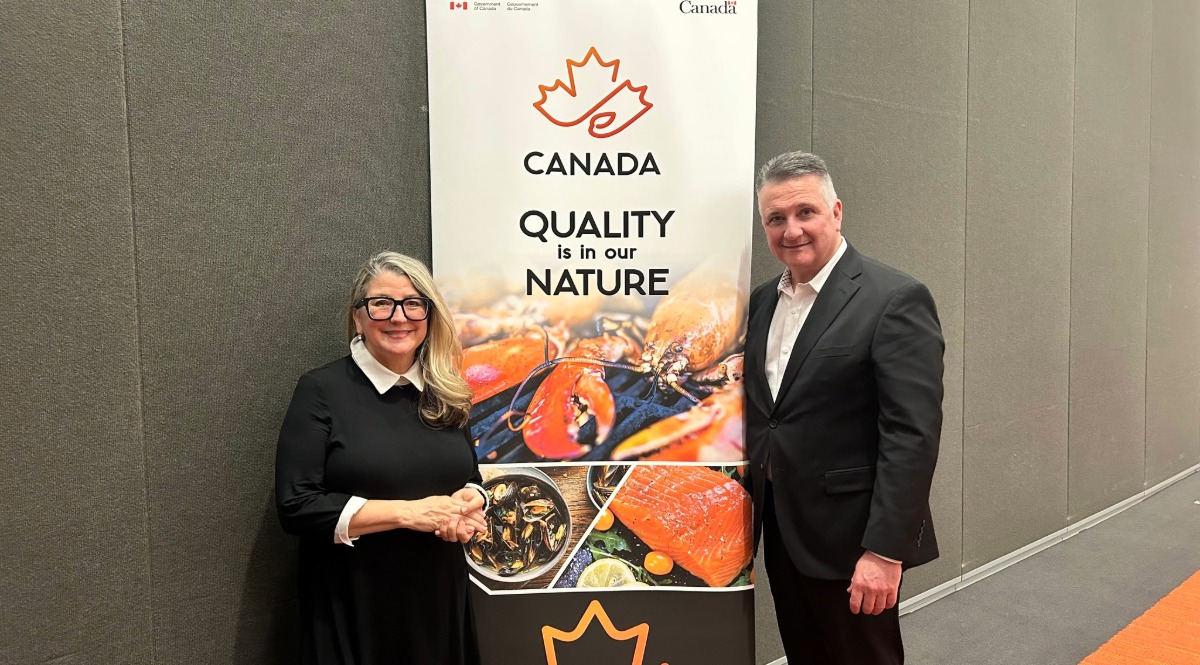
(Facebook image shows British Columbia’s Minister of Agriculture and Food with Canada’s Minister of Agriculture & Agri-Food Heath MacDonald at the recent Seafood Expo in Boston)