
An assessment of aquaculture’s workforce challenge shows the sector’s future depends on leadership trust and social licence but will ultimately be decided by people not platforms.
By Samantha Bacchus McLeod
SeaWestNews
The global aquaculture sector does not have a technology problem. It has a people problem and the next generation of seafood farmers is clear about what it wants.
That message emerged clearly from a recent Next Generation Seafood Alliance (NGSA) webinar, where industry leaders and young professionals agreed that attracting and retaining talent will depend on purpose, trust and leadership not just innovation and automation.
The first session in NGSA’s three-part series, Future Skills for a Changing Industry, focused on how the seafood sector can prepare its workforce for a future shaped by climate pressure, social licence battles, and rapid technological change.
“Innovation is already in aquaculture’s DNA…the challenge now is how we bring people along with it, said Andrew Richardson, founder and president of the Young Aquaculture Society, who moderated the discussion.
Sean Pennells, an aquaculture technician with Sanford Limited in New Zealand said people entering the sector are motivated most by purpose and the sense that their work contributes to a better world.
In New Zealand, that sense of purpose is closely tied to food quality and environmental credibility, he said.
“Young people are asking am I gaining skills, is there progression, is there flexibility, and is there a good work-life balance?
“We’re a tiny country. We compete on quality and environmental sustainability…keeping that clean, green image is central to why people want to work in this sector,” said Pennels.
That theme resonated strongly with Christina Zantioti, president and co-founder of the Network of Women in Aquaculture (NOWA), who said surveys within her organization consistently show young professionals are motivated by impact, not titles.
“We, the young people, are looking not just for a job, but for a purpose,” she said. “Growth does not only mean promotion. It means training, exposure, and experience across different parts of the value chain.”
While governments in several countries have set ambitious growth targets for aquaculture, speakers warned that regulatory uncertainty and political pressure can undermine workforce confidence.
“The government is fully supportive of us, but they haven’t provided the legislative landscape,” Pennels said, referring to New Zealand’s push toward offshore aquaculture. “That stress definitely filters through companies. And stress always filters through organizations.”
When companies are consumed by permitting battles and public opposition, long-term investments in people like succession planning, mentoring, and leadership development are often the first casualties, he said.
“That’s when you see people bouncing between companies or leaving the sector altogether.”
Despite the growing role of artificial intelligence, data analytics, and automation, the webinar participants repeatedly emphasized that core biological and operational knowledge remains irreplaceable.
“To build scenarios or model outcomes properly, you still have to understand the biology,” said Linda Sams, who retired last year after 39 years in the Canadian salmon farming sector, most recently as Cermaq Canada’s sustainable development director in British Columbia.
“We still need to validate and calibrate models. We still need to go out and do the physical work. That knowledge is not going away,” she said.
Sams said the real opportunity lies in integrating experience with new tools, allowing younger workers to challenge assumptions while respecting institutional knowledge.
“Once you have large, accurate data sets, you can challenge the ‘we’ve always done it this way’ mindset,” she said. “Do it respectfully but see it as an opportunity.”
Sams also stressed the importance of integrating Indigenous knowledge alongside Western science, particularly in coastal and ocean-based farming systems.

“That’s a challenge going forward,” Sams said. “But it’s a good challenge if we want better outcomes for everyone.”
Across generations, speakers agreed that mentoring, not hierarchy, will define the sector’s leadership pipeline.
“We should consider mentoring as a two-way exchange,” Zantioti said. “Experience meets new ideas, and both the mentor and the mentee benefit.”
But she cautioned against unrealistic expectations.
“A mentor is not a teacher who solves all your problems,” she said. “Expectations need to be clear from the beginning.”
Sams added that mentorship must be paired with psychological safety.
“You need to let people fail a bit,” she said. “Nine times out of ten they’ll smash it. But that tenth time, that’s when they really learn. And they need to know you have their back.”
Her leadership philosophy was blunt and human.
“Know your team as individuals,” Sams said. “They have kids. They have parents who are sick. Their dog just died. Be firm. Be fair. And be kind. The best leaders are kind leaders.”
Participants said that as activism and misinformation intensify around aquaculture particularly salmon farming, younger workers are increasingly stepping into public facing roles.
“This generation grew up with social media,” Pennels said. “They’re more aware of what it can do for our brand and for our image.”
In New Zealand, he added, awareness of Indigenous rights and expectations is now foundational.
Sams argued that social licence should be treated like any other core operational risk.
“If we resourced communications and public relations the way we resource emerging diseases, we’d be attracting people to the industry,” she said. “Families need to feel pride in where they work.”
For all the challenges discussed, the panel ended on a note of optimism, urging the sector to stop underselling itself.
“Not as many people care about the negative stuff as you might think,” Sams said. “We are starting to turn the tide.”
Pennels agreed.
“When I tell people what my day looks like, they think it’s the coolest job in the world,” he said. “I work with data. I work outside. I handle fish. I see dolphins and seals. You can’t really ask for a better job.”
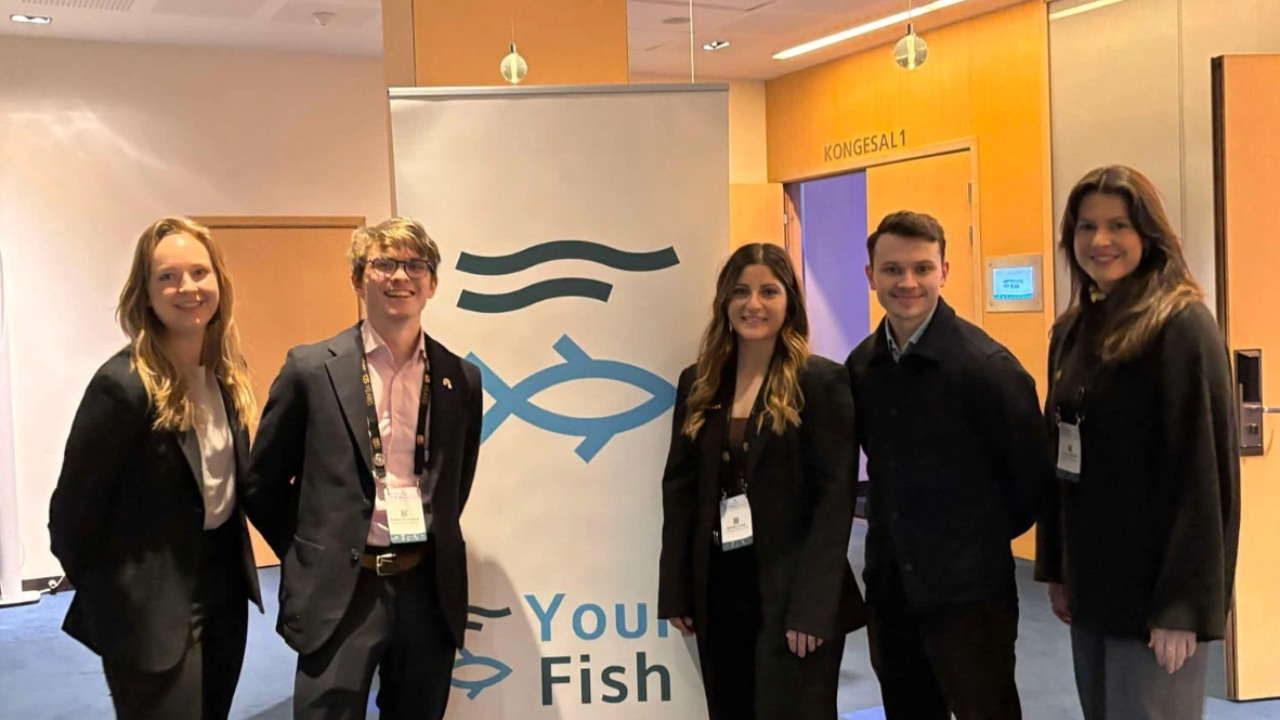
Main File Image Next Generation Seafood Alliance members From left to right, Janicke Eckhoff (NGSA), Andrew Richardson (YAS), Michelle Franze (YSFBC), Mads Aarvik (YoungFish), and Marte Hagen Røe (YoungFish and panel moderator).