
Industry leaders discuss misinformation, transparency and the growing importance of public trust as aquaculture expands to meet global food demand.
By Samantha McLeod
SeaWestNews
A panel of aquaculture leaders and communicators gathered this week to examine one of the sector’s most pressing challenges: how to build and maintain public trust in an era of digital media, activism and rising global demand for seafood.
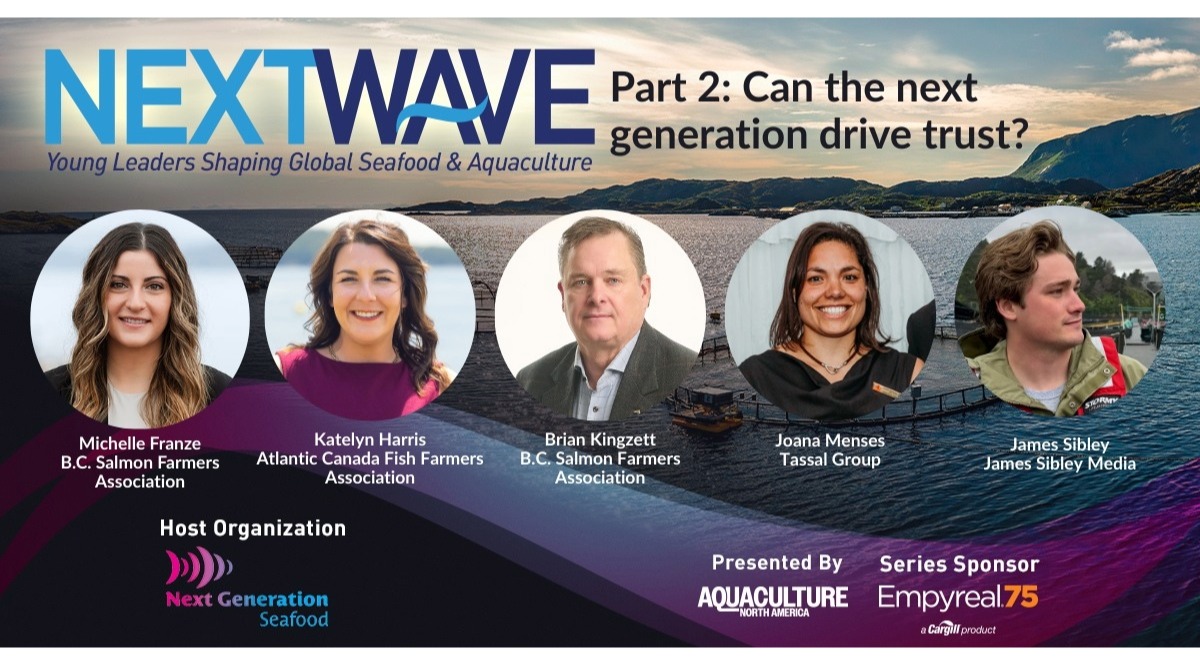
The discussion, titled Building Public Trust in Aquaculture, was hosted by Michelle Franze, Co-founder and Co-Director of the Young Salmon Farmers of BC.
The panel brought together voices from across the global seafood sector, including Brian Kingzett, executive director of the BC Salmon Farmers Association; Katelyn Harris, community outreach and education coordinator with the Atlantic Canada Fish Farmers Association; Joana Menses, an environmental, social and governance specialist in the Tasmanian aquaculture industry; and aquaculture communicator and content creator James Sibley.
Franze opened the webinar discussion by emphasising the increasingly central role aquaculture will play in feeding a growing global population.
“More than half of the seafood consumed globally already is farmed,” Franze said. “Wild catch can no longer meet the growing demand that we’re going to have… we are expected to reach about 9.7 billion by 2050.”
With that demand rising, Franze said the industry must pay close attention to the concept of “social licence,” often described as the informal trust between the public, governments and industry that allows resource sectors to operate.
“Social license is an informal contract,” she said. “It begins with public acceptance or public trust. That trust is built through transparency, accountability, community engagement and a commitment to improving environmental performance.”
Franze added that trust takes time to build but can be lost quickly.
“It takes multiple years for a sector or an organisation to achieve it,” she said. “But it could take five minutes for all that to come crashing down.”
Panelists agreed that the communications environment surrounding aquaculture has changed dramatically with the rise of digital platforms.
“In the digital age that we are in, misinformation is spreading faster than the facts can keep up with,” Franze said.
Sibley, who produces aquaculture-focused educational content online, said social media has transformed how conversations about food production and farming take place.
“Digital media has really redefined a lot of agriculture,” Sibley said. “It’s decentralised the conversations and quickened them. This stuff happens by the hour.”
He noted that negative imagery about fish farming can circulate widely online and shape perceptions before accurate information reaches audiences.
“It is frustrating to see the same image get recycled for five years every 48 hours… and that’s often their first impression of aquaculture,” he said.
At the same time, Sibley said digital platforms also create opportunities for farmers and industry professionals to communicate directly with the public.
“What people trust is somebody that they’ve seen for years… a human being that is accountable to what they’re saying,” he said.
For Harris, whose work involves community outreach and education across Atlantic Canada, one of the most striking challenges is the general lack of public awareness about aquaculture.
“90 per cent of the students that I surveyed have no knowledge of aquaculture or little knowledge of aquaculture,” Harris said.
Rather than skepticism, she said the biggest issue is simply exposure.
“I find the youth are open minded… they’re like a clean slate for educating.”
Among older audiences, however, misconceptions remain common.
“The two main questions will be, do we dye our salmon, and what’s underneath a sea cage,” Harris said.
She said direct engagement with communities — including classroom presentations and visual explanations of farming practices — can help address those concerns.
“I think having people who work literally in the industry be the front face to the public is really important,” she said.
Menses said environmental, social and governance (ESG) expectations are also shaping public perceptions of aquaculture and influencing investment decisions.
“From an ESG perspective, strong performance should, in theory, lead to positive perception,” she said. “But the reality is a single environmental incident can overshadow years of good work.”
Building trust, she said, requires more than data.
“People build trust through relationships, shared values and meaningful conversations, none of which fit neatly into a spreadsheet,” Menses said.
“If we can translate our ESG performance into human stories… that message is often far more credible than a corporate report.”
The panel also explored how other food sectors have navigated similar challenges around public perception.
Kingzett pointed to Canada’s dairy sector as an example of long-term investment in public trust through consistent public engagement.
“Public trust is not a campaign,” Kingzett said. “It’s continually adding coins to a piggy bank.”
The discussion also turned to British Columbia, which panelists described as a closely watched case study in how politics, activism and public perception can influence aquaculture policy.
In June 2024, the federal government announced that ocean-based salmon farms in British Columbia would receive a final five-year licensing period ending in June 2029, after which open-net pen systems are expected to be phased out.
Kingzett said the situation reflects a complex mix of activism, environmental concerns and political decisions.
“Hindsight is 20/20,” he said. “Salmon farmers believe they are on the right side of history from a food security and sustainability perspective… but that does not mean we are not an easy target for activism.”
He added that other regions should pay close attention.
“You’re not immune,” Kingzett said. “You need to build trust ahead of problems emerging.”
Sibley said farmers in other parts of the world are watching developments in British Columbia closely.
“I would describe it as a case study,” he said. “Farmers around the world are watching what happens there.”
Despite the challenges, panelists agreed that aquaculture has an opportunity to strengthen its relationship with the public through transparency, communication and collaboration.
They also emphasised the importance of supporting younger professionals entering the sector.
“The leaders of today need to bring young people to the table,” Menses said. “In ten or twenty years they will be the leaders in aquaculture.”
For Harris, building stronger connections across the industry will also be essential.
“I think if we collaborate more within our own industry… we will lift it up higher and more quickly,” she said.
As aquaculture continues to expand to meet global demand for seafood, the panel concluded that building public trust will remain a central task for the industry in the years ahead.