
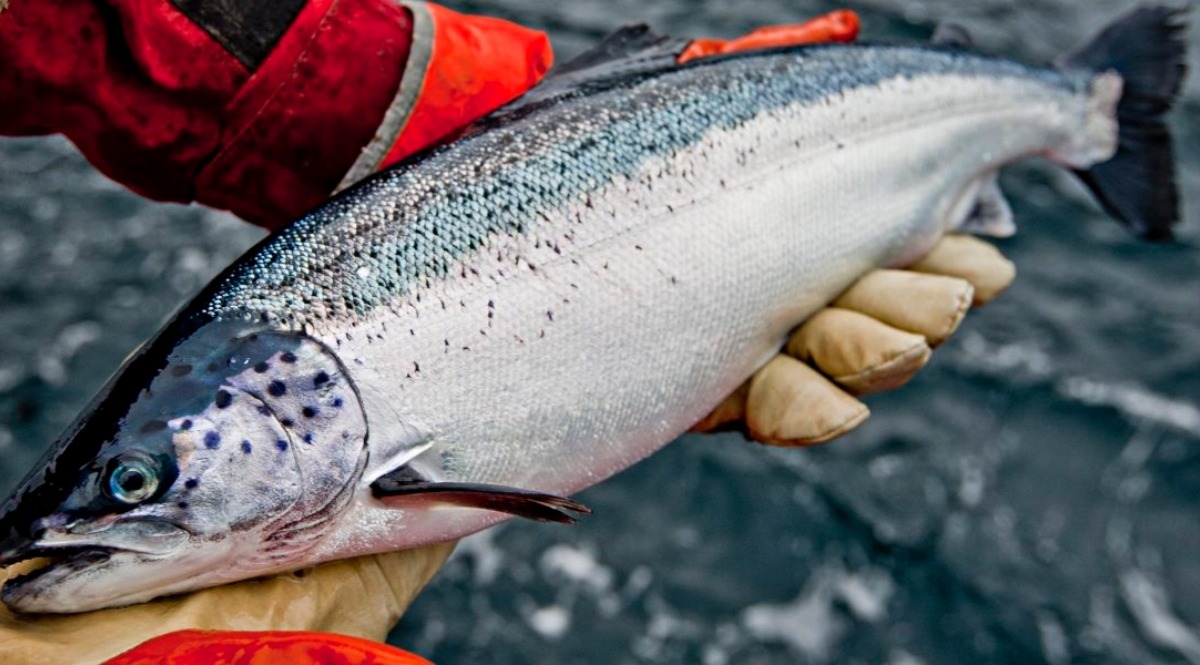
While global competitors scale up to meet rising demand for farmed salmon, Canadian production has flatlined as the country increasingly relies on expensive imports to fill the gap.
Commentary
By Stewart Muir
Resource Works
Canada is a nation defined by its water, possessing the longest coastline in the world and a natural aptitude for the “blue economy.” Yet, when it comes to the global salmon farming sector—one of the fastest-growing food production industries on the planet—Canada is stuck in low gear.
While nations like Norway and Chile have turned their shorelines into economic engines, Canada’s aquaculture sector remains mired in regulatory uncertainty and missed opportunities.
The disparity is not just a matter of lost potential; it is a visible trend of stagnation.
According to industry data, in 1991, Canada was on a relatively level playing field with its major competitors. At that time, Norway, Chile and Canada were all producing well under 200,000 tonnes of farmed seafood annually.
However, the paths diverged sharply over the next three decades.
By 2023, Norway’s production surged to over 1.6 million tonnes, and Chile followed closely behind, consistently hovering near the 1.5-million-tonne mark. During that same period, Canada’s production line remained stubbornly flat, failing to even crack the 200,000-tonne threshold.
The missed opportunity becomes even more stark when looking at smaller international players. The Faroe Islands, a North Atlantic archipelago with a population of just 56,000, has become a global leader in high-quality salmon production.
The fact that a tiny island nation can outpace a G7 country with three oceans suggests that Canada’s struggle is a result of policy choices, not a lack of resources or talent.
This lack of growth exists despite clear signals that the federal government understands the sector’s importance.
In 2017, the Finance Minister’s Advisory Council on Economic Growth, led by Dominic Barton, identified aquaculture as a high-potential sector for Canadian export growth. The “Barton Report” was supposed to be a catalyst for expansion. Instead, since that report was published, Canadian production has actually seen a slight decline rather than the projected takeoff.
The consequences of this “salmon gap” are now hitting Canadians in the wallet. Because domestic production in regions like British Columbia has been restricted or shuttered, Canada has been forced to look elsewhere to satisfy its appetite for salmon.
The result is a massive surge in seafood imports. Data from early 2026 shows that Canada’s salmon imports have climbed steadily, rising from roughly $300 million in 2015 to nearly $700 million by 2024.
This represents a significant transfer of wealth; instead of supporting local coastal communities and Canadian workers, millions of dollars are being sent abroad to purchase a product that Canada is perfectly capable of producing in its own waters.
There is a vision for a different future. The Ocean Supercluster has set an ambitious target to grow Canada’s ocean economy fivefold to $220 billion by 2035. This target, outlined as recently as March 2025, reflects the massive scale of the “blue” opportunity.
However, reaching that $220-billion figure will be impossible if the aquaculture sector—a cornerstone of any modern ocean economy—remains trapped in a cycle of regulatory delays and shrinking output.
If Canada is to stop exporting economic opportunity and start realizing its potential, it requires a shift in perspective. Currently, Canada is choosing to be a customer of the global salmon market rather than a leader.
The coastline is there. The market is there. The only thing missing is the domestic will to compete.
Stewart Muir is the CEO of Resource Works.
(Main image courtesy of Cermaq)