
As Falklanders weigh whether salmon farming could become a new economic pillar, two aquaculture specialists are drawing on British Columbia’s experience to show how science, local knowledge and strong regulation can guide the choice.
By Fabian Dawson
SeaWestNews
Two of Canada’s top aquaculture experts are helping Falkland Islanders navigate a pivotal decision on whether salmon farming could become a new pillar of the local economy in this South Atlantic territory.
Speaking at a recent public meeting in Stanley, veterinary fish pathologist Dr. Gary Marty and former federal aquaculture regulator Bernie Taekema drew heavily on their experience in British Columbia as Falkland Islanders began a consultation that will help determine the future of salmon farming in their waters.
Their visit was facilitated by Unity Marine, the joint venture between Falklands fishing company Fortuna Ltd. and Danish aquaculture interests that wants to build a new salmon sector in the Islands, potentially producing up to 50,000 tonnes of Atlantic salmon a year.
According to local media reports, Fortuna general manager Darren Christie, speaking for Unity Marine, stressed that the current process is not a referendum on his company’s blueprint.
“The consultation does not seek approval for a particular farm or development application,” he told the meeting, echoing the government’s own summary documents. “For now, the Islands are being asked a more basic question if salmon farming should be allowed at all, and if so, how far do we go?”
The consultation includes public meetings, drop-in sessions and an official survey running until October 30. The findings will be presented to the Falkland Islands Executive Council and Members of the Legislative Assembly, who will decide whether to permit a salmon farming industry in principle and, if so, establish limits on its size and impact.
An independent assessment commissioned by the Falkland Islands Government found that an industry producing about 30,000 tonnes of salmon a year could add roughly US$40 million to US$47 million annually to the territory’s economy, equivalent to about 11 per cent of gross domestic product.
The consultation follows several years of political turmoil fuelled by activist misinformation and disputed science, echoing the debate that has divided coastal British Columbia.
Unity Marine has outlined what a mature Falklands salmon industry might look like, with annual production of up to 50,000 tonnes of Atlantic salmon from 16 ocean sites, supported by hatcheries and shore-based infrastructure. The proposal is being used as an example for analysis rather than as a formal application now before the government.
Company chair James Wallace, a ninth‑generation Islander, said the debate goes far beyond raising fish.
In an interview with Ian Roberts, host of the Salmon Farming: Inside & Out podcast, Wallace framed the issue as a test of whether small remote communities will be allowed to build viable futures for themselves or be frozen as symbolic wilderness reserves for outsiders.
“Historically, the Falklands story has been about balancing stewardship with economic resilience,” he said. “We did that with fisheries. I see salmon farming as potentially the next chapter in that story, if the science stacks up and the regulation is strong.”
Against that backdrop, Dr. Marty and Taekema were brought in to talk less about ideology and more about evidence.
Dr Marty, a veterinary pathologist with a PhD in comparative pathology, spent nearly two decades as diagnostic fish pathologist for the B.C. Ministry of Agriculture, examining disease in both farmed and wild fish.

In Stanley, Dr. Marty challenged activist claims that pathogens from salmon farms are causing wild salmon populations to decline.
Using decades of data, Dr. Marty compared sockeye salmon returns in the 30 years before salmon farms were established in British Columbia with the 30 years after. More sockeye returned during the period when farms were operating, he said, which does not support claims that salmon farming caused a broad population decline.
He also summarized a peer‑reviewed paper he co‑authored with Canadian and U.S. university and agency scientists, published in Aquaculture, Fish and Fisheries, which reviewed evidence on pathogens associated with salmon farms.
The paper concluded that the weight of available evidence points to no more than minimal effects on wild salmon populations, directly undermining activist claims that diseases from salmon farms pose a major conservation threat.
While Dr. Marty’s talk focused on “what the science shows, and what it doesn’t,” Taekema’s presentation drilled into how governments decide where, and whether, to put fish farms in the water.
An aquaculture biologist by training, Taekema spent many years working on marine‑farm approvals and oversight for Canada’s federal government. He described the B.C. process as slow, layered and deliberately conservative.
A typical application can take two years or more, he said, in part because environmental surveys must be carried out in specific seasons. Roughly 60 environmental, operational and planning criteria can be examined before a marine finfish site is declared suitable.
These range from basics like water depth, currents, wave exposure and seabed type to more complex questions such as commercial fisheries, juvenile salmon migration routes, marine‑mammal usage, seabirds, navigation, tourism, culturally important sites and other ocean users.
Local knowledge, including input from First Nations, fishers and coastal communities, is a central part of the assessment process, he said.
Given Ottawa’s plan to ban open‑net salmon farms out of B.C. waters by 2029, Islanders also wanted to know why they should listen to two experts from a jurisdiction that is actively shrinking, not expanding, its marine salmon footprint.
Dr. Marty and Taekema argued that Canada’s decision was driven largely by political pressure and activist campaigning rather than clear scientific evidence that salmon farms have caused broad declines in wild salmon.
The policy has also been strongly opposed by salmon-farming First Nations, companies and coastal communities that warn it will eliminate thousands of jobs and more than $1 billion in annual economic activity.
Both experts repeatedly emphasized that British Columbia’s experience is a reference point, not a blueprint for the Falklands. Any move toward salmon farming would require local science, local modelling and a regulatory system designed specifically for Falklands waters, wildlife and communities.
That is exactly what James Wallace and Unity Marine is hoping the consultation will deliver – a decision made by Falkland Islanders, based on evidence gathered in the Falklands, about the kind of future they want to build.
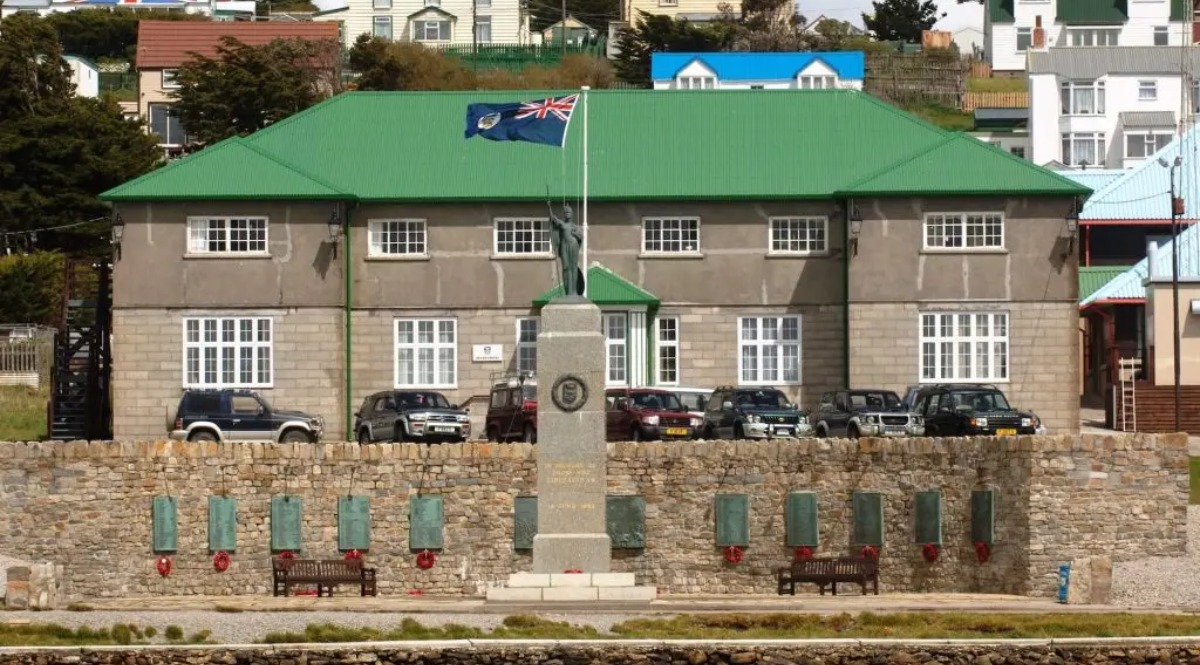
Main image shows Government House in Stanley, Falklands