
Surging demand in China’s seafood market, combined with renewed Canada–China trade engagement could create major export opportunities for farmed salmon from British Columbia
By Fabian Dawson
SeaWestNews
China’s growing appetite for salmon is reshaping the global seafood trade and Canada’s Pacific coast could be well positioned to help feed that demand.
New research into China’s fast-expanding salmon market suggests the country’s consumers are embracing the species at an unprecedented pace, driven by changing food culture, e-commerce distribution and the rising popularity of sushi and sashimi.
For British Columbia’s aquaculture sector, currently navigating political uncertainty and regulatory change, the findings point to a massive export opportunity emerging on the other side of the Pacific.
“China is a very big market,” said Mausam Budhathoki, a postdoctoral researcher in the Department of Food Science at the University of Copenhagen, in an interview with SeaWestNews.
“Salmon is already very popular there. It has become integrated into the cuisine, especially with sushi and sashimi, and people like the taste,” he said. “They go to restaurants, they order salmon, and demand keeps growing.”
China’s imports of salmon have surged dramatically in recent years.
In 2023 alone, imports rose 46 per cent year over year, with shipments of fresh and chilled Atlantic salmon jumping 63 per cent, according to research examining the evolving Chinese seafood market. Exporters from Norway, Chile, Scotland, Iceland and Canada are now competing to supply what analysts increasingly see as one of the most dynamic seafood markets in the world.
Even short-term trade data highlights the pace of that expansion.
Earlier this year, a surge in shipments ahead of Lunar New Year briefly pushed China past Poland to become Norway’s largest weekly salmon export market. This is a sign of how quickly Chinese consumers are incorporating salmon into celebratory meals and everyday dining, said Budhathoki, adding the trend reflects both changing tastes and the rapid modernization of China’s food distribution system.
“Salmon has become one of the major imported seafood products,” he said. “After shrimp and prawns, salmon is among the biggest imported seafood categories.”
China has tried to build its own domestic Atlantic salmon industry, but technical and environmental challenges have limited production. Instead, the country has increasingly relied on imports.
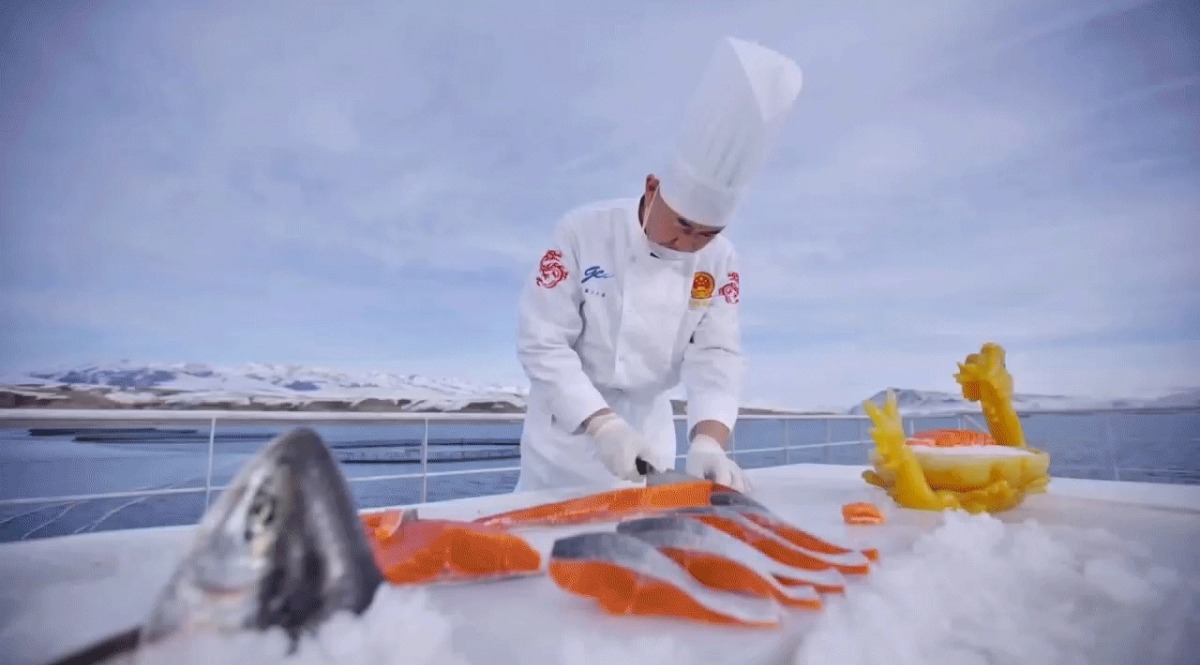
Domestic producers have expanded rainbow trout farming, and since 2018 the Chinese government has allowed trout to be labelled and sold as “salmon.”
Yet Budhathoki said scaling up domestic production remains difficult.
Many trout farms are located far from China’s main seafood consumption centres, such as Shanghai and Beijing, creating logistical hurdles similar to importing fish from overseas.
“Most of these farms are quite remote,” he said. “Transporting the fish to the main markets is still a challenge, so imports remain very important.”
Budhathoki’s research also found that Chinese consumers place strong emphasis on where their salmon comes from.

In blind taste tests conducted as part of his study, participants could not reliably distinguish between imported Atlantic salmon and domestically produced rainbow trout.
But once the country of origin was revealed, preferences shifted strongly toward imported fish, particularly salmon associated with established producing countries.
“There is a strong association between salmon and certain origins,” Budhathoki said.
“Norway has done a lot of promotion around origin. Consumers recognize it. If other countries, including Canada, emphasize their origin and branding in the same way, it could help them in this market.”
The expanding Chinese seafood market comes at a moment when Canada is actively seeking to deepen trade ties with Beijing.
During a recent visit to China, Prime Minister Mark Carney met with Chinese President Xi Jinping and other senior officials to launch a renewed Canada-China economic partnership focused on trade, energy and agri-food exports.
China is already Canada’s second-largest export market for agriculture, forest and seafood products, with roughly $13.4 billion in annual sales.
Ottawa has set a goal of increasing exports to China by 50 per cent by 2030, a target that could place seafood, including farmed salmon from British Columbia at the centre of future trade growth.
Budhathoki said Canadian salmon already enjoys a reputation as a premium product among Chinese buyers.
“I think Canada does have a good market there,” he said. “A lot of the premium Atlantic salmon goes from Canada to China.”
For Canadian exporters, Budhathoki said, success in China may depend on emphasizing quality, origin and sustainability rather than competing solely on price.
The growing Chinese market presents a striking contrast to the policy debates currently unfolding in Canada.
In British Columbia, the future of salmon aquaculture remains uncertain as the federal government works toward transitioning ocean salmon farms to new technologies by 2029, a legacy from the Trudeau-era fuelled by anti-fish farming activists.
Across British Columbia, salmon farms now operate in partnership with First Nations and collectively generate roughly $1.17 billion in annual economic activity while supporting approximately 4,560 full time jobs.
The BC Salmon Farmers Association and their First Nation partners project that a science-based stable federal and provincial aquaculture policy framework could generate as much as $2.5 billion in annual economic activity, contribute $930 million to Canada’s GDP and support roughly 9,000 jobs nationwide.
Main image from a promotional video showcasing Xinjiang “salmon” which is actually farmed rainbow trout which China has officially classified under the broader “salmon” umbrella since 2018.