
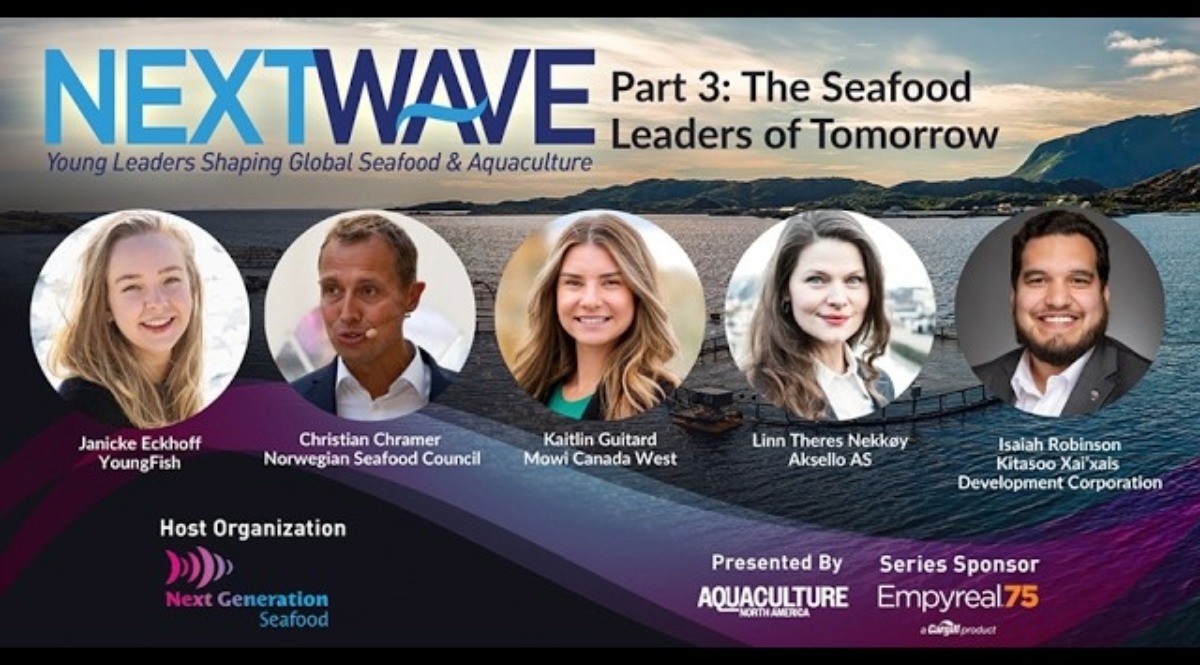
At a recent webinar on seafood’s leaders of tomorrow, speakers from Norway and Canada, made clear that aquaculture’s future will be shaped by people who show up, keep learning and help others grow.
By Samantha McLeod
SeaWestNews
The path to leadership in aquaculture runs through showing up, learning continuously, carrying pressure and helping others rise. That message anchored a recent Next Generation Seafood Alliance webinar on the seafood leaders of tomorrow.
The session was moderated by Janicke Eckhoff, board member of YoungFish and president of the Next Generation Seafood Alliance. Participants included Christian Chramer, CEO of the Norwegian Seafood Council; Kaitlin Guitard, Fish Health and Food Safety Lab Manager at Mowi Canada West; Linn Theres Nekkøy, Daily Manager at Aksello AS; and Isaiah Robinson, Deputy Chief Councillor of the Kitasoo Xai’xais Nation in British Columbia.
Across the discussion, leadership was framed less as a title and more as a practice. It came through in different ways from each speaker via consistent themes about openness to learning, resilience under pressure and a willingness to bring others along.
Chramer set the tone early. He urged younger professionals to focus on the job they have, rather than constantly looking over the horizon to the next one, and he stressed the role of mentorship, reading, travel and continuous development in shaping future leaders. His most memorable line captured the wider spirit of the conversation. “Building yourself also means building others,” Chramer said.
He also stripped away any polished view of leadership. “My experiences being a leader is that it is always challenging,” he said, adding that leadership brings responsibility, long hours and constant demands. For those entering the sector, his message was growth comes with pressure, and pressure is part of the path.
That point resonated strongly with the British Columbia speakers, whose comments reflected a sector where leadership is increasingly shaped in difficult conditions as Ottawa sits on a plan to ban ocean salmon farming by 2029.
Guitard said she did not enter salmon farming expecting to become a public advocate. But that changed when farms in the Discovery Islands, including the nursery site where she worked, were shut down. The experience pushed her into a much more public role and forced her to find her voice in a contentious policy environment.
“I was not asked, but I decided that I was going to join a fight and to have a voice,” Guitard said, referring to a campaign of falsehoods by anti-salmon farming activists in Canada.
Her remarks gave the webinar one of its clearest reminders that leadership often begins when circumstances leave no room to stay on the sidelines. She also spoke about the support younger professionals need from established leaders in the sector. For her, development happens when people are trusted, included and given the chance to grow through real participation.
“Being a part of the conversation, being in the meetings, giving them the benefit of the doubt, and really believing in them,” she said, is what helps create a strong foundation for emerging leaders.
Robinson brought the discussion into the reality of Indigenous leadership and community responsibility on the B.C. coast. His comments stressed that leadership is grounded in sacrifice, accountability and consistent participation.
“It’s all about sacrifice when it comes to leadership,” Robinson said.
He also made clear that leadership is shaped by how a person chooses to engage. “How you want to show up, is my perspective, and how you participate, is really the foundation,” he said.
That hands-on view reinforced that in aquaculture, leadership is not built from distance. It is built in the work itself, through direct involvement and continued responsibility to the people and communities affected by that work.
Nekkøy added a perspective centered on education, self-development and responsibility for others. She said learning does not stop once someone enters management or reaches a senior role.
“You never fully learned to continuously gain more knowledge within new fields,” Nekkøy said.
She also framed leadership as a responsibility to people first. “The most important thing for a leader is that you’re not necessarily the one who is responsible for the results of the company, but you’re responsible for the people who are supposed to make those results,” Nekkøy said.
That emphasis on people, development and trust fit closely with the wider message of the session. Chramer spoke of mentorship and building others. Guitard spoke of voice, inclusion and belief. Robinson spoke of sacrifice and participation. Nekkøy spoke of continual learning and responsibility for the people around you.
Taken together, the Seafood Leaders of Tomorrow session offered a grounded picture of leadership in aquaculture that is shaped by experience, strengthened through learning and tested under pressure.
Image: screenshot of the panel of speakers.