
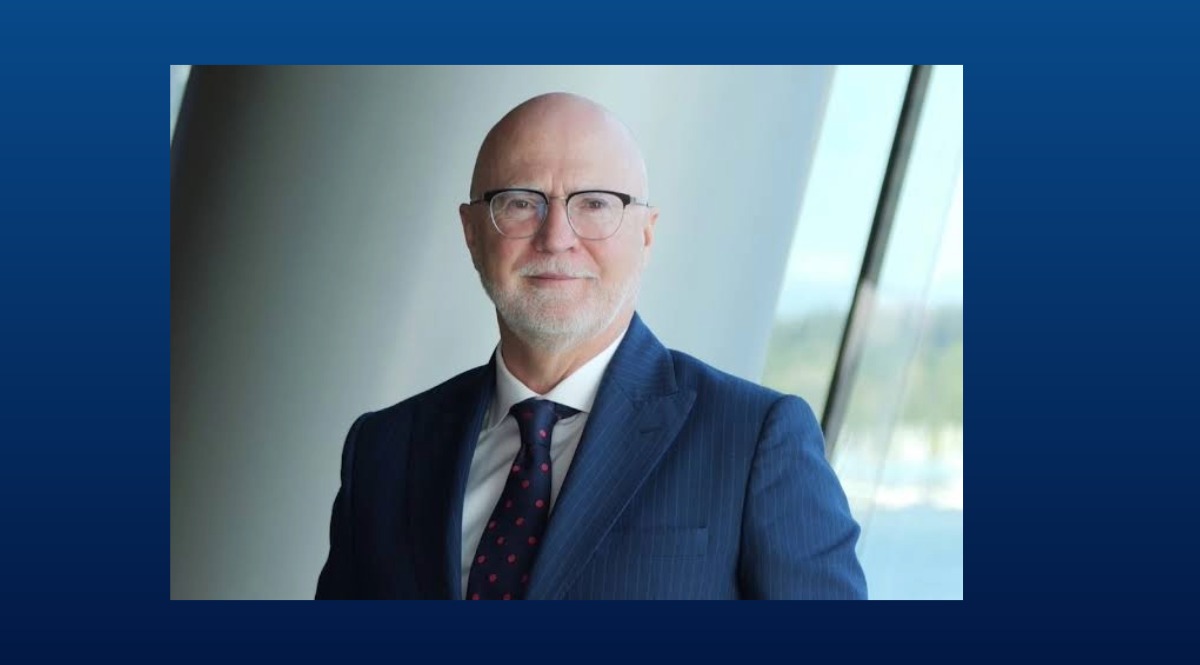
Stewart Muir, a leading B.C. resource advocate, lays out the playbook activist-friendly Trudeau-era politicians used to choke off aquaculture investment and kill conventional salmon farming on Canada’s West Coast.
By Fabian Dawson
SeaWestNews
Call a shutdown a transition. Change the burden of proof. Promise a replacement technology that isn’t ready. Set a deadline and let investment flee.
That, according to Resource Works founder Stewart Muir, is how the B.C. salmon farming sector is being dismantled without government ever openly saying it is shutting it down.
Speaking to seafood leaders at the Cold Harvest conference in St. John’s, Muir used British Columbia’s salmon farming sector as a warning to Atlantic Canada, arguing that the political and regulatory forces that weakened the industry on the West Coast could eventually move east.
He laid out nine steps he says explain how production fell, investment stalled and companies came to face a federal deadline ending conventional open-net pen farming after June 2029.
The veteran journalist and author argued the policy moved ahead despite the absence of scientific findings that salmon farming must be eliminated to protect wild salmon.
“I’ve yet to see the evidence that any of this is benefiting wild salmon, which I thought was the point,” he told delegates.
The warning comes as Prime Minister Mark Carney’s government reviews the Trudeau-era policy.
The first step in the playbook, Muir said, is language.
“Don’t call the ban a ban. Call it a transition,” he said. Calling it a transition implies there is a viable destination waiting for the industry.
In B.C., that destination has frequently been presented as closed containment and land-based salmon farming. But Muir said full-lifecycle Atlantic salmon production on land has yet to prove it can commercially replace marine production at the scale required.
“A transition with no destination isn’t a transition,” he said.

Two B.C. government-commissioned studies have found large-scale land-based salmon farming is not currently commercially viable as a replacement for ocean production.
Instead of allowing emerging technologies to prove themselves while existing marine farms improve, Muir argued, Ottawa placed a deadline on the industry before its proposed replacement had shown it could take over.
The second step involves changing the scientific test. For years, the question was whether salmon farms were causing measurable harm to wild salmon populations. Muir said the debate shifted toward demanding that farms prove they pose no risk at all.
“You frame the question around zero, and every measurable effect becomes a failure, no matter how small or well managed.”
Federal peer-reviewed science and other research have found no evidence that removing ocean salmon farms would produce a detectable improvement in wild Pacific salmon productivity. Opponents argue that uncertainty surrounding pathogens, sea lice, cumulative effects and changing ocean conditions justifies a precautionary approach.
Muir pointed to the closure of salmon farms in the Discovery Islands as a test of claims that removing the operations would improve Fraser River sockeye returns. Instead, he said, returns continued to swing sharply after farms were removed, from a stronger-than-expected return to the much weaker 2026 dominant-cycle run.
“It was a boom and a bust, with the (migratory) corridor empty both times of salmon farms,” he said.
If returns rise, closures get the credit. If they fall, the answer becomes more time or more closures.
“A claim that can’t lose isn’t science,” he said. “It’s a campaign.”
Muir traced some campaign tactics to B.C.’s forestry battles of the 1980s and 1990s, where retail pressure, celebrity campaigns, restaurant pledges and dramatic imagery moved environmental disputes into public and political pressure.
Another part of the playbook, Muir said, is simplifying the debate until the people who depend on the industry disappear from it.
For years, B.C. salmon farming was framed largely as wild salmon versus foreign-owned corporations.
“That framing for a long time erased the people in between,” Muir said.

He pointed to processing workers, boat operators, feed suppliers, marine contractors and coastal businesses. The biggest omission, he said, was First Nations that chose salmon farming as a source of employment, own-source revenue and greater economic independence.
“There are First Nations strongly opposed to open net pens,” he said. “There are First Nations strongly in favour.”
Rights Holder First Nations hosting salmon farms have pushed Ottawa for greater authority over licensing, science, stewardship and investment decisions in their territories, while other Nations continue to oppose open-net pen farming.
Muir said government policy cannot treat Indigenous opinion as uniform when different Nations are making different economic and environmental choices.
For Atlantic Canada, his strongest warning centred on investment.
Governments do not have to physically close an industry, he said. They only have to make investors believe it may not have a future.
“Set a date and let capital do the rest.”
The federal government’s 2029 deadline has already changed investment decisions in B.C., Muir argued, because salmon farming requires long-term spending on hatcheries, vessels, processing, farm infrastructure and technology.
“The 2029 deadline did its damage today,” he said. “The industry starts dying five years ahead of the capital plan.”
B.C. farmed salmon production has fallen by more than 40 per cent since 2015 as farms have been removed and uncertainty over the sector’s future has grown.
Muir said the concern now extends beyond B.C., with Atlantic Canadian producers and multinational companies watching federal policy on the West Coast when deciding where to invest.
He closed with further elements like selling a cure for a problem that is difficult to isolate, undermining confidence in the industry’s strengths and allowing political emotion to carry more weight than evidence.
“That’s the playbook,” he told delegates, warning that what happened in B.C. shows how quickly political uncertainty can choke off investment and become economic reality for any industry, anywhere in Canada.
(Main image shows Stewart Muir, the founder of Resource Works)