
New national report shows fewer fish escapes, increased use of sustainable feed and improved environmental practices amid growing scrutiny of the global salmon farming industry.
By Fabian Dawson
SeaWestNews
Canadian salmon farmers are reporting major improvements in environmental performance, including a sharp reduction in fish escapes and increased use of sustainably sourced feed, according to a new national report released today.
The 2026 Sustainability Report, published by Canadian Seafood Farmers (CSF), shows that just two farmed salmon escaped into Canadian waters in 2025, compared with 114 the previous year, while 95 per cent of fishmeal and fish oil used in feed came from certified sustainably managed or compliant fisheries.
The report also shows that 80 per cent of salmon feed now comes from non-marine ingredients, reflecting decades of changes in how farmed salmon are raised.
The findings come amid international scrutiny of the seafood industry following an investigation by The Outlaw Ocean Project linking parts of the global fishmeal and fish oil supply chain to depleted fisheries, pollution and labour abuses.
Canadian producers have challenged the broad portrayal of aquaculture in that investigation, arguing that practices uncovered in troubled overseas fisheries should not be used to characterize Canadian salmon farming.
The latest report provides four years of data on fish health, feed sourcing, environmental safeguards and food production from seven salmon-farming companies operating across five provinces.
“Canada’s salmon-farming sector continued to improve in several areas in 2024 and 2025, including fish escapes, sustainable feed sourcing, and packaging, while facing increased environmental pressures that affected fish survival, sea lice management, and antibiotic use,” the report states.
One of the report’s most significant findings is the industry’s reduced dependence on wild-caught fish for salmon feed.
When commercial salmon farming began in Canada nearly 50 years ago, virtually all feed was made from fish and fish products. Today, marine ingredients account for just 20 per cent, with the remainder coming from grains, plant oils and alternative proteins.
The industry uses certification programs such as MarinTrust and the Marine Stewardship Council to assess responsible sourcing, traceability and fisheries management.
It aims to reach 100 per cent sustainable sourcing, with the remaining gap attributed to supply-chain availability and certification challenges.
“This is remarkable progress, and we are committed to 100% sustainable sourcing and constant improvement and innovation,” said Canadian Seafood Farmers president and CEO Timothy Kennedy.
The report also highlights the industry’s growing connection to Canadian agriculture. In 2024, salmon farmers purchased more than $250 million worth of grains, seeds, oils and other proteins from domestic farmers.
Feed manufacturers are also developing alternatives such as omega-3-rich algae oils, fermentation-based proteins and insect proteins to further reduce reliance on marine ingredients.
All participating salmon farmers had underwater camera systems installed at ocean farms to monitor feeding and fish health, helping reduce wasted feed and limit organic material reaching the seabed. All farms also met applicable seabed environmental requirements before restocking.
In primary processing operations, all packaging reported by participating companies was reusable, recyclable or biodegradable, although that measure covered four of the seven companies.
However, changing ocean conditions continue to create challenges.
Fish survival declined from 90.2 per cent in 2024 to 85 per cent in 2025, a fall of 5.2 percentage points attributed to harmful algal blooms, low-oxygen events and difficult environmental conditions.
The number of farms requiring remedial action for sea lice increased from 11 to 14, while non-medicinal treatments accounted for 44 per cent of sea lice treatments, down slightly from 45 per cent the previous year.
Antibiotic use declined from 2024 levels but remained higher than in 2022 and 2023.
Greenhouse gas emissions per kilogram of production also increased, partly because newer semi-closed and closed containment systems require more energy.
The report says producers are pursuing renewable energy, electrified equipment and shore-based power to reduce emissions.
The report highlights several conservation initiatives involving First Nations and salmon farmers.
In British Columbia, Cermaq and the Ahousaht First Nation have developed a preventive approach to sea lice management combining Indigenous oversight, traditional knowledge and fish-health monitoring.
Cermaq completed a full 22-month production cycle without mechanical sea lice removal. Average motile sea lice levels across its farms in Ahousaht territory were 0.30 per fish during the reporting period, compared with 1.93 in 2022.
Cermaq is also supporting an Ahousaht-led hatchery in Maaqutusiis capable of incubating up to 100,000 chum salmon eggs to help rebuild wild populations.
In Atlantic Canada, Cooke Aquaculture is participating in the Inner Bay of Fundy salmon recovery program, which has released more than 13,230 mature fish over the past decade.The project has also confirmed more than 700 salmon returning to spawn.
The report also shows that Canadian farmers are making greater use of harvested salmon.
The utilization rate increased to 93 per cent in 2025, from 91 per cent in 2024, with processing by-products used for nutritional supplements, pet food and fertilizers.
Salmon farmers donated the equivalent of 21,787 meals to food banks and charitable organizations in 2025, down from 28,333 the previous year. The report attributes the decline in food donations to reduced production in British Columbia following government-imposed farm closures.Monetary donations supporting food security, however, roughly doubled, rising to $310,461 in 2025 from $150,425 in 2024.
Nationally, salmon farming generated more than $4.7 billion in economic output, contributed $1.7 billion to GDP and supported 13,242 full-time jobs in 2024, according to figures cited in the report.
Kennedy has maintained that Canadian producers should be assessed on their own standards and performance.
“We should be growing more salmon in Canada for Canadians, as we know the standards are amongst the highest in the world,” he said.
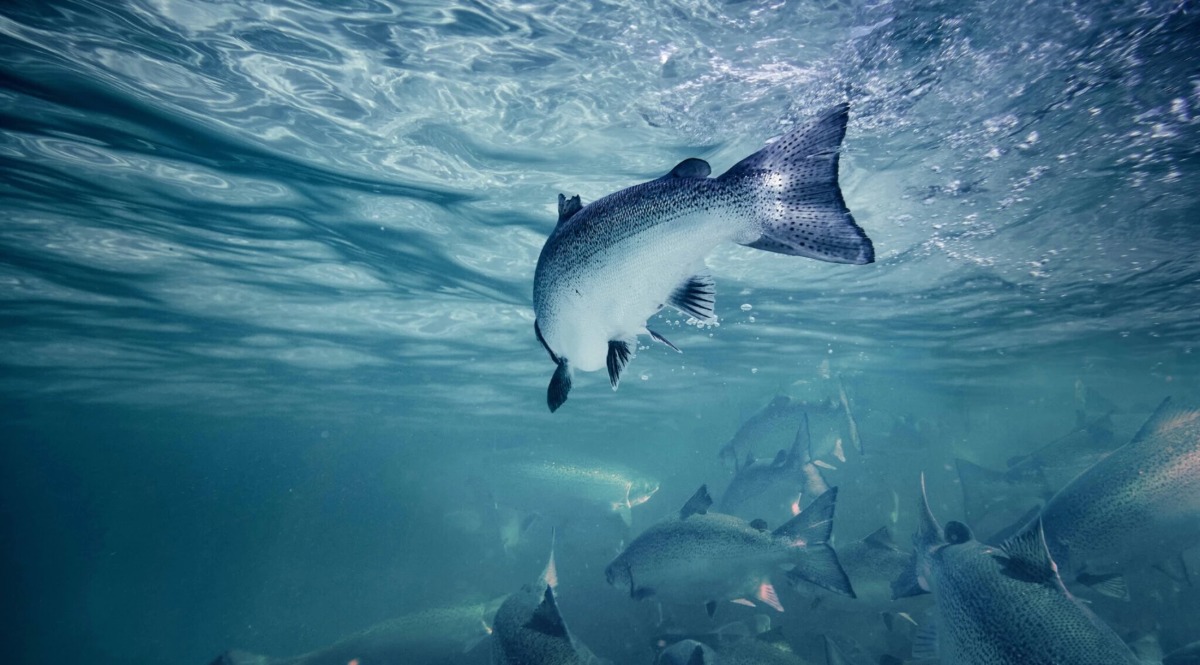
(Main image courtesy of the Global Salmon Initiative shows salmon in an ocean pen)