
Canada’s latest food sentiment index found no year-over-year increase in preference for wild-caught fish over farm-raised fish, undercutting activist claims that seafood shoppers are turning against aquaculture.
By Fabian Dawson
SeaWestNews
The ideologically motivated anti-aquaculture activist campaign may be growing louder in Canada, but it is not winning over seafood consumers, a new survey from Dalhousie University shows.
The school’s Spring 2026 Canadian Food Sentiment Index found no year-over-year increase in Canadians’ average tendency to choose wild-caught fish over farm-raised fish, undercutting the relentless activism aimed at steadily turning the public against aquaculture.
Dalhousie’s survey found that Canadians’ average score for choosing wild-caught fish over farm-raised fish was 3.29 in Spring 2026, exactly the same as in Spring 2025. On the report’s five-point scale, that means consumers, on average, only “sometimes” favour wild over farmed fish, and that preference has not strengthened over the past year.
For years, anti-salmon farming campaigners have tried to cast farmed fish as something consumers should reject on environmental, ethical and even moral grounds. In British Columbia especially, salmon farming has been framed by its opponents not as a food production sector to be improved through science and regulation, but as an industry to be eliminated outright.
But this survey of 3,000 Canadians suggests that campaign is generating far more political heat than consumer conversion.
The Dalhousie report also shows Canadians are paying closer attention to where their food comes from. More respondents now say they often or always check food origin, a sign that provenance matters.
But even with that rising interest in source, there has been no corresponding increase in preference for wild-caught over farm-raised fish, as activists keep claiming.
Earlier data from Dalhousie University’s Agri-Food Analytics Lab found that nearly eight in 10 Canadians consume salmon, making it one of the country’s most widely eaten fish.

The national survey of more than 10,000 consumers also showed strong repeat demand, with a significant share of households reporting weekly consumption.
This study further highlighted growing acceptance of farmed salmon. A majority of respondents said they believe aquaculture is a sustainable way to produce salmon in Canada.
Nowhere is this more evident than in Atlantic Canada, where a recent regional survey found support for aquaculture has climbed to 85 per cent, signalling that when people see the industry as part of their economy, food system and coastal identity, they are far less likely to buy into activist propaganda.
Dalhousie’s latest Canadian Food Sentiment Index lands as B.C. salmon farmers and their First Nations partners meet with MPs and federal officials in Ottawa to urge the Carney government to reverse a Trudeau-era policy to ban ocean salmon farming in British Columbia.
That activist-driven policy decision was made despite decades of data and volumes of studies, including many by the government’s own scientists, showing that farmed salmon has minimal impact on wild stocks.
If the Mark Carney government does not reverse course, the full phaseout would wipe out British Columbia’s remaining 50,000 tonnes of farmed salmon production and cost Canada $1.17 billion a year in economic activity, $435 million in GDP, 4,560 jobs and roughly $259 million in family income. Taxpayers could also face at least $9 billion in compensation and transition-related subsidies.
Canada’s leading food scientist, Dr. Sylvain Charlebois, one of the authors of Dalhousie’s Food Sentiment Index, has labelled the Trudeau-era plan to ban ocean salmon farming in British Columbia “an illogical move driven by activism rather than science.”
“It is clear to me that activism has successfully influenced the decision … to me, it doesn’t make any logical sense to do what the government is doing right now,” Dr. Charlebois, dubbed “The Food Professor” by the media, told SeaWestNews in an earlier interview.
“It will increase the carbon footprint of Canada’s food production sector and lead to higher salmon prices,” he warned.
Other highlights from the Spring 2026 Canadian Food Sentiment Index include:
- Food remains the household expense Canadians are most likely to say has increased the most over the past year, cited by 81.1 per cent of respondents.
- Canadians are increasingly viewing recent food inflation as moderate rather than extreme, with 31.0 per cent estimating food prices rose 5 to 7 per cent over the past year.
- Grocery costs continue to climb, with average monthly food-at-home spending rising to $412.06 in Spring 2026, up from $396 a year earlier.
- Total monthly household food spending reached $519.96 in Spring 2026, an increase of $22.96, or 4.6 per cent, from a year earlier.
- About 34 per cent of respondents said they had to draw on savings or borrow money to buy food in the past year.
- Affordability remains Canadians’ top food value at 45.5 per cent, well ahead of nutrition at 24.9 per cent and taste at 16.0 per cent.
- Canadians are paying closer attention to food origin, with 21.2 per cent saying they always check where food was produced and 37.1 per cent saying they often do.
- Most Canadians still buy local food at least sometimes, though the earlier “Buy Canadian” surge appears to be softening.
- Trust in food institutions remains relatively stable, with Health Canada ranking highest at 3.89, just ahead of Canadian farmers at 3.86.
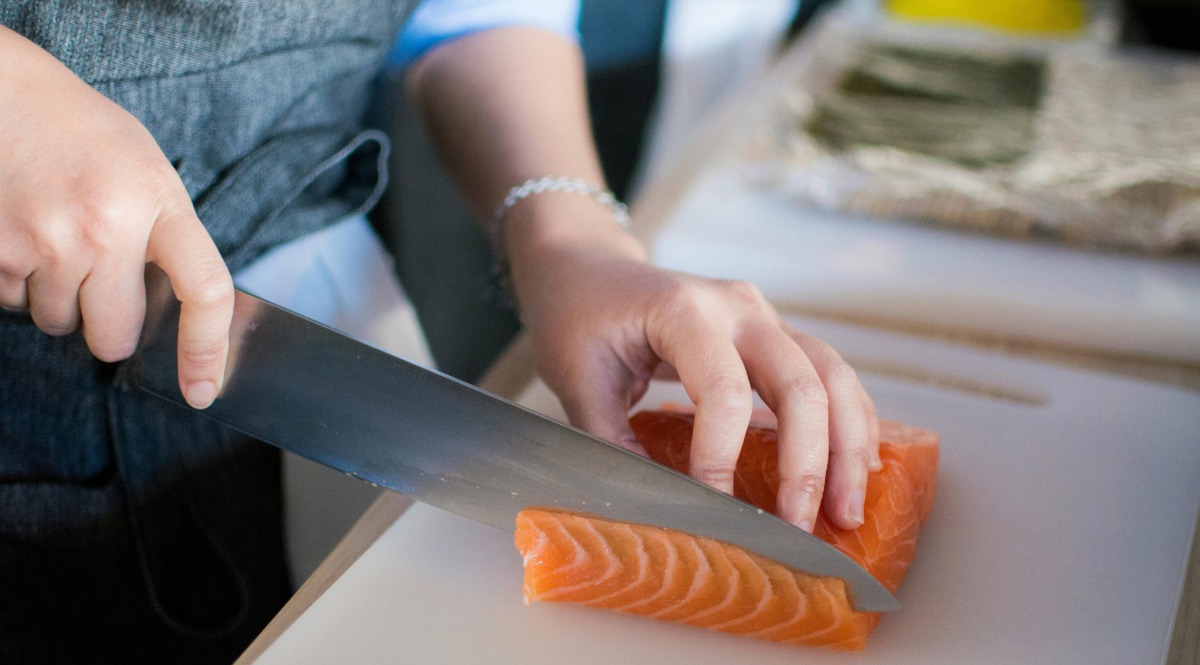
(Main image from Pexels shows a sushi chef preparing farmed salmon)