
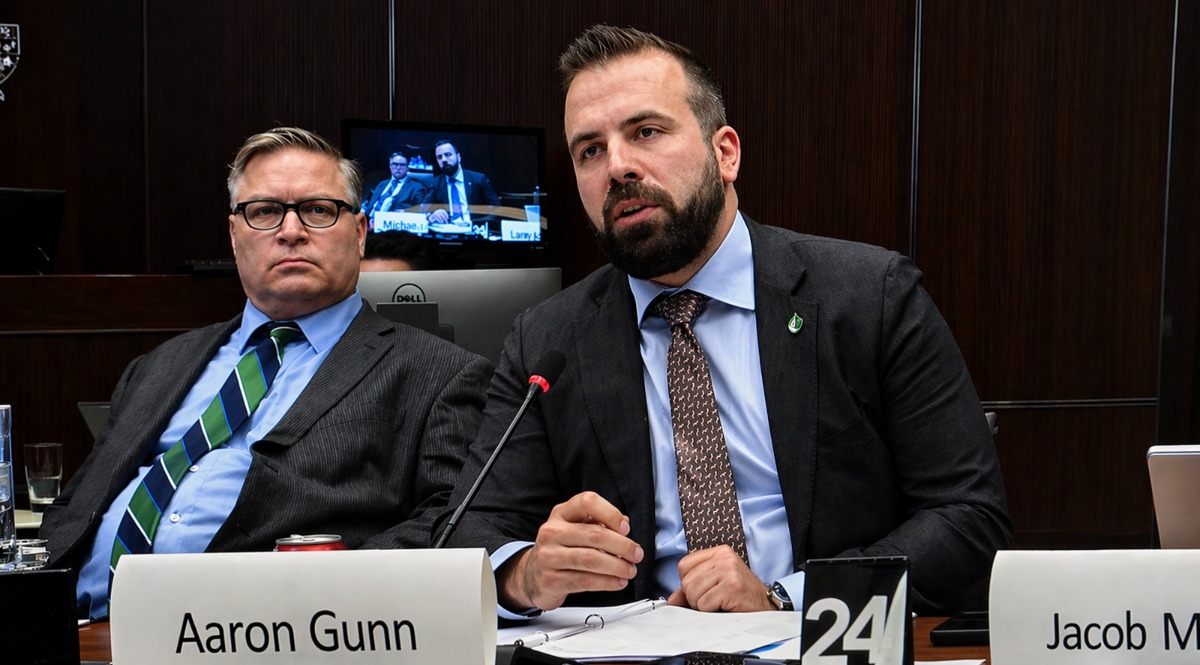
Conservative MP Aaron Gunn’s bid to force release of a key B.C. salmon farming report was shut down by what he calls a “childish and embarrassing” filibuster.
By Fabian Dawson
SeaWestNews
Why is the federal government hiding the long-promised report on the future of salmon farming in British Columbia?
That question is now hanging over Ottawa after Conservative MP Aaron Gunn was blocked from getting a production order for the report, which Fisheries Minister Joanne Thompson said eight months ago would be released “very shortly.”
“Workers in the salmon farming industry deserve answers,” said Gunn, the MP for North Island-Powell River, a riding that would bear much of the fallout if the Carney government follows through on the Trudeau-era plan to ban ocean salmon farming in British Columbia by 2029.
“They were promised clarity by this past fall, and here we are in April with nothing from the minister, nothing from the department, and no idea whether the government is preparing to put over 4,000 Canadians out of work,” Gunn told SeaWestNews.
Gunn raised the issue at yesterday’s meeting of the Standing Committee on Fisheries and Oceans, saying he had strong backing from members to seek clarity on the status of the report, prepared by Innovation, Science and Economic Development Canada (ISED).
The ISED report is meant to guide the transition of the B.C. salmon farming sector which generates more than $1.17 billion a year for British Columbia’s economy and supports 4,560 full-time jobs.
Instead of debating the production order or allowing it to go to a vote, Liberal MP Ernie Klassen of South Surrey–White Rock used up the remaining committee time by reading at length from the 2012 Cohen Commission report, into the decline of Fraser River sockeye salmon. That effectively shut down Gunn’s effort to force disclosure.
Gunn described the move as a blatant filibuster aimed at preventing MPs, the salmon farming sector, their First Nations Partners and coastal communities on Vancouver Island from seeing what Ottawa already knows about the consequences of its transition plan.
“We’re not forcing the government to make any decision,” he said. “We’re just forcing them to be transparent with Canadians about what their plans are for salmon farming in B.C.”
He said the refusal to release the report raises a deeper possibility that the evidence gathered by ISED officials, after over 110 engagements with stakeholders, may not match the political outcome the government wants.

“Maybe what the Department (ISED) found based on evidence is different from the political or ideological decision they’re planning to make.
“It was a childish and embarrassing tactic aimed at blocking transparency and keeping Canadians in the dark about the future of salmon farming in B.C.,” said Gunn, who plans to raise the matter again when the committee meets next week.
The current federal policy direction still points toward ending open-net pen salmon farming in British Columbia by 2029, despite decades of data and federal scientists repeatedly finding that B.C. salmon farms pose no more than a minimal risk to wild salmon stocks.
Gunn said a Conservative government would not advance policy on ideology over science, especially if it risks wiping out thousands of jobs in coastal and Indigenous communities that depend on the salmon farming sector.
Meanwhile, aquaculture industry leaders say they are hearing a more constructive tone from federal departments on the salmon farming file, even as Ottawa continues to keep the transition report out of public view.
Speaking to Fish Farming Expert at Seafood Expo Global in Barcelona this week, Cermaq chief executive Steven Rafferty said he has seen “a more proactive” approach from federal departments, with more meetings, more requests for information and what he described as “a change in mindset” around salmon farming’s economic importance.
“We’ve met multiple people from the Canadian government over the last few months and there is a change in mindset; there’s much more understanding that this is a big, multi-million-dollar industry and it can’t just disappear,” he said at the Expo, which was also attended by Minister Thompson.
Gunn’s push for transparency comes as a recent RBC Thought Leadership report warns that regulatory drag and policy uncertainty are driving investment out of Canada, a trend already playing out in B.C.’s salmon farming sector.
“When you have a government that isn’t being transparent about whether they’re even going to allow the industry to operate beyond 2029, who in their right mind would invest here?” added Gunn.
(Main image shows Conservative MP Aaron Gunn ( North Island-Powell River) at last Monday’s meeting of the Standing Committee on Fisheries and Oceans. Next to him is Clifford Small, Conservative MP for Central Newfoundland)