
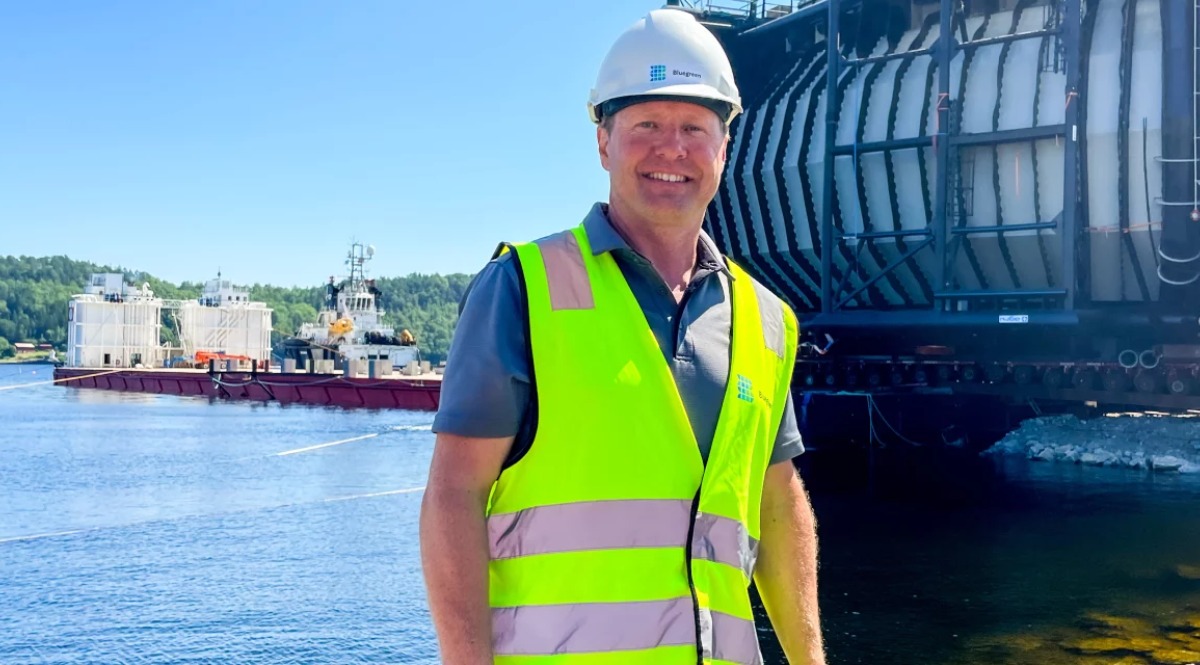
A ‘Marine Donut’ will be built and tested in Campbell River, but its developer says the closed-containment aquaculture system is no near-term replacement for existing ocean salmon farming in B.C.
By Fabian Dawson and Samantha McLeod
SeaWestNews
A $51-million project to adapt and commercialize a Norwegian closed-containment salmon farming system in British Columbia is being launched in Campbell River, marking the largest project funded by Canada’s Ocean Supercluster to date.
But Bluegreen, the company behind the ‘Marine Donut’ technology, says the system is not intended to replace B.C.’s existing ocean salmon farms.
“We are not here to replace open-net salmon farming,” Bluegreen CEO Nils-Johan Tufte told SeaWestNews.
“We are here to work alongside and develop technology that makes sense for all parties,” he said, adding that replacing B.C.’s current ocean-farmed salmon production with closed containment technology “would take a long time.”
The first unit planned for Campbell River will be a relatively small post-smolt pilot aimed at proving the biology and economics under Pacific Coast conditions, said Tufte.
The Coalition of First Nations for Finfish Stewardship (FNFFS) welcomed the investment, saying the announcement sharpened the need for Ottawa to clarify the future of salmon farming in B.C.
Coastal Nations are being asked to consider and invest in new technologies while the federal government has yet to say whether it will maintain its policy to end conventional open-net pen salmon farming after 2029, the Coalition said.
“This is the Indigenous-led model we have long been advocating for,” said Dallas Smith of the Tlowitsis Nation, a Coalition spokesperson.
But Smith cautioned against treating one technology as a blanket replacement for salmon farming across the coast.
“One promising project cannot be put forward as a solution for all Nations,” he said. “Each territory is unique. New technologies need to be proven and adopted where they make sense, not forced through an arbitrary deadline.”
The BC Salmon Farmers Association also welcomed the ‘Marine Donut’ project and Wei Wai Kum First Nation’s involvement, while stressing that trials of new technology should proceed alongside current production.
“Innovation and existing production can move forward together,” said association executive director Brian Kingzett. “Testing new systems can complement the continuous improvements already taking place across the sector.”

The association said technologies such as ‘Marine Donut’ still need to be tested under actual B.C. conditions for biological performance, environmental outcomes, reliability, energy requirements and commercial viability.
The federal government announced in 2024 that conventional marine net-pen salmon farming would no longer be permitted in British Columbia after June 30, 2029. A final review of this activist-driven Trudeau-era policy is expected soon.
The ‘Marine Donut’ project, announced yesterday, will receive $14.5 million from Canada’s Ocean Supercluster toward its $51-million cost, with the balance coming from project partners.
“As global demand for sustainable seafood continues to grow, Canada has a significant opportunity to become a global leader in sustainable aquaculture,” said Kendra MacDonald, Chief Executive Officer, Canada’s Ocean Supercluster.
“Innovations like Bluegreen’s Marine Donut® can help position Canada at the forefront of this sector while strengthening food security, advancing Indigenous participation and leadership, and supporting resilient coastal economies.”
Bluegreen, a Norwegian industrial technology company specializing in large thermoplastic structures, will establish manufacturing capacity in Campbell River. The project is supported by Wei Wai Kum First Nation and will include local manufacturing, training and technology development.
‘Marine Donut’ is a large floating closed-containment structure that keeps salmon separated from the surrounding marine environment while allowing greater control over water quality and production conditions.
The system is designed to reduce exposure to sea lice, prevent fish escapes and allow collection of sludge and feed residues.
Bluegreen has already completed two production cycles with salmon producer SalMar in Norway, producing close to 2,000 tonnes of fish. The system can be used for both post-smolt production and full grow-out.
Tufte told SeaWestNews the first Campbell River unit will be used for post-smolt production and biological validation rather than full commercial grow-out. The company hopes to have the first Canadian-built ‘Marine Donut’ in the water next summer.
Tufte said Bluegreen does not yet know what a Marine Donut manufactured and operated in Canada will cost.
“That’s what we are going to learn through this full-scale pilot here in Canada,” he said.

The first systems will inevitably cost more, he added, with costs potentially falling if the technology attracts enough customers to support larger-scale manufacturing.
That uncertainty is central to the wider debate over whether alternative systems can be deployed quickly enough and economically enough to replace existing production before Ottawa’s 2029 deadline.
The First Nations Coalition said technologies such as ‘Marine Donut’ require research, trials, infrastructure, regulatory approvals and investment before their commercial and operational viability across B.C.’s varied coastal environments can be established.
“Deployment timelines do not wait while Ottawa deliberates,” the Coalition said, warning that Nations and industry partners are already making decisions about future production, employment and investment.
The Coalition is calling on Ottawa to abandon the 2029 deadline and replace it with a technology-neutral approach led by rights-holder First Nations, allowing existing production to continue as new systems are developed and tested.
For Campbell River, the project also carries a manufacturing and training component.
Bluegreen plans to establish a North American production base in the city rather than ship completed systems from Norway.
Working with North Island College, it plans to train up to 140 students in thermoplastic manufacturing, including students recruited from local First Nations, as well as five to 10 Marine Donut operators.
Tufte said bringing the technology to Canada will provide his company with answers it cannot get from its Norwegian operations.
“Marine Donut has been commercially demonstrated through two production cycles in Norway,” he said. “The next step is to adapt and validate the technology for the conditions along Canada’s Pacific coast.”
Main image shows Bluegreen CEO Nils-Johan Tufte in front of his company’s ‘marine donut’ aquaculture innovation.