
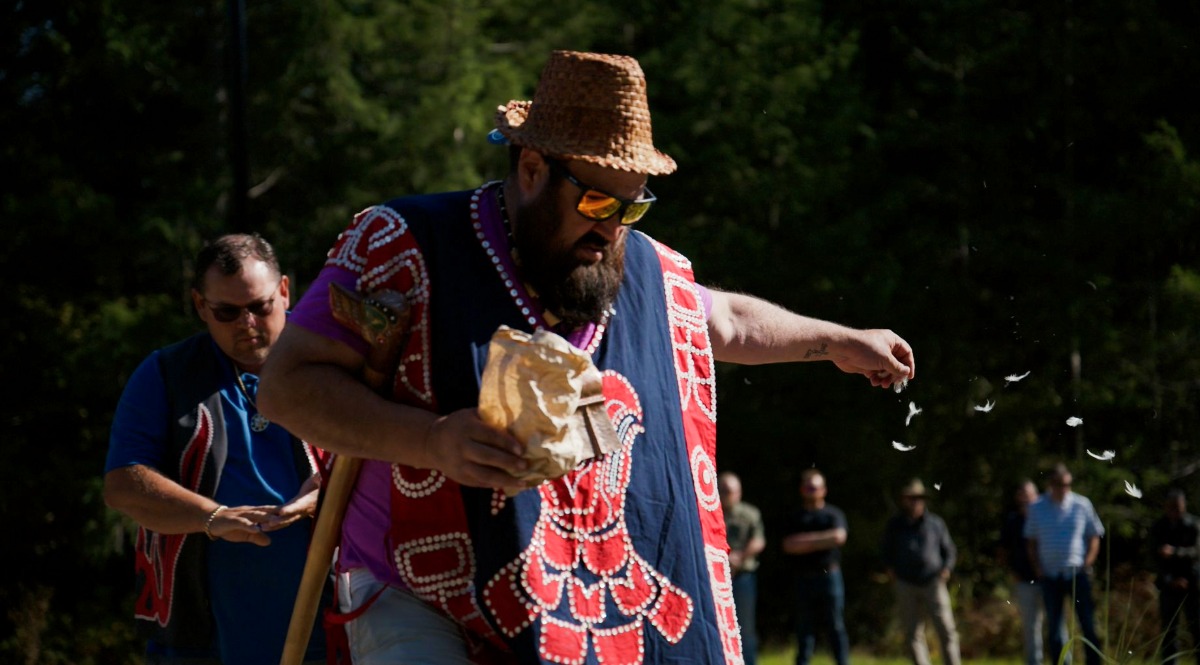
As the first five families prepare to move into Nenagwas, the Tlowitsis First Nation’s new home on Vancouver Island, Ottawa’s plan to ban ocean salmon farming in British Columbia threatens to stall a homecoming more than five decades in the making.
By Fabian Dawson
SeaWestNews
This fall, five Tlowitsis families will turn onto a road south of Campbell River on Vancouver Island, where two canoes signal the start of a homecoming more than half a century in the making.
They will carry their belongings into new homes at Nenagwas, a community made possible in large part by salmon-farming revenue and named for what it promises to become, “a place to come home to.”
Their arrival will mark the beginning of the Tlowitsis Nation’s return to life as a community, bringing together families scattered across British Columbia after government policies drove them from their ancestral village of Kalagwees on Turnour Island in the 1960s.
For Dallas Smith, a Tlowitsis Nation strategic negotiator, the first move-ins carry both the excitement of seeing families finally come home and the anxiety of not knowing how many more will be able to follow.
As Nenagwas prepares to welcome its first residents, Smith said another federal policy carrying the familiar outsider assumption that Ottawa knows what is best for Indigenous communities, is threatening the next stage of the Tlowitsis Nation’s long journey home.
Salmon farming is one of the Tlowitsis Nation’s main sources of own-source revenue. That income has helped pay for the homes at Nenagwas and support a wider vision that includes childcare, recreation, cultural facilities, food production and, eventually, expanded education and health services.
But a Trudeau-era policy to remove marine salmon farms from British Columbia waters by June 30, 2029, has placed that revenue, and the pace of Nenagwas’ growth, in doubt.
“Our future self-determination depends on it right now,” Smith said, pointing to the Carney government’s delayed decision on whether to retain the activist-driven aquaculture policy.
“We’ve been able to get limited government support for infrastructure, but we’ve had to build all the houses under own-source revenue,” Smith told SeaWestNews.
“That’s why we’ve only started the next five houses, because of the uncertainty on aquaculture. So, we’re having to look at other opportunities to help pay for the next phase of buildings.”
The Tlowitsis have partnerships with the salmon-farmers in their territory and have said those arrangements provide revenue, employment and support for environmental stewardship.
“Aquaculture plays a major role,” Smith said. “It’s one of our major revenue providers that actually goes towards the building of the houses.”

Ten homes have been completed at Nenagwas and five more are nearing completion, with the first five families expected to move in by the end of September on the 635-acre property purchased by the 500-member First Nation in 2018.
The $85-million development is ultimately planned to include 180 homes, along with the infrastructure and community facilities needed to rebuild the Tlowitsis Nation on traditional lands.
A new band office and resource management centre are already operating. Roads, sewer lines and serviced lots are in place. A wastewater treatment plant is waiting for enough residents to move in before it can begin operating properly.
Each completed home represents far more than a roof and four walls, said Smith.
It is a tangible expression of the Tlowitsis Nation’s right to rebuild its community, govern its affairs and shape its future on traditional lands, he said.
The uncertainty over the future of Nenagwas is part of a much broader fight being led by the Tlowitsis and other Indigenous leaders in the Coalition of First Nations for Finfish Stewardship over who has the authority to decide what salmon farming activity takes place in their traditional territories and waters.
The Coalition says that authority should rest with the Rights-holder Nations whose traditional waters sustain aquaculture. They are urging Prime Minister Mark Carney to reverse the Trudeau-era ban with an Indigenous-led system of licensing, science, stewardship and investment.
“B.C. coastal First Nations believe in conservation and having a choice to responsibly develop sustainable aquaculture economies for our people and within our territories, and salmon aquaculture is the backbone,” Smith said.
Every salmon farm in British Columbia now operates with the consent of a Rights-holder First Nation. Yet Ottawa’s 2029 policy would shut down those farms regardless of the decisions made by the Nations that host them.
For the Tlowitsis, that contradiction goes to the heart of reconciliation. The federal government speaks of Indigenous self-determination while retaining the power to eliminate an industry the Nation has chosen to support, regulate and rely upon.
“We are salmon people,” Smith said. “It is our responsibility to preserve and protect our wild salmon. We know that we can both farm salmon and protect wild salmon, because that’s what we have been doing every day for decades.”
The issue is no longer theoretical for a sector that supports about 4,560 full-time jobs, including more than 1,000 Indigenous workers, and generates roughly $1.17 billion a year in economic activity across British Columbia.
The next six-year salmon production cycle is fast approaching, forcing companies and First Nations to make investment, stocking and employment decisions before Ottawa has clarified whether farms will be allowed to operate beyond 2029.
Without certainty, companies may halt production, trigger further job losses and cut revenue that coastal Nations use for housing, infrastructure, stewardship and social programs.
At Nenagwas, conceived to reunite the Tlowitsis after more than 50 years without a home of their own, that uncertainty over salmon aquaculture in B.C. can be measured in homes.
The Nation had hoped to build about 15 houses a year over the next three years. Smith now fears that pace could fall to three or four.

Earlier government decisions emptied Kalagwees, the Tlowitsis Nation’s ancestral home. The current one could strip away the revenue needed to complete Nenagwas, our new home, said Smith.
The language is different, but the Tlowitsis say the underlying mentality remains familiar: outsiders deciding what is best for an Indigenous Nation and leaving its people to live with the consequences.
“This unlawful interference does not only harm our ability to build sustainable economic development. It threatens our collective future,” the Nation said in a declaration issued in December 2025.
Main image –Dallas Smith, a member of Tlowitsis Nation participating in the blessing of two canoes at the entrance of Nenagwas. (Photo: John Fulton / Tlowitsis Nation)