
Two new reports warn that declining aquaculture and forestry production, coupled with inadequate power planning, threaten jobs, businesses and future growth across Vancouver Island.
By Fabian Dawson
SeaWestNews
Vancouver Island’s resource economy is under mounting pressure as forestry mills shut down, salmon farming production declines and escalating U.S. tariffs threaten businesses already struggling with weak markets and rising costs.
The troubling outlook is outlined in the Vancouver Island Economic Alliance’s (VIEA) 2026 State of the Island Economic Report, featured at its 20th anniversary summit in Nanaimo today.
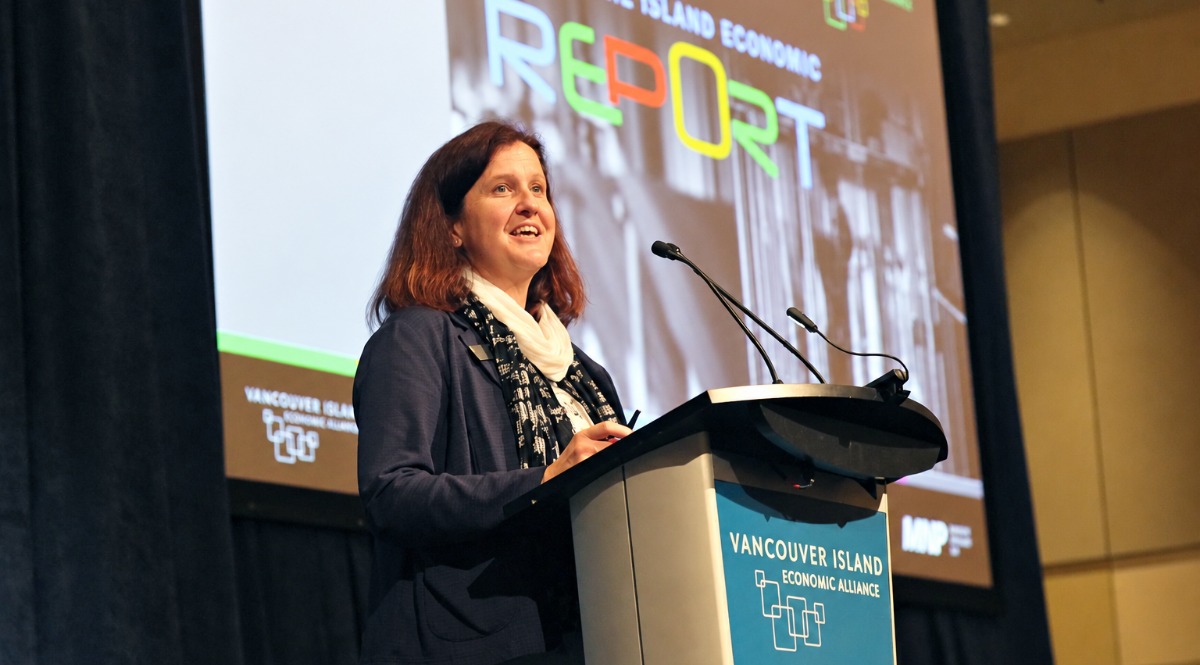
Presented by Susan Mowbray, a partner in MNP’s Vancouver Consulting Practice, the report warns that shrinking resource industries, government spending cuts and slowing population growth will further weaken the Island’s outlook into 2027.
Particularly concerning is the deterioration of British Columbia’s salmon farming industry, where production has fallen by approximately 45 per cent between 2019 and 2025, reducing employment and spending among suppliers that support smaller coastal communities.
The industry’s future remains uncertain as Ottawa considers whether to proceed with a Trudeau-era plan to end ocean salmon farming in B.C. by June 2029, despite federal assessments that the marine operations only have a minimal impact on wild stocks.
An economic impact study commissioned by the B.C. Salmon Farmers Association previously estimated that eliminating marine salmon farming would put 4,560 full-time jobs and $1.17 billion in annual economic activity at risk.
“This is having negative impacts on small coastal communities,” the report states, warning that the industry’s loss could also have significant consequences for the region’s shellfish sector, which employs roughly 1,000 people across 150-plus businesses and generates $80 million in economic activity.
The pressure on aquaculture comes as Vancouver Island’s other major resource industry, forestry, faces its own economic difficulties.
Weak lumber demand, rising U.S. tariffs and mill closures have taken a toll on production, employment and exports, according to the VIEA report.
Timber harvesting across the Island’s three natural resource districts fell to approximately 7.4 million cubic metres in 2025, down from 9.7 million cubic metres in 2021, a decline of nearly 24 per cent.
U.S. softwood lumber tariffs, which the report says have reached a combined 45 per cent for certain products, are adding to the industry’s difficulties. Forest products and log cargo volumes through Nanaimo and Port Alberni have also declined, reflecting the broader weakness in coastal forestry.
The difficulties facing Vancouver Island’s resource industries are unfolding against a weakening regional labour market.
The Island’s unemployment rate reached 5.8 per cent in September 2026, up from 5.6 per cent a year earlier, although it remained below the provincial average of 6.7 per cent.
Tourism remains one of the Island’s brighter economic sectors, although its outlook is mixed.
The report expects tourism to remain relatively strong in 2027 as Canadian and international travellers continue seeking alternatives to U.S. destinations. However, signs of declining American visitor numbers could affect tourism businesses on southern Vancouver Island.
The warning about Vancouver Island’s weakening resource economy is being reinforced by a new report that argues the region’s electricity planning could make its industrial decline even worse.

Stewart Muir, president and CEO of Resource Works, is releasing Stranded Potential: Vancouver Island’s Industrial Future this week, warning that BC Hydro’s long-term electricity forecasts assume major industries will continue shrinking rather than planning for their recovery.
Muir, who will address the VIEA summit on Thursday, argues that declining industrial electricity demand is being treated as a benefit when it should be seen as a warning about disappearing jobs, investment and economic opportunities.
He points to BC Hydro’s forecast that electricity consumption by the forestry sector will fall by nearly half by 2050 as an example of planning around industrial decline.
“That’s completely the wrong way to go about this, and it needs to be called out,” he said.
Muir says the Island should instead be preparing for renewed investment in forestry, mining and aquaculture, backed by enough reliable electricity to support industrial expansion.
“When investors show up with a billion dollars, as they want to in mining and aquaculture, that’s a jobs story as well as an energy story,” he said.
He argues that the consequences extend beyond lost production to the kinds of jobs available to Island workers.
Muir estimates that about 60 per cent of Vancouver Island’s electricity comes from the Mainland through undersea cables, leaving the region heavily dependent on power generated elsewhere.
While that connection will remain essential, he says the Island needs to expand its own reliable electricity supply, particularly as BC Hydro has been a large net importer of electricity in recent years.
A longtime advocate of expanding B.C.’s power capacity, Muir applauded the growing First Nations investment in wind energy, including projects from Cape Scott to the Yə̓yus development near Campbell River.
“Their projects should be the foundation of a bigger Island economy, not backfill for a shrinking one,” he said.
Muir says reversing the Island’s industrial decline will require at least 400 megawatts of additional firm electricity supply, with a decision on that capacity needed by the end of 2027.
He pointed to Prime Minister Mark Carney’s pledge to make Canada an energy superpower through major projects and expanded resource exports, particularly on the West Coast.
“The choice facing Vancouver Island is whether to continue planning for diminishing industrial and resource activity or provide the energy infrastructure needed to reverse it,” Muir said.
(File image of economist Susan Mowbray speaking at a Vancouver Island Economic Alliance summit)