
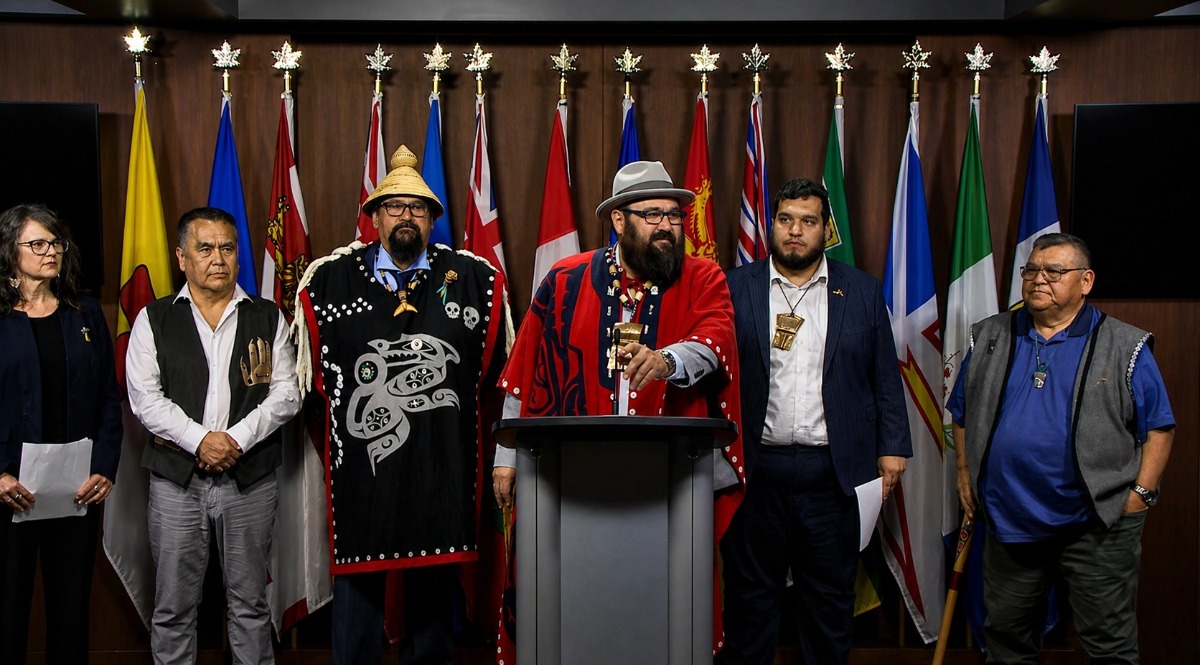
Coastal Indigenous leaders are pressing Prime Minister Mark Carney to reverse Ottawa’s 2029 ocean salmon farming ban on Canada’s West Coast and recognize a First Nations-led path for aquaculture, investment and food security.
By Fabian Dawson
SeaWestNews
Aquaculture in British Columbia should be licensed by the First Nations whose traditional waters sustain it, coastal Indigenous leaders said today as they urged Prime Minister Mark Carney to reverse Ottawa’s plan to ban ocean salmon farming on Canada’s West Coast.
The move would place Rights-holder Nations at the centre of aquaculture decisions in B.C., shifting the future of ocean salmon farming away from years of activist-driven federal policies and toward Indigenous-led licensing, science, stewardship and investment.
The call for salmon farming sovereignty was the sharpest pillar in a new First Nations-led plan unveiled by the Coalition of First Nations for Finfish Stewardship (FNFFS), which says the Trudeau-era 2029 ban threatens Indigenous economies, Canadian food security, youth employment and hundreds of millions of dollars in stalled investment.
The coalition said the ban was announced without a credible economic impact analysis of the coastal communities it would hit hardest, and despite science, technology and the lived experience of First Nations showing that ocean farms can operate responsibly alongside wild salmon.
“B.C. coastal First Nations believe in conservation and having a choice to responsibly develop sustainable aquaculture economies for our people and within our territories, and salmon aquaculture is the backbone,” said Dallas Smith of the Tlowitsis First Nation, who acts as a spokesperson for the Coalition.
“100% of salmon farms in B.C. operate with the permission of Rights-holder Nations. In the midst of an affordability crisis, and in a sector where two-thirds of the workforce is under 35, maintaining jobs that grow Canadian food for Canadian families should be a priority for the Government of Canada,” he said.
“We are salmon people. It is our responsibility to preserve and protect our wild salmon…We have been stewards of wild salmon for thousands of years and will continue for thousands more. We know that we can both farm salmon and protect wild salmon, because that’s what we have been doing every day for decades.”
Pressured by the anti-salmon farming lobby, the Trudeau Liberals announced the ban in 2024 despite decades of real-world data, extensive scientific review and findings from its own federal scientists that salmon farms pose no more than a minimal risk to wild fish stocks.
Currently in B.C., every salmon farm operates under a formal partnership with a First Nation, generating about $134 million a year in direct economic benefits for Indigenous communities and supporting more than 1,000 Indigenous workers across the coast.
The broader sector generates about $1.17 billion a year in economic activity and supports roughly 4,560 full-time jobs and hundreds of vendors across the province’s salmon farming supply chain.
B.C.’s salmon farmers and their First Nations partners say a stable, evidence-based federal and provincial policy framework would allow the sector to more than double its impact, generating up to $2.5 billion annually in economic activity, $930 million in GDP and 9,000 Canadian jobs.
Smith said Ottawa’s policy has already frozen about $500 million in new foreign direct investment in rural and remote coastal communities adding, “by reversing this ban, now the investment can be deployed not in five years, but in months.”
That timing is critical because the next six-year salmon grow-out cycle begins in June, forcing companies to make investment, stocking and employment decisions long before the 2029 deadline arrives.
Without immediate policy clarity, the aquaculture companies face two stark choices, proceed with production that could force them to cull millions of healthy fish or halt the cycle entirely, triggering immediate job losses across rural, remote, coastal and Indigenous communities.
Jennifer Woodland, chair of the B.C. Salmon Farmers Association (BCSFA) and director of corporate and government relations at Cermaq Canada, said decisions about whether or not to continue stocking these sites is happening right now.
“For every cycle of fish that does not end up on a dinner plate, jobs are lost. Salmon gets flown in from other countries, and First Nations miss out on significant revenue, revenue that they are using to invest back into critical infrastructure and the health of their communities.”
The call for First Nations aquaculture licensing authority made on Parliament Hill today, sits alongside four other pillars of the FNFFS plan aimed at putting science, stewardship and ownership under greater Indigenous leadership.
The plan calls for transforming the Centre for Aquatic Health Sciences in Campbell River into an Indigenous Centre for Aquatic Health Sciences, bringing together western science and Traditional Ecological Knowledge.
It also includes a First Nations-led Salmon Stewardship Fund, with salmon aquaculture companies making per-harvested-tonne contributions to support aquatic health science, monitoring and stewardship.

The remaining pillars focus on ownership, including a majority Indigenous equity investment in the largest seafood harvesting facility network in Western Canada and increased First Nations equity investment across B.C.’s coastal aquaculture industry and the supply-chain businesses that support it.
Deputy Chief Councillor Isaiah Robinson of the Kitasoo Xai’Xais Nation said the 2029 ban is already cutting into Klemtu, a remote central coast community accessible only by boat or plane.
“Kitasoo Xai’Xais Nation has a 40-year history with aquaculture in our traditional territory, and we have confidence in the science and modern technology behind it,” Robinson said.
“Living 800 km up the B.C. central coast, and accessible only by plane or boat, we are already feeling the social and economic effects of the 2029 net pen ban in job losses. Salmon aquaculture is 51% of our economy.”
“It just doesn’t make sense that the federal government wants us to accept the development related to tankers, pipelines and increased natural resource development, yet it continues to block new investments in the highly regulated salmon farming sector that feeds families and employs thousands in rural B.C.,” he said.
He turned Carney’s own Davos message back on Ottawa, citing the Prime Minister’s warning that a country that cannot feed itself, fuel itself or defend itself has few options.
“Coastal First Nations are part of Canada, and we will continue farming salmon in a way that protects ourselves, but also Canadians,” Robinson said.
Hereditary Chief Richard “Hasheukumiss” George of the Ahousaht First Nation placed the issue squarely in the frame of rights, title and economic fairness.
“We are the rights and title holders in our traditional territories,” George said, after an earlier press conference today by some Indigenous leaders, who are aligned with the anti-salmon farming lobby.
“These are the same organizations who have no formal or recognized rights and title and spend their time protesting responsible development,” he said.
George said the Carney government has called for Canadians to stand together and build Canada strong, and that coastal First Nations and their industry partners are part of that agenda.
“We are not asking to stand outside your economic agenda,” he said. “We’re asking to stand inside it alongside the government, partner to partner.”
In 2024, more than $700 million worth of farmed salmon was imported into Canada, he said, with much of the product coming from countries such as Norway, Chile and Scotland.
“The 2029 ban does not eliminate the global demand for salmon. It eliminates Canadian grown salmon,” George said.
“Reverse the ban. Walk with us. Elbows up. Local communities and First Nations together, we’re all here to stay…This, my friends, is ‘Reconcili-Action, moving forward together as one.”
Steven Rafferty, CEO of Cermaq, said First Nations leadership has been central to shaping responsible and sustainable aquaculture in B.C.
“Their stewardship, combined with our company values, demonstrates how economic opportunity, responsible production, and environmental responsibility can go hand in hand,” Rafferty said.
Ivan Vindheim, CEO of Mowi ASA, said Ottawa’s net-pen policy has damaged coastal communities, British Columbia and Canada, while directly affecting foreign investment.
“It has weakened food security and food sovereignty, forcing Canadians to rely on imported salmon instead of affordable Canadian-raised fish or go without,” Vindheim said.
“The time is now to create certainty for the First Nations involved in salmon farming and for the industry,” Vindheim said.
Main image from the press conference today – From left: Jennifer Woodland, chair of the B.C. Salmon Farmers Association,Chief Simon Tom, Tla-o-qui-aht First Nation, Hereditary Chief Richard “Hasheukumiss” George, Ahousaht First Nation, Dallas Smith, spokesperson for the Coalition of First Nations for Finfish Stewardship, Deputy Chief Councillor Isaiah Robinson, Kitasoo Xai’Xais Nation; and Chief Harvey Robinson, Kitasoo Xai’Xais Nation.