
A routine letter to Ottawa from international salmon-farming groups is being recast as a foreign-influence threat by activists whose fundraising pitch and public support are losing ground.
Commentary
By Fabian Dawson
SeaWestNews
As Canada’s spy agency warns that foreign states are trying to influence Ottawa, anti-salmon-farming activists in B.C. are trying to capitalize on those fears by turning a routine industry letter into a national security scare.
Hoping outrage will do what their discredited science and tired fundraising pitches could not, activist Stan Proboszcz has cast a letter from international salmon-farming associations to Prime Minister Mark Carney as if he had uncovered a spy ring.
In reality, the letter does what industry letters in Ottawa do every day. It makes the case that the Trudeau-era 2029 ocean salmon farming ban in British Columbia is scientifically weak, economically reckless and technically unrealistic.
It reinforces what federal science reviews, coastal First Nations and decades of real-world data have already made clear. Wild and farmed salmon can thrive in B.C. waters.
The signatories included representatives from the International Salmon Farmers Association, Norwegian Seafood Federation, Faroese Aquaculture Association, Fisheries Iceland, Irish Farmers’ Association, Salmon Chile, Salmon Scotland and Salmon Tasmania.
The letter warns that the current policy has frozen “hundreds of millions of dollars” in investment and that removing the ban would send a clear signal that global investors can trust Canada again.
For Proboszcz and his allies, this apparently amounts to a five-alarm national security event. Canadians must now be on high alert for aquaculture groups armed with stationery and a working knowledge of federal lobbying rules.
By that logic, Proboszcz and his foreign-funded allies have spent years mounting their own influence campaign, pushing Ottawa to kill a Canadian food-producing sector while pretending their lobbying is somehow cleaner because it comes wrapped in activist language.
Ottawa is a city built on advocacy. Ask any lobbyist and they will tell you these kinds of letters land on ministers’ desks every day. Industry groups write them. Unions write them. Environmental NGOs write them. Foreign governments, aid coalitions, trade associations and business councils write them.
They are not covert operations. They are policy arguments.
The only reason this one is being treated like a spy file is because it comes from salmon farmers and says things Proboszcz and his allies do not want Canadians to hear.
Pouncing on the manufactured outrage reported by The Tyee in breathless tones, activist Bob Chamberlin also joined the performance, warning that any retreat from the ban would betray First Nations and wild salmon.
What he left out is the part activists always leave out. Many coastal First Nations support salmon farming, want First Nations-led licensing, and are tired of being erased by people who claim to speak for reconciliation while ignoring the Nations that disagree with them.
Currently, all B.C. salmon farms operate in partnership with First Nations, supporting about 4,560 full-time jobs, more than $1.17 billion in annual economic activity and roughly $134 million in direct annual benefits to Indigenous communities.
Chamberlin constantly claims he has the support of a majority of First Nations for the planned 2029 ban, while ignoring a larger reality. Many of these same First Nations support forestry, mining, energy and infrastructure projects that can damage wild salmon habitat when poorly managed.
Somehow, he always finds the salmon farm when the activist fundraising pitch needs a villain, while the pipeline, the clearcut, the mine road and the urban runoff get a free pass.
Last month, the Coalition of First Nations for Finfish Stewardship (FNFFS) was in Ottawa to remind politicians of this inconvenient reality.
“BC coastal First Nations believe in conservation and having a choice to responsibly develop sustainable aquaculture economies for our people and within our territories, and salmon aquaculture is the backbone,” said Dallas Smith, Tlowitsis First Nation member and spokesperson for the FNFFS.
Isaiah Robinson of the Kitasoo Xai’xais Nation put it even more plainly, saying anti-salmon-farming campaigners “do not run salmon farming in our territories” and are “actively impeding” First Nations sovereignty.
The real interference in B.C.’s salmon farming debate is not a signed letter from seafood associations warning Ottawa about a reckless policy.
It is activists trying to override the rights, decisions and economic futures of coastal First Nations while claiming to defend them and dressing that campaign up as a spy plot.
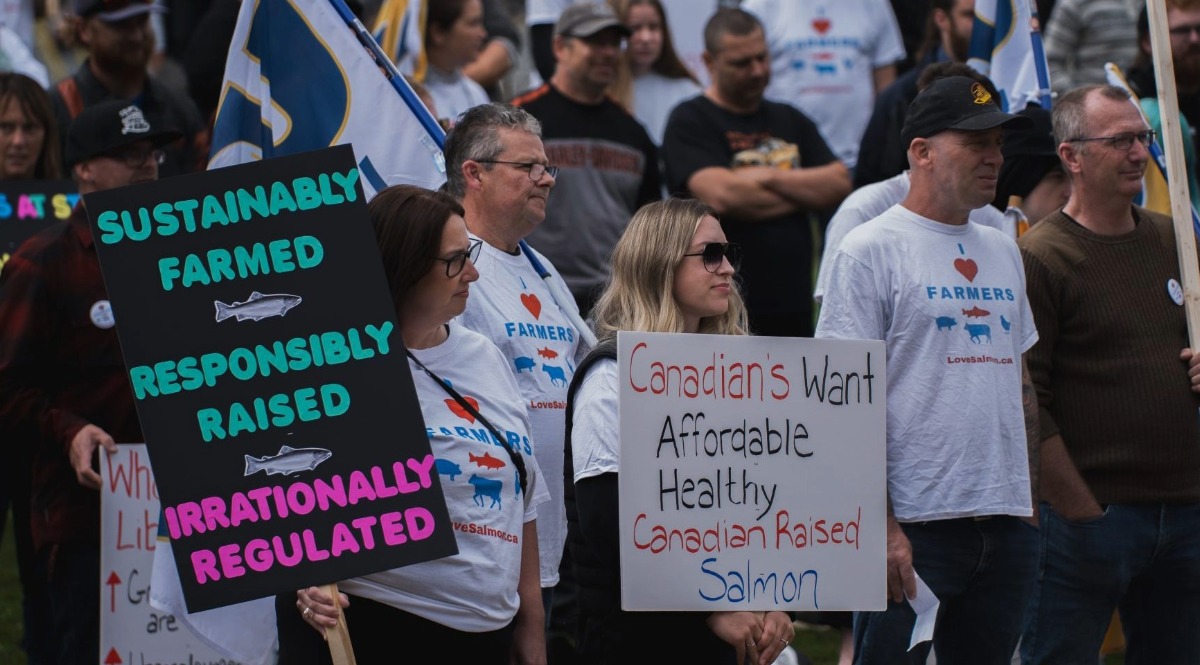
(Facebook File Image shows aquaculture workers, suppliers and members of the United Steelworkers Union at a rally against the proposed ban on ocean salmon farms in BC)