
Proposed levy would create a permanent source of money for wild salmon science in British Columbia, paid directly by salmon farming companies operating in First Nations territories.
By Fabian Dawson
SeaWestNews
Coastal First Nations in British Columbia fighting Ottawa’s 2029 salmon farming ban say they will require partner companies to pay into a permanent Indigenous-led science fund to support wild salmon research and conservation.
The Coalition of First Nations for Finfish Stewardship (FNFFS) says the levy would be collected from salmon farming companies and directed to the Indigenous Centre for Aquatic Health Sciences and Stewardship, known as ICAHS.
The centre is being developed from the Campbell River-based BC Centre for Aquatic Health Sciences, an ISO-accredited research laboratory that is now transitioning to Indigenous-led governance.
“The Coalition will require salmon farming companies to fund wild salmon research through ICAHS,” the coalition said in its newly launched Keep Food Affordable campaign.
The proposal places a new financing mechanism at the centre of the First Nations-led campaign to reverse Ottawa’s plan to shut down open-net salmon farms in British Columbia by June 30, 2029.
The federal ban was announced in 2024 by the Trudeau government after years of pressure from anti-salmon farming groups. It came despite federal science reviews repeatedly finding that salmon farms in B.C. pose no more than a minimal risk to wild fish stocks.
In B.C., every salmon farm now operates under a formal agreement with a First Nation, generating about $134 million a year in direct economic benefits for Indigenous communities and supporting more than 1,000 Indigenous workers across the coast.
The broader salmon farming sector generates about $1.17 billion a year in economic activity, supports roughly 4,560 full-time jobs and works with hundreds of vendors across the province’s supply chain.
The coalition says the proposed levy would create a permanent and predictable source of money for wild salmon science, paid directly by the companies harvesting farmed salmon in First Nations territories.
“With the lifting of the 2029 net-pen salmon farming ban, the Coalition will require partner companies to contribute funds towards wild salmon research and conservation through the Indigenous Centre for Aquatic Health Sciences,” the campaign states.
“The federal government’s 2029 salmon farming ban would kill this funding,” the coalition said adding, the levy would be tied to production.
“Every pound of farmed salmon harvested in BC would contribute directly to the science that monitors, protects, and restores wild salmon populations,” the campaign says. “As long as the farms operate, the funding flows.”
“That is science funded directly by the companies that harvest the fish, governed by the First Nations in whose waters those fish are raised,” the campaign says. “A permanent, built-in commitment to wild salmon conservation that grows alongside the industry itself.”

The proposed ICAHS levy would sit on top of the money salmon companies already channel each year through the BC Salmon Farmers Association into research, reporting and public outreach on wild and farmed salmon.
ICAHS is located in the territory of the Wei Wai Kum and We Wai Kai First Nations. It works with wild, enhanced, Indigenous and salmon farming communities in B.C. to provide research and diagnostic information on salmon health.
According to the coalition, the centre will bring together Western science and traditional ecological knowledge, train First Nations community members in scientific methods and provide laboratory analysis, environmental monitoring and research capacity that individual communities could not sustain on their own.
“The levy would strengthen and expand this work under Indigenous governance,” the campaign states.
The proposal is part of a broader First Nations plan that challenges Ottawa’s decision to phase out open-net salmon farming in B.C. waters by 2029. FNFFS argues the ban will remove jobs, weaken Indigenous economic partnerships, cut domestic food production and eliminate one of the few proposed long-term private funding streams for wild salmon research.
“No farmed salmon harvested means no levy collected,” the campaign says. “No levy means no industry-funded wild salmon research through ICAHS.”
The campaign also points to wider pressures facing wild Pacific salmon, including warming ocean temperatures, changing currents, habitat degradation, shifting predator-prey patterns and changing freshwater conditions.
The coalition says those problems require long-term research, consistent monitoring and scientific capacity in coastal communities.
“The ICAHS model offers something the current approach does not — a permanent, non-governmental funding source tied to a productive economic activity, governed by the people who have stewarded these waters for thousands of years,” the campaign says.
The levy proposal follows the coalition’s call for the Carney government to reverse the Trudeau-era ban and allow aquaculture to be licensed by the First Nations whose traditional waters sustain it.
The move, the coalition says, would place Rights-holder Nations at the centre of aquaculture decisions in B.C., shifting the future of ocean salmon farming away from years of activist-driven federal policy and toward Indigenous-led licensing, science, stewardship and investment.
FNFFS has also launched a petition campaign through its Keep Food Affordable website, warning that Ottawa’s ban would remove Canadian salmon from grocery shelves, weaken coastal First Nations economies and kill a levy designed to fund wild salmon research.
“The investment is on the table,” the campaign says. “The plan is ready. The only thing standing in the way is federal policy.”
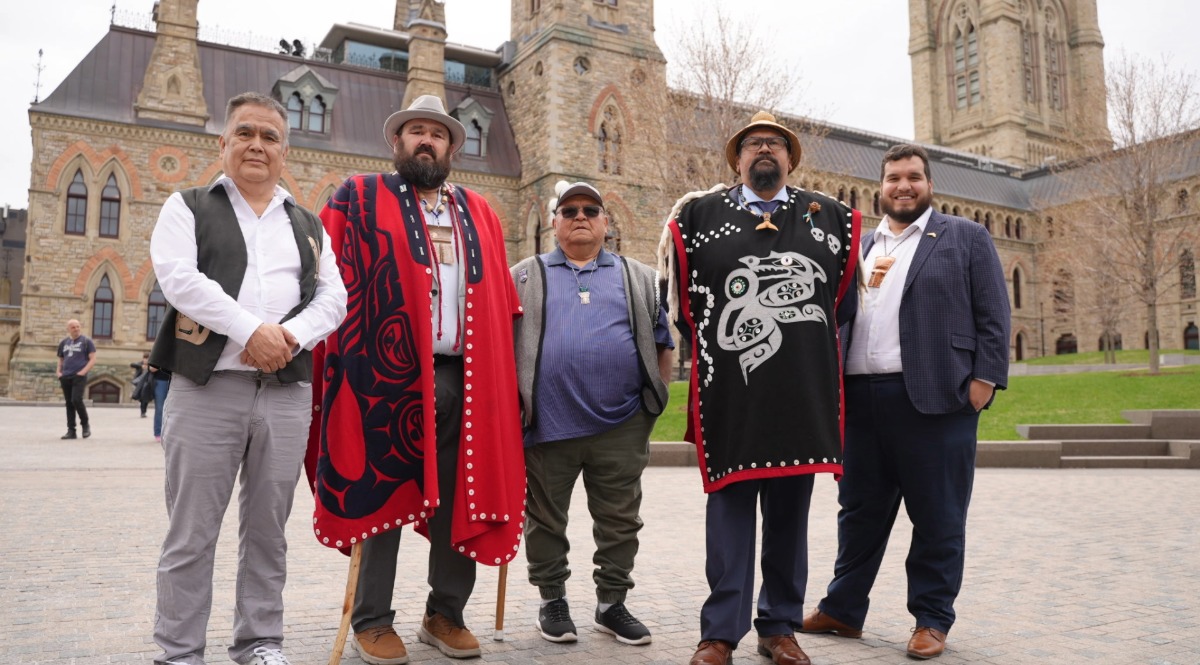
(Main submitted photo shows members of First Nations for Finfish Stewardship Coalition, in Ottawa)