
This letter, written in response to a request for a meeting with Prime Minister Mark Carney, turns the questions back on B.C.’s First Nations Leadership Council over science, reconciliation and the future of salmon farming.
Dear members of the First Nations Leadership Council,
Thank you for your June 17th letter urging Canada to respect First Nations, follow science and protect wild salmon.
We agree. We are just unclear about which First Nations voices you believe should count.
Every salmon farm now in British Columbia operates under an agreement with a rights-holder First Nation. The sector supports about 4,560 full-time jobs, including more than 1,000 Indigenous workers, and provides roughly $134 million a year in direct benefits to First Nations.
Several coastal Nations want salmon farming to continue in their territories. Some are calling for First Nations-led licensing, science and stewardship.
So, my question to you is does reconciliation include respecting those decisions, or only the decisions of Nations opposed to the industry?
Your letter also cites government science.
At least 10 federal scientific reviews have concluded that salmon farms pose no more than a minimal risk to wild salmon. The Cohen Commission asked DFO to demonstrate minimal risk. DFO did that.
Should the science be accepted, or should studies continue until they produce a more politically useful answer?
The Discovery Islands court ruling confirmed that a minister had the authority to refuse licences. They did not find that salmon farms harmed wild salmon or that removing farms would rebuild wild stocks.
That distinction matters, since your letter implies the court has settled the science on farm impacts and recovery, when the reasons deal with the minister’s right to act on perceived risk, not proof of harm or benefit.
The timing of your letter is also awkward.
Our government has just announced a $3-billion food security plan focused on producing more Canadian food, reducing imports and creating jobs in rural, coastal and Indigenous communities.
B.C. salmon farming already does that.
The sector generates more than $1.17 billion in annual economic activity. Yet production has fallen by more than 40 per cent since 2015, while Canadian salmon imports have climbed to nearly $700 million a year .
Apparently, for some groups, farming salmon in Norway, Chile or Scotland and shipping it to Canada is acceptable. Producing it here, under Canadian rules and agreements with First Nations, is the problem.
We would also welcome clarification on resource development.
First Nations across B.C. support or benefit from mines, pipelines, LNG projects, forestry and ports on their traditional territories.
Will the FNLC defend their right to make those choices while denying coastal Nations the same right to support salmon farming?
Should the precautionary principle apply equally to those projects, or has it developed a special interest in ocean salmon farms?
Your letter promotes closed containment as the alternative. Coincidentally, we have just received a presentation from an activist group, closely aligned with the same ideology, asking Ottawa for roughly $2 billion to make land‑based salmon farming work.
But there is still no evidence that this technology can replace existing ocean production at scale, or operate profitably, without taxpayers and coastal communities being left on the hook if it fails.
So, before our meeting, we would appreciate answers to four questions.
Do rights-holder First Nations have authority over sustainable projects in their own territories?
Does federal science matter when it conflicts with your political advocacy?
Should the same standards apply to salmon farms also apply to mines, pipelines, forestry and LNG in your traditional territories?
And how does eliminating 4,560 jobs and more than $1 billion in Canadian food production strengthen food security or reconciliation?
We look forward to a respectful discussion, preferably one where the conclusion is not decided before the science is read.
Sincerely,

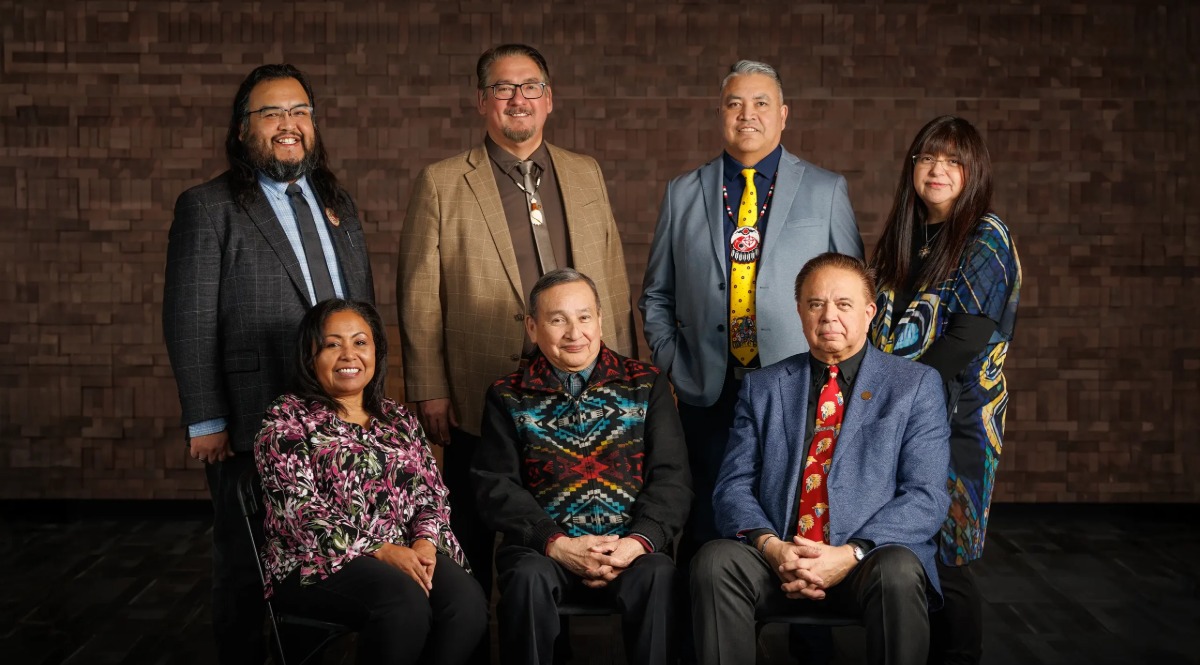
Main file image shows members of the First Nations Leadership Council