
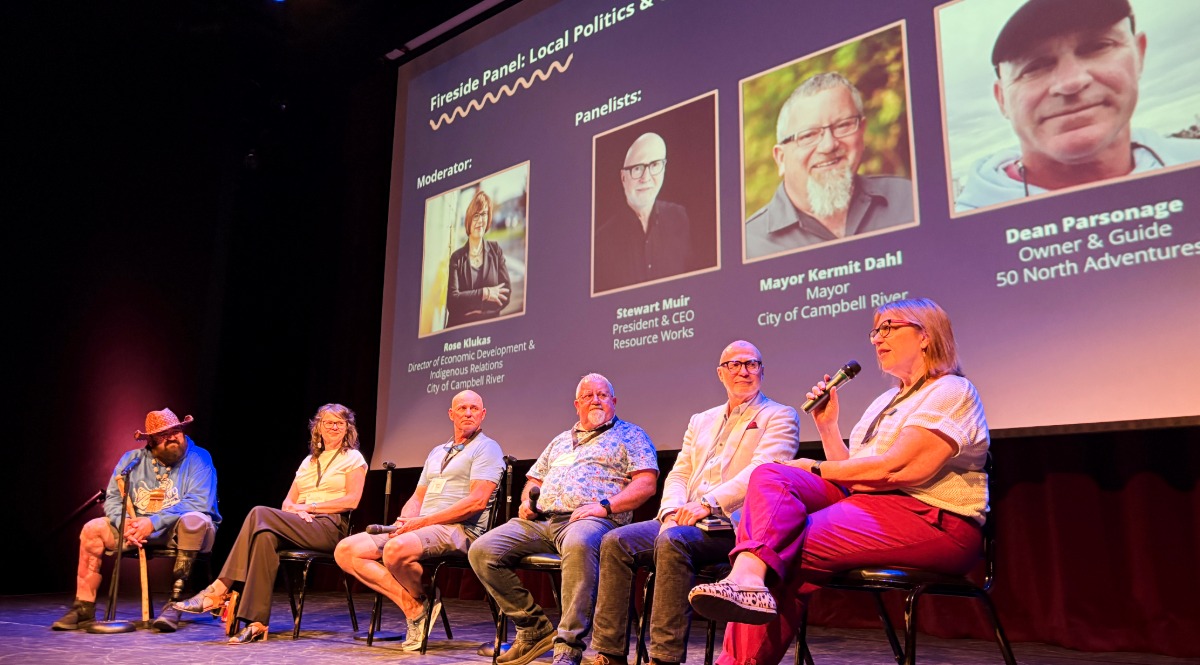
After years of uncertainty, B.C.’s salmon farmers used their AGM in Campbell River to show a growing coalition of support from First Nations leaders, politicians, agriculture advocates, tourism operators, resource communities and food-trust experts.
By Fabian Dawson
SeaWestNews
After years of uncertainty, B.C.’s salmon farmers say they are waiting with cautious optimism for an imminent federal decision that will shape the future of their industry, their coastal communities and Canada’s ability to produce more of its own food.
At the B.C. Salmon Farmers Association’s 42nd AGM in Campbell River this week, that cautious optimism was backed by a growing coalition of support from First Nations leaders, politicians, agriculture advocates, tourism operators, resource communities and food-trust experts.
The key message was that while B.C.’s salmon farmers are still waiting for Ottawa to decide their future, they are no longer standing alone.
Speaker after speaker framed salmon farming as much more than an aquaculture file. They described it as food security, coastal employment, Indigenous economic opportunity, a vital part of Canada’s resource economy and a test of whether Ottawa is prepared to back science, communities and domestic food security.
Salmon farming in British Columbia currently supports about 4,500 full-time jobs and generates more than $1.17 billion in annual economic activity. It supports scores suppliers, processors, water taxis, equipment companies, restaurants, tourism operators and families across coastal communities.
It also operates through formal agreements with First Nations whose territories host salmon farms, creating jobs, business opportunities and long-term revenue streams in places where few other year-round industries exist.
Those numbers, and the coastal benefits behind them, framed every speech at the AGM as the Carney administration weighs whether to continue or abandon an activist-driven Trudeau-era plan to ban ocean salmon farming in B.C. by 2029.
So was the fatigue of a sector that has spent years under a federal cloud while successive fisheries ministers have promised to listen, praised the importance of the industry, and then allowed ideology to drive policy ahead of science, coastal jobs and food security.
Dallas Smith, speaking on behalf of the Coalition of First Nations for Finfish Stewardship, captured both the frustration and the changing mood around a sector that government scientists have repeatedly found poses no more than a minimal risk to wild salmon stocks.
“Here we are again,” Smith said. “We’ve been talking to each other for more than five years now.”
But this year, Smith said, the conversation feels different because First Nations, salmon farmers and coastal communities have built stronger relationships and a clearer vision for the future.
“What has put us in a position of opportunity is the fact that we’re talking about those long-term goals and visions together, and we’re building them together.”
Smith said relationships between First Nations and the salmon farming sector have grown dramatically in recent years. That work, he said, has created the foundation for a new model that includes science, stewardship, licensing authority and equity positions for host Nations.
“The future is equity positions with First Nations communities that are going to continue to support local communities.”
He said activists and misinformation campaigns have distorted the debate for too long, while ignoring the lived reality of coastal communities.

“We’ve taken away the emotion of the aquaculture discussion and made it clear this is about ocean management,” Smith said. “This is about how we best manage the oceans for the conditions of society today and society tomorrow.”
That food-security message was echoed by Aaron Gunn, the Conservative MP for North Island-Powell River , who said salmon farming matters far beyond Vancouver Island.
Gunn said salmon farming should be seen as part of Canada’s national food-security system at a time when global instability, tariffs, trade restrictions and rising costs are forcing countries to think harder about what they can produce at home.
He said governments in Ottawa and Victoria cannot claim to support domestic production while imposing policies that make it harder for resource and food-producing sectors to operate.
“We need to get back to making decisions based on science, data and common sense,” Gunn said.
He called it a national embarrassment that Canada has the geography, climate and knowledge to be a world leader in salmon farming yet is importing farmed salmon from other countries instead of producing more of it at home.
The aquaculture sector also gained new national weight this week when the Canadian Agri-Food Trade Alliance welcomed the Canadian Aquaculture Industry Alliance (CAIA) as a Friend of CAFTA, adding Canada’s seafood farmers to an alliance of export-oriented agriculture and food organizations.
“The aquaculture sector is the future for growing healthier and more sustainable Canadian-raised seafood,” said Timothy Kennedy, president and CEO of CAIA. “At a time when trade policy and market access are increasingly important to Canada’s economic future, joining CAFTA ensures aquaculture has a seat at the table alongside the country’s leading export sectors.”
Dr. Anna Kindy, the Conservative MLA for North Island, said her support for salmon farming grew after she visited coastal communities and fish farms directly.
“I’m a science-based person with a physician background, and I was shocked at how highly regulated fish farms were,” Kindy said.
“Since then, I’ve been 100 per cent on board,” she said. “There’s a lot of misinformation out there.”
“B.C. can become one of the leading producers of a sustainable, safe, highly regulated fish-farming industry,” she said.
The agriculture sector brought the same argument from another direction.
Jennifer Woike and Danielle Synotte of the B.C. Agriculture Council (BCAC) told the AGM that aquaculture belongs inside Canada’s broader food system, not outside it.
“BCAC and our members believe that aquaculture is agriculture,” said Synotte.

She said aquaculture must be eligible for relevant federal agriculture programs because of its contribution to the economy and food security.
“The national policy framework should be grown to accommodate this industry, which is an important contributor to food security in Canada and around the world,” Synotte said.
The AGM also heard that the future of salmon farming will depend on public trust, not just policy.
Lisa Bishop of the Canadian Centre for Food Integrity said Canadians are thinking differently about food, science, regulation, misinformation and domestic production than they did only a few years ago.
“Most Canadians don’t wake up in the morning thinking about salmon farming,” Bishop said. “They think about feeding their families, healthy food, affordability, community and confidence in the systems they trust.”
That gives salmon farmers an opening, she said.
“The opportunity right now is to connect salmon farming to those values.”
Bishop warned that accurate information does not automatically rise above fear, misinformation or activist campaigns.
“You can’t out-fact fear,” she said.
“Salmon farming should not be positioned as a standalone issue,” Bishop said. “It should be positioned as part of a larger story about agriculture, food, health, communities, resilience and Canada’s future.”
That larger story was reinforced during a resource communities panel that linked salmon farming to forestry, tourism, mining, agriculture and the wider economy.
Stewart Muir, President and CEO of Resource Works, said the idea that the resource economy is only a rural issue is wrong.
“When there is growth in the resource economy and new jobs are created, 55 per cent of those new jobs occur in Metro Vancouver,” he said. “It really is an urban and rural connection.”
Jennifer Woodland, chair of the B.C. Salmon Farmers Association, said the industry’s advocacy has changed because salmon farmers are now working with other sectors facing similar pressures.
“There has been a recognition and an awakening as a country that we do need our resource communities, that we do need our food sector, and that we need to be more secure in our food,” Woodland said.

Campbell River Mayor Kermit Dahl said local governments must speak up because they live with the fallout when resource industries are weakened.
“If all the resource communities and all of our municipal governments start to speak as one, then all those folks in Victoria and Ottawa have to pay attention,” said Dahl, who convened the Alliance of Resource Communities (ARC last year.
Dean Parsonage of 50 North Adventures said tourism feels the pressure when resource industries are weakened. Workers have less money for holidays, local spending falls, and small businesses that depend on a strong coastal economy are left trying to make up the difference, he said.
The AGM closed on a note that brought the sector’s wider message back to the next generation with the presentation of the Young Salmon Farmers Award.
This year’s recipients were Amanda Luxton, manager of the land-based Tsulton Broodstock Site of Mowi Canada West and Kirstyn Hallberg, a senior environmental specialist at Cermaq Canada.
“What made this year’s Young Salmon Farmers Award especially powerful is that the recipients are young mothers building careers in this sector while raising families in coastal communities,” said Woodland, who returned as chair of the B.C. Salmon Farmers Association.
“That says everything about what is at stake here. Salmon farming is creating futures for young people, for women, for families and for the communities that depend on this work.”
Main image shows a panel discussion at the 42nd AGM of the B.C. Salmon Farmers Association. (L to R) Dallas Smith of the Coalition of First Nations for Finfish Stewardship, Jennifer Woodland, chair of the B.C. Salmon Farmers Association, Dean Parsonage of 50 North Adventures, Campbell River Mayor Kermit Dahl, Stewart Muir, President and CEO of Resource Works and moderator Rose Klukas, Campbell River’s Director of Economic Development and Indigenous Relations.