
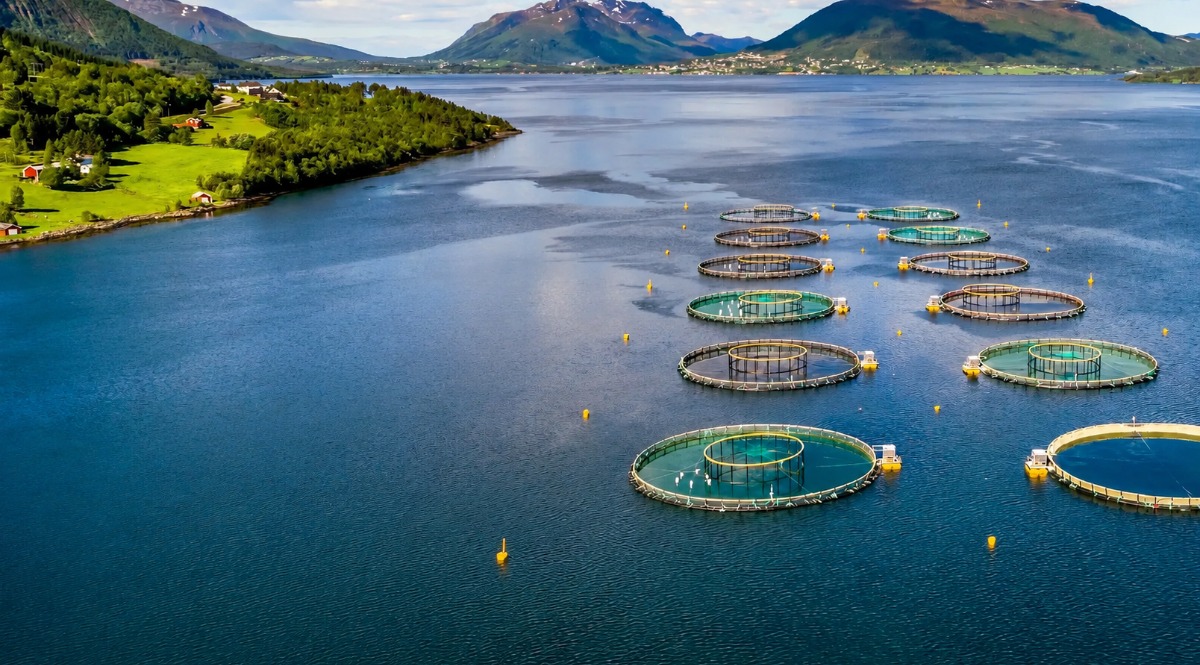
New government-backed monitoring in the world’s largest Atlantic salmon farming nation found very low pathogen levels in migrating post-smolts, adding to a growing body of science that challenges activist claims against ocean aquaculture.
By Fabian Dawson
SeaWestNews
A new Norwegian government-backed study has found very low levels of pathogen infections in wild Atlantic salmon migrating through major aquaculture regions, adding fresh international evidence against claims that salmon farms are driving disease impacts in wild fish.
The 2025 annual health monitoring report by Norway’s Institute of Marine Research examined wild Atlantic salmon post-smolts caught in four aquaculture production areas, including Hardangerfjorden, one of the country’s most intensive fish farming regions.
Researchers tested 200 wild post-smolts for three pathogens associated with salmon farming: infectious piscine orthoreovirus 1, known as PRV1; piscine myocarditis virus, known as PMCV; and Renibacterium salmoninarum, the agent that causes bacterial kidney disease, or BKD.
PRV1 was not detected in any of the tested wild fish. The BKD agent was also not detected in any of the fish tested for it. Only two post-smolts, showed low concentrations of PMCV.
“The results in this report showed that post smolt from the studied fjords had very low occurrence of pathogen infections that occur in Norwegian aquaculture,” the report states.
The Norwegian report challenges the central claim used by anti-salmon farming activist groups in Canada and around the world that areas with salmon farms show clear signs of pathogen pressure in wild fish moving through those waters.
The study also looked directly at farming intensity. In 2025, the four production areas studied produced a combined 601,557 tonnes of farmed fish, more than 11 times British Columbia’s annual farmed salmon production.
“Our results indicate that the prevalence of pathogen infections in post-smolt collected from these production areas was not associated with high fish farming intensity,” the report states.
The new Norwegian report lands in that same scientific current that 10 assessments by the Canadian Science Advisory Secretariat (CSAS), which found B.C. salmon farms pose no more than minimal risk to wild salmon from key pathogens.
It also echoes independent research that examined decades of real world data which showed that the risk of disease transmission from farmed to wild salmon has been greatly exaggerated by activists.
Recent B.C. studies have also challenged the “no farms means no sea lice” claim by activist groups. In the Broughton Archipelago, sea lice levels on juvenile wild salmon remained unchanged or increased after farm production dropped by more than 95 per cent. In the Discovery Islands, sea lice levels in 2024 were among the highest recorded even after farms had been removed from the area.
But despite the voluminous data, the Trudeau-administration bowed to the activist lobby and announced in 2024 a policy to ban ocean salmon farming in British Columbia by 2029.
If implemented, the policy’s consequences will kill B.C.’s salmon farming sector that supports about 4,560 full-time jobs, including more than 1,000 held by Indigenous workers, contributes roughly $1.17 billion a year to the provincial economy, and operates entirely under agreements with Rights Holder First Nations.
In a recent op ed, First Nations leaders urged the current Carney administration to reverse the Trudeau‑era plan to phase out net‑pen salmon farming and instead enshrine salmon aquaculture as a cornerstone of Canada’s new Food Security Strategy.
“The choice before the federal government is clear. It can maintain a policy that risks shrinking Canada’s domestic food supply, suppressing Indigenous-led economic development and increasing dependence on imported seafood,” they wrote.
“Or it can provide the certainty needed for responsible salmon aquaculture to continue producing healthy Canadian food, supporting Indigenous communities and attracting new investment.”
B.C. salmon farmers and their First Nations partners say that with regulatory certainty, the sector could generate $2.5 billion in economic output and support 9,000 jobs by 2030.
The federal government is expected to make a decision soon on the future of salmon farming in British Columbia.
(Main image courtesy of Mowi shows a fish farm in Norway)