
The BC Centre for Aquatic Health Sciences is transitioning into an Indigenous-led aquatic science and stewardship research hub to braid First Nations knowledge with marine research in decisions affecting British Columbia’s coastal waters.
By Fabian Dawson
SeaWestNews
At 21, Rilee Henderson is getting a front-row seat to a new model of coastal stewardship in British Columbia, one that brings First Nations knowledge and cutting-edge marine research into decisions affecting the traditional territories of Indigenous communities.
The Wei Wai Kum First Nation member has just started as an intern at the BC Centre for Aquatic Health Sciences (BC CAHS) in Campbell River, where his work focuses on the impact of sea lice on juvenile salmon.
“It’s exciting to be learning this work in the lab and seeing how it connects back to our waters and our communities,” Henderson said.
“It opens up a pathway to connect what young people like me are learning in schools and colleges with the oral histories, ecological knowledge and stewardship values passed down by our elders.”
For Elan Downey, the marine specialist who oversees Henderson’s internship, his work is more than a training opportunity. It is part of a larger effort to build trust and transparency between scientists and the First Nations communities whose waters are being studied.
“We are learning from First Nations and they are learning from us,” said Downey, who has been with BC CAHS for nearly two decades and now helps connect the lab’s marine research with the on-the-water knowledge of First Nation guardian programs.
This shared approach is central to the next chapter for BC CAHS, which is transitioning into the Indigenous Centre for Aquatic Health Sciences & Stewardship, or iCAHS.
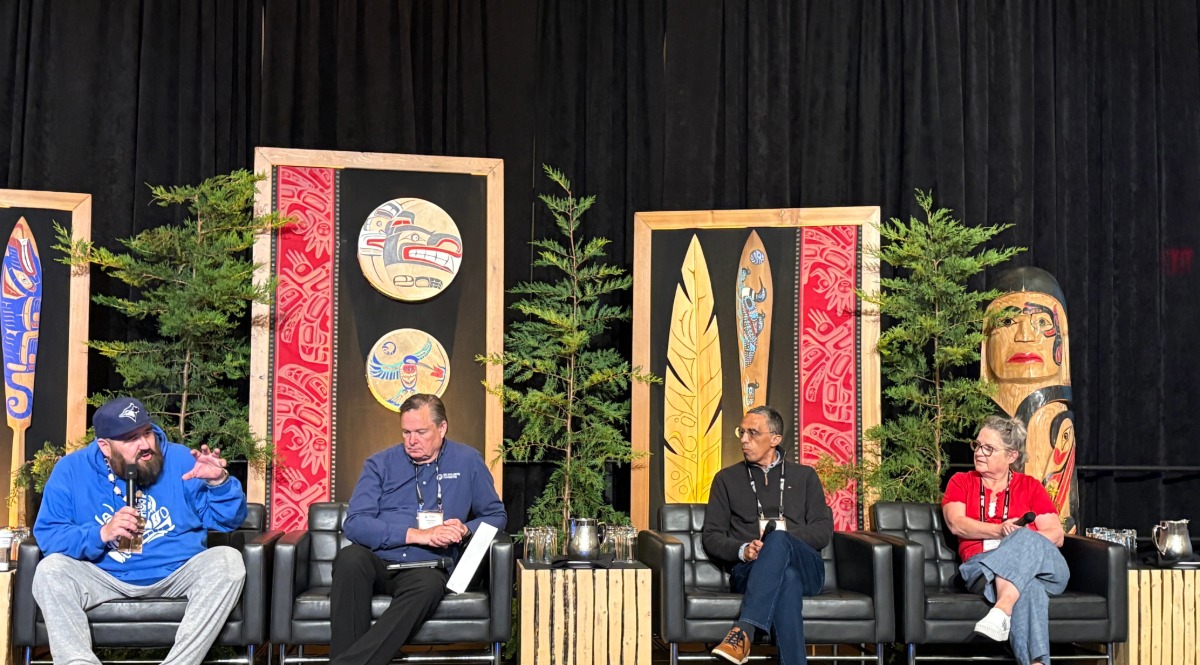
The transition was outlined during a panel discussion at the recent Indigenous Resource Opportunities Conference in Nanaimo, where First Nation leaders, scientists and aquaculture representatives said coastal Nations need their own trusted science capacity to guide decisions in their territories.
Dallas Smith, president of Nanwakolas Council, told the session that First Nations must be able to understand the science behind decisions affecting their lands, waters, economies and future generations.
“We really need to understand data and information and science, and not just to defend a decision or a project or a goal, but to understand how we’re going to manage our territories in accordance with the customs and traditions that have sustained our people for over 10,000 years,” Smith said.
That need became especially clear around salmon aquaculture in British Columbia, where science has often been used selectively by governments, activists and outside groups to undermine a sector that supports First Nations jobs, revenue, stewardship authority and economic self-determination.
“When we started this, it was because of the challenges we were having on aquaculture,” Smith said. “Aquaculture science was being so subjectively used by everybody to achieve their means that those of us who are dependent on the resource and the sector were getting left behind.”
The answer, he said, is for Indigenous communities to have the capacity to follow the science from start to finish, ask their own questions, understand the methods and apply the findings in their own territories.
“We have to do our own science,” Smith said. “We have to have accepted scientific protocol in place, but we have to see it from the start to the finish.”
BC CAHS has operated for about two decades as a not-for-profit aquatic health lab in Campbell River. Its work includes aquatic animal health, pathogen testing, water quality, food safety, conservation research and support services for coastal communities and industries.
The transition to iCAHS is designed to place that technical capacity within a stronger Indigenous governance and stewardship framework.
Linda Sams, a director with the centre, said the organization has “consciously chosen to move along a path of being Indigenous governed,” with more than half its board members representing First Nations or serving as First Nation leaders.

“One of our focuses is pursuing scientific excellence and innovation through the incorporation of Indigenous knowledges,” Sams said, adding western science is often still catching up to what Indigenous peoples have known for generations.
The iCAHS model is being designed to braid those knowledge systems in a way that respects each Nation’s authority, values and protocols.
Sams said that work has to be done carefully and case by case, because each Nation will have its own needs, knowledge holders and rules for how information is shared.
Dr. Ahmed Siah, managing director of the BC CAHS, said the lab’s credibility is grounded in independent research, international standards and open access to findings.
“The Center for Aquatic Health Sciences is an independent facility for research and science,” he said, adding that the ISO-certified centre publishes its research so it is available for public review and discussion.
Brian Kingzett, executive director of the BC Salmon Farmers Association, told the Nanaimo session that the salmon farming sector already submits large amounts of data to federal regulators, but much of it remains difficult for First Nations and the public to use.
“Our farms submit reams of data to the federal government… but it’s never summarized and not available,” Kingzett said.
After being challenged by Indigenous leaders, the association worked with the centre to assemble more than 600 references and data sets from government, academia, non-government organizations and industry.
Kingzett said the exercise showed why an independent science body with Indigenous governance is needed on the coast.
“The salmon farming sector is a case study in this, but this applies to all the resource sectors that we’re dealing with here on the coast,” he said.
While aquaculture helped drive the conversation, iCAHS is expected to have a much broader role.
Panelists said its work could support research on bear viewing, environmental DNA sampling in protected areas, water quality, conservation outcomes, aquatic health, food safety and other issues affecting coastal ecosystems.
The common thread is data sovereignty and decision-making.
Smith said too many outside groups have treated Indigenous territories as places to collect information without ensuring that Nations have full access to the data or a clear role in how it is interpreted and used.
“For far too often, people, whether it’s industry or the conservation sector, just want to come in and do data in our territory,” he said. “They just want to come in and get what they want to know.”
That has to change, he said.
“When people are gathering data in our territories, we must have access to it, so that we can understand right from the start to the finish how that data is going to be used,” Smith said.
Main image shows (L to R) Dallas Smith, president of Nanwakolas Council, Brian Kingzett, executive director of the BC Salmon Farmers Association, Dr. Ahmed Siah, managing director of the BC CAHS and Linda Sams, a director with the BC CAHS.