
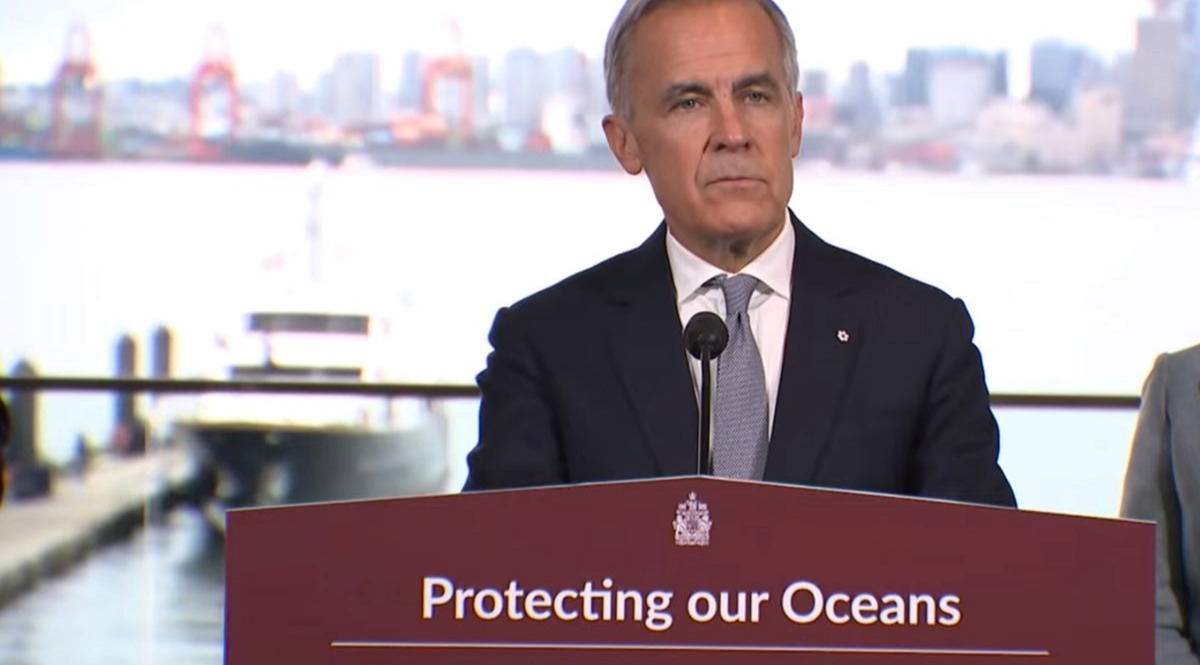
Prime Minister Mark Carney lays out a new “protect while we build” ocean-economy strategy as salmon farmers and their First Nations partners await a decision on the future of marine aquaculture in British Columbia.
By Fabian Dawson
SeaWestNews
Prime Minister Mark Carney has announced $1.2 billion in new ocean protection spending as his government prepares for increased shipping, energy development and port expansion on Canada’s West Coast.
Speaking on Vancouver’s waterfront Monday, Carney set out a policy of managing environmental risks while allowing major economic projects to proceed, arguing that stronger ocean protections will be needed as Canada expands ports, increases trade and considers new energy infrastructure.
The package includes more than $740 million over four years for ocean conservation and marine safety, another $136 million for marine-life protection, and $186 million to expand Indigenous partnerships and conservation work on B.C.’s coast.
The announcement forms the first part of a broader national ocean strategy built around protecting the oceans, securing Canadian waters and building the ocean economy. Ottawa said details of the final two pillars will be released in the coming months.
Carney repeatedly linked environmental protection with economic development, saying Canada intends to expand infrastructure and trade while placing stricter conditions on activities that affect marine ecosystems.
“We can and will do both,” Carney said. “We will build major infrastructure, diversify our trade, and create hundreds of thousands of jobs — safely, responsibly, and in ways that protect our oceans for generations to come.”
The federal government is planning billions of dollars in West Coast infrastructure investment, including expansion at the Port of Vancouver and Prince Rupert, while assessing other major projects that could significantly increase vessel traffic.
Carney said that growth will bring additional environmental pressure.
“We must further strengthen our conservation efforts through fast, effective response plans, and by changing how we build, how we travel, and how we operate on the water to minimize impact,” he said.
Among the measures announced are expanded Coast Guard marine-traffic monitoring, stronger search-and-rescue capacity, extended radio and radar coverage, a national nearshore ocean forecasting system and a new environmental recovery framework for marine pollution incidents.
Ottawa will also modernize Fisheries and Oceans Canada enforcement, giving conservation officers additional surveillance tools, drones, training and equipment.
The government said the measures are intended partly to prepare for major energy, LNG, port and resource developments, including a potential new bitumen pipeline, that are expected to increase marine shipping along the B.C. coast.
Carney described the government’s approach as “protect while we build.”
Rather than rejecting major development because of potential environmental effects, he said projects would face conditions intended to reduce those effects.
“Every project we advance must fully assess its potential impact on the environment and have a plan to mitigate it,” Carney said.
Carney said such requirements can add substantially to project costs but argued they allow economic development and environmental protection to proceed together.
The government is also committing additional funding to underwater-noise monitoring and mitigation as vessel traffic grows. Measures include encouraging quieter propellers, electric and hybrid motors and hull modifications.
Ottawa has set a goal of holding ocean noise around Vancouver at approximately 2023 levels even as shipping increases.
The announcement also expands Indigenous involvement in marine governance. Ottawa will provide $186 million for the Northern Shelf Bioregion Reconciliation Framework Agreement covering the region from northern Vancouver Island to the Alaska border.
Carney said the five-year agreement with British Columbia and 18 First Nations will strengthen collaborative governance, conservation and emergency preparedness. The government is also funding Indigenous-led stewardship and restoration in the Lower Fraser River estuary.
Missing from both the speech and the main announcement, however, was any reference to salmon farming, even as one of the biggest unresolved ocean-related economic decisions in British Columbia remains before the federal government.
The previous federal government, under sustained pressure from anti-fish-farming activists, had decreed that conventional ocean salmon farming in B.C. coastal waters will be prohibited after June 30, 2029, despite its own science assessments that found the sector posed no more than a minimal risk to wild salmon.
The salmon farming sector is now awaiting a decision from the Carney government on whether that policy will remain unchanged or be revised.
Aquaculture industry observers told SeaWestNews that Carney’s broader approach to marine development could provide a framework for reconsidering the planned 2029 ban on salmon farming in B.C.
“For a new bitumen pipeline and more tankers, the government isn’t saying no. It’s setting conditions, monitoring and mitigation,” the statement said. “We think that’s the right approach, and we’re asking for the same treatment.”
The sector maintains ocean salmon farms could continue operating under tougher requirements covering sea-lice management, siting, monitoring and new containment technologies instead of being prohibited outright.
Industry-commissioned economic analysis estimates B.C. salmon farming supports about $1.17 billion in annual economic activity and roughly 4,560 full-time jobs, many in coastal and Indigenous communities.
It projects that with regulatory certainty and continued investment, the sector could grow to $2.5 billion in annual economic output, $930 million in GDP and about 9,000 jobs by 2030, rising to $4.2 billion in annual output and more than 16,000 jobs by 2040.
(Main image shows Prime Minister Mark Carney announcing Canada’s new “protect while we build” ocean-economy strategy)