
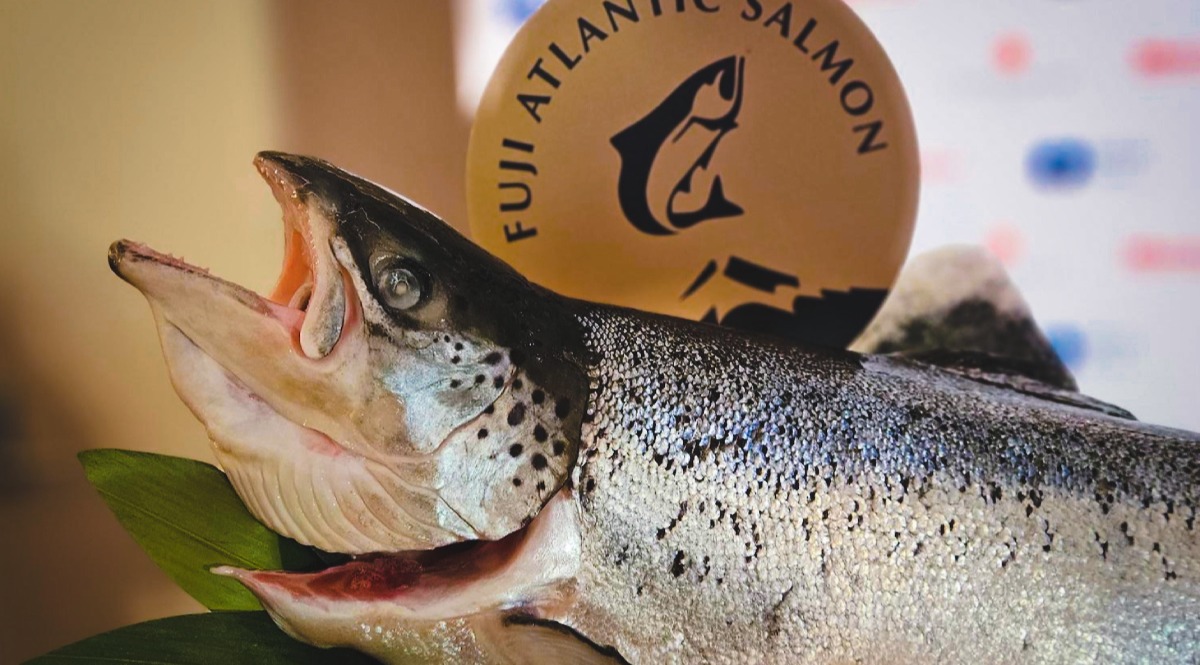
Anti-salmon farming campaigner Tony Allard wants Canada to abandon B.C.’s ocean salmon farms in favour of fish grown in tanks on land. Now, the Japanese operation he holds up as proof of that future is on the brink of financial collapse.
By Fabian Dawson
SeaWestNews
A land-based salmon farming operation in Japan, championed by Canadian activists as a model to replace ocean aquaculture in British Columbia is fighting for survival after warning investors it could run out of money.
Norwegian-owned Proximar Seafood, which operates a high-tech Atlantic salmon facility near Mount Fuji, has failed to secure emergency financing despite months of negotiations with lenders and shareholders.
The company warned on October 27 that its available cash would be exhausted by the end of the month. In a further announcement on October 30, it confirmed that no funding agreement had been reached, leaving its financial future uncertain.
The financial crisis is particularly embarrassing for the anti-salmon farming lobby in British Columbia, where Proximar was recently held up as evidence that Atlantic salmon production could move out of the ocean and onto land.
In July, Tony Allard, chair of Wild Salmon Forever and Wild First, specifically promoted Proximar in an opinion article urging Prime Minister Mark Carney to proceed with the federal government’s plan to ban conventional ocean salmon farming in B.C. by 2029.
“Today in Japan, Proximar Seafood, sponsored by Grieg Kapital from Norway, is selling Atlantic salmon raised on land to Asian markets under a long-term offtake agreement with Marubeni,” Allard wrote in the July 13 article published by National Newswatch.
Less than four months later, the company he singled out as an example of success is struggling to pay its bills, seeking relief from creditors and warning that its survival depends on fresh financing.
Mindaugas Cekanavicius, an analyst with Norwegian investment firm Norne Securities, expressed serious doubts about whether lenders and investors could put together a rescue package for Proximar.
“It would take a small Christmas miracle,” he told industry publicationIntraFish.
Proximar’s financial troubles follow a string of setbacks involving land-based salmon farming ventures that are being promoted as alternatives to conventional ocean aquaculture.
Atlantic Sapphire, the Florida-based company that set out to revolutionize salmon production in the United States, has faced repeated operational problems, heavy financial losses and restructuring.

In British Columbia, Kuterra, an early land-based Atlantic salmon venture developed by the ‘Namgis First Nation, received $6 million in federal funding but failed to establish a commercially sustainable Atlantic salmon business. The operation struggled with production targets and financing before eventually moving away from Atlantic salmon.
Other companies, including Salmon Evolution, Gigante Salmon and Andfjord Salmon, have also encountered production or financial challenges, according to Cekanavicius.
These failures and setbacks have not prevented activists from promoting land-based salmon farming as the preferred replacement for B.C.’s ocean-based industry.
Allard has been particularly vocal in demanding that Carney preserve the Trudeau government’s 2029 deadline for removing conventional ocean salmon farms from the province. That policy is under review by the Carney government.
In his July commentary, he argued that fully closed land-based systems represented the direction in which the global industry was moving.
Allard’s proposals put the direct investment required for such a transition at between $1.8 billion and $2.2 billion in taxpayer dollars, with at least a decade needed to develop a stable industry at scale.
And that investment would have to be made while closing an existing industry that generates approximately $1.17 billion in annual economic activity, supports 4,560 full-time jobs and provides about $134 million in direct economic benefits to First Nations.
Two studies commissioned by the B.C. government have already raised concerns about the commercial feasibility and environmental footprint of replacing marine salmon production with land-based facilities, citing high capital costs, substantial energy requirements and infrastructure challenges.
The BC Salmon Farmers Association (BCSFA) has consistently argued that land-based and closed-containment technologies should be part of the sector’s future, but not as a government-mandated replacement for existing ocean farms. It wants innovation encouraged where it is technically and economically viable, while marine salmon farming continues to operate under strict regulation.
For activists who have repeatedly pointed to overseas projects as proof that Canada should abandon conventional marine aquaculture, Proximar has become another uncomfortable example of the distance between technological ambition and financial reality, said an industry official.
(Main file image from Proximar)