
A major UN report says aquaculture now supplies most seafood eaten worldwide, while Canadian production stagnates ahead of a federal decision on salmon farming in British Columbia.
By Fabian Dawson
SeaWestNews
Global aquaculture has reached record levels and is set to drive nearly all future seafood growth, while Canada remains mired in regulatory uncertainty, stalled production and discredited anti-fish-farming activism.
A new report from the United Nations Food and Agriculture Organization (FAO) said aquaculture produced 103 million tonnes of aquatic animals in 2024, passing the 100-million-tonne mark for the first time and accounting for 53 per cent of global production.
The findings are contained in the FAO’s new State of World Fisheries and Aquaculture 2026 report, which describes seafood farming as the main force behind the continued expansion of global aquatic food production.
“Global production of aquatic resources has continued to grow, driven primarily by aquaculture,” said Qu Dongyu, FAO Director-General.
It said that between 2000 and 2024, global aquaculture production of aquatic animals rose by more than 70 million tonnes, an increase of 215.5 per cent. Asia’s production climbed 220.6 per cent, while Latin America and the Caribbean expanded by 428.8 per cent and Africa by more than 500 per cent.
North America recorded growth of just 7.3 per cent over the same 24-year period, the weakest performance of any region in the world. Its aquaculture production increased from about 584,500 tonnes in 2000 to 627,300 tonnes in 2024, an average annual growth rate of only 0.3 per cent.
By comparison, aquaculture expanded at an average annual rate of 7.8 per cent in Africa, 7.2 per cent in Latin America and the Caribbean and five per cent in Asia.
The regional figures in the report include Canada and the United States, but they reflect a broader pattern seen in Canadian production data.
Canada produced 160,318 tonnes of farmed seafood in 2024, up from the previous year but still about 20 per cent below the national peak of 200,804 tonnes recorded in 2016.
The value of Canadian aquaculture production has also failed to regain earlier highs. Industry data show the value of farmed seafood produced in Canada reached $1.36 billion in 2024, down 21 per cent in real terms from its 2018 peak.
Canada’s reduced output has been accompanied by rising dependence on foreign salmon.
Salmon imports have more than doubled since 2015 and are now worth about $700 million annually, with growing volumes arriving from Chile and Norway. Northern America as a whole recorded a US$18-billion trade deficit in aquatic animal products in 2024, the largest regional deficit identified in the FAO report.
The UN agency expects the divide between expanding and stagnant producers to continue unless countries create conditions for investment and sustainable development.

Global aquaculture production of aquatic animals is projected to reach 119 million tonnes by 2034, an increase of about 16 million tonnes from 2024. Total fisheries and aquaculture production is forecast to reach 214 million tonnes, with farmed production accounting for almost all of the net growth.
The FAO said aquatic foods supplied at least 20 per cent of the animal protein consumed by more than 40 per cent of the world’s population in 2023. Global per-capita availability has risen above 21 kilograms a year, while 89 per cent of all aquatic animal production is now used as food.
Those trends have made aquaculture increasingly important to food security, trade and employment. Fisheries and aquaculture directly employed more than 65 million people in 2024 and supported the livelihoods of more than 600 million people worldwide.
The report calls for targeted investment, clear policy frameworks, improved technology and science-based regulation to expand aquaculture while managing environmental and social impacts.
That is the same prescription Canada’s seafood farmers are urging Ottawa to adopt under its new national food strategy.
In British Columbia, where all salmon farms operate under agreements with the First Nation, volumes of peer-reviewed scientific studies have shown that the marine operations have minimal impact on wild fish stocks.
Despite that evidence, the Trudeau government imposed a 2029 ban on open-net pen salmon farming in B.C., a decision designed to win votes from the anti-fish farming lobby rather than follow the science
Coastal Indigenous leaders are now urging the Carney-administration to abandon the planned ban in favour of a First Nations-led licensing and regulatory system that would allow ocean salmon farming to continue under stronger environmental safeguards.
The sector in B.C. generates more than $1.17 billion in annual economic activity and supports about 4,560 full-time jobs, including more than 1,000 held by Indigenous workers.
Industry projections show a stable science-based regulatory framework could lift economic output to $2.5 billion and support about 9,000 jobs by 2030.
“While other countries are actively growing their sectors, Canada has remained largely flat for the past two decades…Canada has everything it needs to be a global leader in aquaculture: resources, expertise and demand,” said Timothy Kennedy, President & CEO of Canadian Aquaculture Industry Alliance (CAIA)
“With the right policy support, we can get back to being a global leader,” he said.
“What we need now is a policy framework that enables growth. This is about growing Canada’s economy, growing our food system, and growing opportunity in coastal and rural communities.”
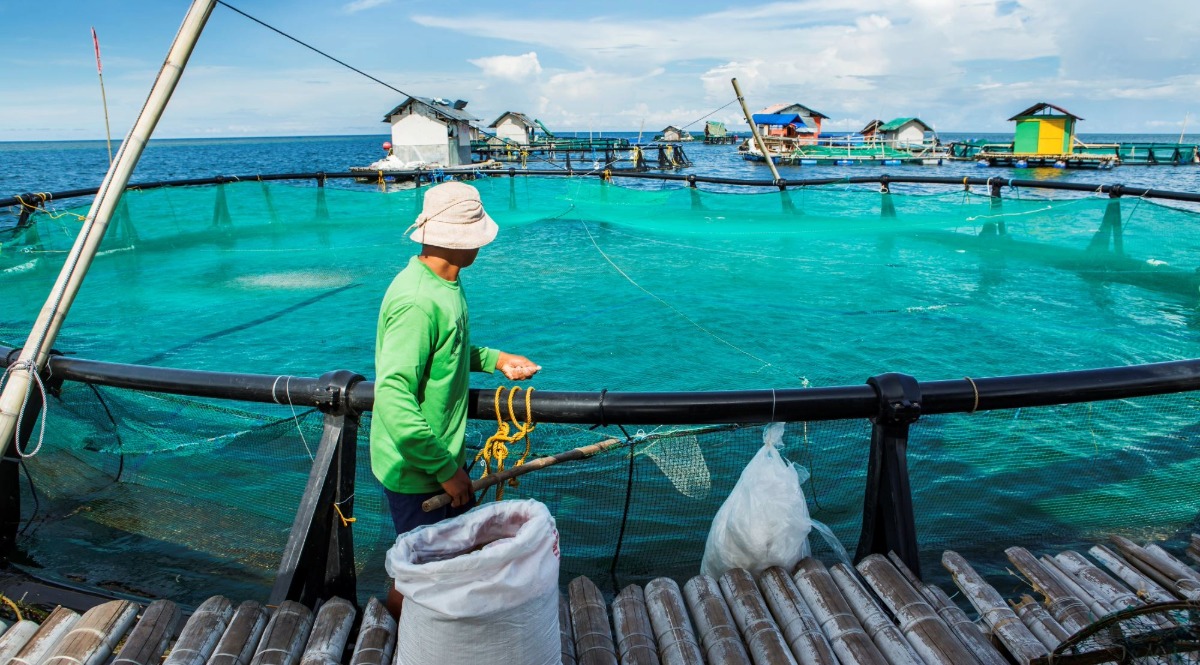
Main image shows a fish farmer at an ocean pen in the Philippines. ©FAO / David Hogsholt