
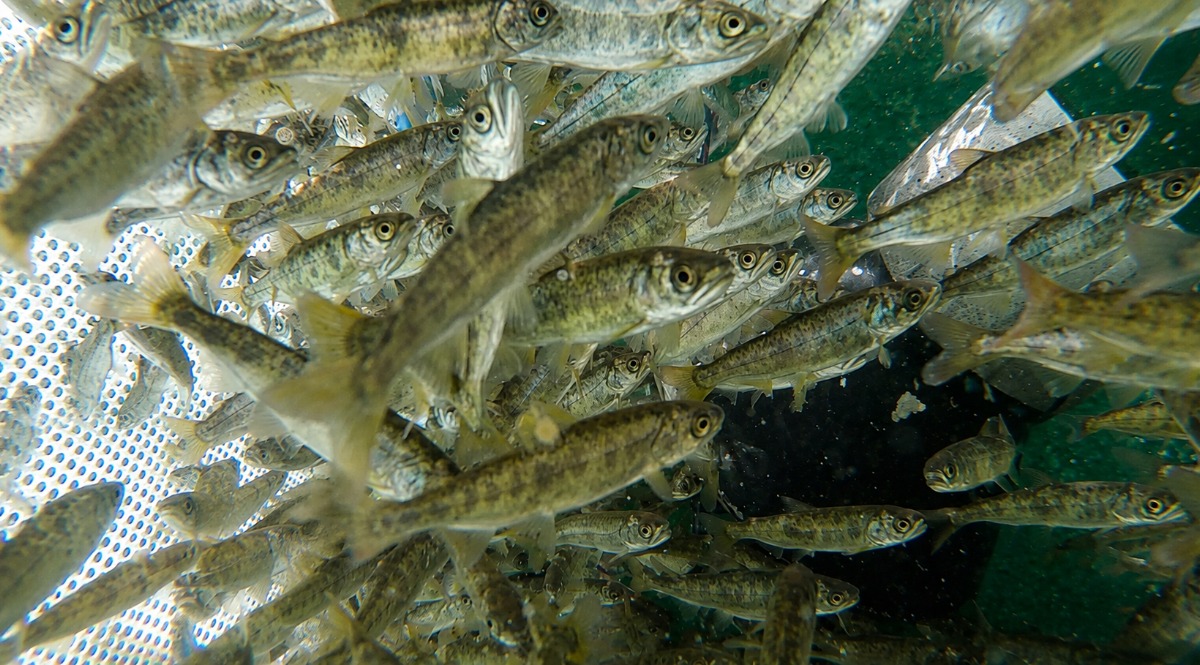
The federal government is investing millions in First Nations-led hatcheries to produce more salmon while pursuing a policy that would dismantle another Indigenous-backed form of salmon production on the B.C. coast.
By Fabian Dawson
SeaWestNews
The federal government has offered another revealing glimpse into what the word “wild” really means in British Columbia’s salmon debate.
Last week, Fisheries Minister Joanne Thompson announced more than $53 million to build three new First Nations-linked salmon hatcheries in British Columbia, with the facilities expected to produce close to one million juvenile Chinook and sockeye each year.
The funding includes;
- $38 million for the Upper Fraser River Salmon Conservation Hatchery in Prince George, to be built on the north bank of the Nechako River near its confluence with the Fraser River in partnership with the Lheidli T’enneh First Nation. The facility is planned to produce up to 400,000 juvenile Chinook salmon annually, with room for future expansion.
- $7.5 million for the Wilp’Ho Dix Hatchery on the Kitwanga River, a Skeena River tributary in northwestern B.C. Developed in collaboration with the Gitanyow First Nation, the facility will initially accommodate 300,000 juvenile sockeye annually and could eventually expand to 400,000, and
- $7.5 million for a Chinook hatchery near Hanceville, west of Williams Lake, on the Chilcotin River in the upper Fraser watershed. Operated by the Tŝilhqot’in National Government, it will initially have capacity to produce 250,000 Chinook fry each year.
Together with B.C.’s existing network of federal, First Nations and community enhancement facilities, the new hatcheries will add to a system that already releases more than 300 million juvenile salmon into the province’s rivers and coastal waters every year.
Like farmed salmon, hatchery fish begin life in a controlled production system. They are fed specially formulated commercial feed and raised under fish-health programs that can include vaccination and, when medically necessary, treatment for disease.
They are then deliberately released into B.C.’s rivers and coastal waters, where they face pathogens, predators and competition for food and habitat before returning years later to commercial, recreational and Indigenous fisheries.
Today some major B.C. salmon runs and fisheries are already heavily dependent on hatchery production, with hatchery-origin fish making up around 85 per cent of Chinook production in at least one major region.
In many cases, without some form of marking, most people would never know the difference. Ottawa is now expanding the mass marking of hatchery-origin salmon so returning hatchery fish can be distinguished from naturally produced salmon.
DFO’s own Wild Salmon Policy is clear about what constitutes a wild salmon.
Salmon are considered ‘wild’ if they have spent their entire life cycle in the wild and originate from parents that were also produced by natural spawning and continuously lived in the wild.
By that definition, a hatchery salmon is not a wild salmon.
It may spend years feeding in the Pacific. It may return up a B.C. river alongside naturally spawned fish. It may ultimately be caught by a commercial fisher and sold as ocean-caught wild salmon.
But its life began in a human-controlled production system, similar to farmed salmon.
Ottawa says the three new hatchery projects will rebuild salmon populations, support Indigenous communities and strengthen food security.
Those aims are remarkably similar to the case coastal First Nations have made for maintaining salmon farming in their territories.
Salmon farms operating on the B.C. coast are highly regulated food-production facilities. The fish are raised under controlled husbandry systems, fed formulated diets, vaccinated where appropriate, monitored for disease and managed throughout their production cycle.
The key difference is that farmed salmon remain contained until harvest.
Yet the political treatment of the two systems could hardly be more different.
Hatchery production is described as enhancement.
Salmon farming is routinely described by opponents as a threat to wild salmon.
Hatcheries receive public investment. Ocean salmon farms in B.C. face a federal 2029 shutdown deadline.
And First Nations participation is celebrated when Indigenous communities operate hatcheries, while the choices of coastal Nations that support salmon farming have received far less weight in the political debate.
Ottawa’s current policy would end conventional ocean salmon farming in B.C. by June 30, 2029, a deadline inherited from the Trudeau government.
The activist-driven policy threatens an industry that operates under agreements with the First Nations in whose territories the farms are located and supports thousands of jobs and more than $1 billion in annual economic activity.
The current policy also sits uneasily beside years of federal scientific assessments and decades of data, which have shown that the ocean salmon farms pose a minimal risk to the marine environment under existing practices.
Meanwhile, hatchery production is not without environmental trade-offs of its own.

Scientists have long studied the potential for hatchery fish to compete with naturally produced salmon for food and habitat, stray onto spawning grounds and alter the genetic composition of local populations.
Those concerns have led to better marking, genetic management and other safeguards.
They have not led governments to demand the elimination of hatcheries.
Instead, Ottawa manages the risks and keeps investing.
That is the standard coastal First Nations and salmon farmers have been asking the federal government to apply to salmon aquaculture.
The broader point is not that hatcheries and salmon farms are identical. They are not.
Their purposes, production systems and environmental interactions differ.
But both are human-managed salmon production systems designed to put more fish into the food system, support communities and meet public policy objectives.
And both involve choices about acceptable risk.
The debate therefore goes well beyond “wild versus farmed.”
It is increasingly about which form of human-managed salmon production Ottawa is prepared to support, which risks it is willing to manage and whose decisions about salmon production are allowed to stand.
For consumers, it comes down to a simple question: how “wild” is B.C.’s wild salmon if fish sold as “wild” or “ocean-caught” may have begun life in a hatchery, raised in a farming environment rather than through natural spawning?
Activists have spent years selling the public a neat story about wild salmon on one side and farmed salmon on the other.
Ottawa’s own hatcheries show the real story is nowhere near that simple.
(Main image shows fish at a DFO hatchery)