
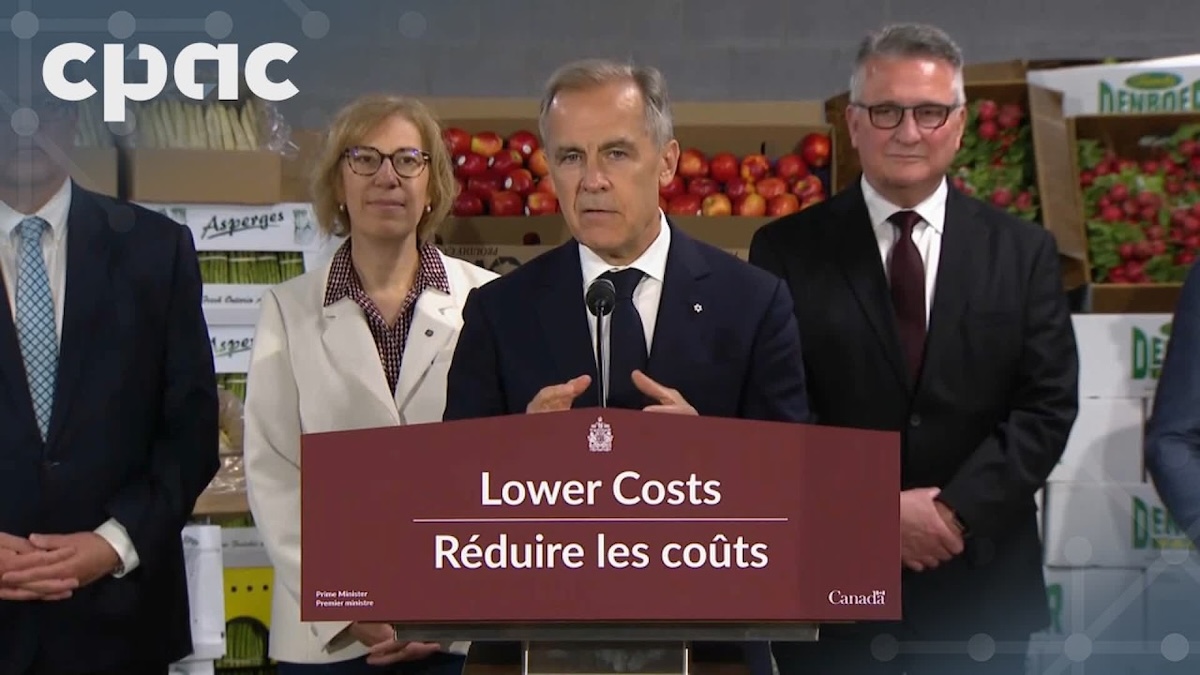
Prime Minister Mark Carney’s new food security agenda gives his government a chance to correct course on the future of salmon aquaculture in B.C. and protect a Canadian food sector already delivering what he says Canada needs.
Commentary
By Fabian Dawson
SeaWestNews
Prime Minister Mark Carney’s bold new $3-billion, 10-year plan to strengthen Canada’s food security is both promising and perplexing.
It is promising because Canada urgently needs more domestic food production, shorter supply chains, lower grocery costs, stronger processing capacity and less reliance on foreign suppliers as trade shocks, global conflicts and climate change reshape the world economy.
It is perplexing because his government is still sitting on a Trudeau-era plan to ban ocean salmon farming in British Columbia, a Canadian food sector already producing fresh, high-quality protein at scale, backed by federal science showing minimal risk to the marine environment.
The disconnect becomes clear when Carney’s new National Food Security Strategy is measured against what B.C. salmon farmers are already delivering.
• Carney is promising more Canadian food production.
B.C. salmon farmers are already producing fresh Canadian protein in Canadian waters, year-round, at commercial scale. Ocean-raised salmon generates more than $1.17 billion a year for the B.C. economy, supports about 4,560 full-time jobs, and remains one of the province’s most important agri-food exports.
• Carney is promising more Canadian food on Canadian plates.
Ottawa’s 2029 ban would remove a major source of Canadian-grown seafood from the domestic market. That means less B.C. salmon in Canadian grocery stores and restaurants, and more room for imported farmed salmon from Norway, Chile, Scotland and other competitors. Data from the Canadian Aquaculture Industry Alliance shows British Columbia’s farm-raised salmon output has fallen by more than 40 per cent since 2015, while Canada’s salmon imports have more than doubled over the same period, reaching roughly $700 million annually.
• Carney is promising stronger supply chains.
B.C. salmon farming already supports a working coastal supply chain that includes marine service firms, trucking companies, feed producers, fabricators, welders, electricians, shipyards, net makers, processors, logistics companies, technology developers and trades contractors. More than 70 supplier companies have warned that federal uncertainty is already causing declining production, stalled investment and layoffs across Vancouver Island.
• Carney is promising economic resilience.
The proposed federal phase-out has already helped drive a 45 per cent decline in B.C. salmon production over the past six years, leading to more than $437 million in annual lost vendor spending. That is the opposite of resilience. It is the slow dismantling of a food-producing sector that already exists.
• Carney is promising food sovereignty.
In B.C., 100 per cent of salmon farms operate with the permission of Rights-holder First Nations. The sector generates about $134 million a year in direct economic benefits for Indigenous communities and supports more than 1,000 Indigenous workers across the coast.
• Carney is promising opportunities for young workers.
Coastal First Nations leaders have pointed out that two-thirds of the salmon farming workforce is under 35. In remote communities where other industries have declined, these are not theoretical jobs. They are real paycheques, training pathways and careers that keep young people connected to their territories.

• Carney is promising stronger food infrastructure.
B.C. salmon farmers already support processing, cold storage, marine transportation, hatcheries, feed systems, veterinary services, monitoring programs and port activity. Replacing that with land-based tanks would require billions in new capital, years of construction and far more energy, while still failing to match existing ocean production at scale.
• Carney is promising to cut red tape.
B.C. salmon farmers are being held back by the largest piece of red tape of all, an activist-induced, politically imposed 2029 ban that has frozen investment, destabilized supplier contracts and left coastal communities unable to plan.
• Carney is promising science-based growth.
Decades of real-world scientific data, including at least 10 studies by government scientists, have concluded that marine net-pen salmon farms in B.C. have no more than minimal impact on wild salmon populations. The science has also found that removing ocean farms would have no measurable effect on wild Pacific salmon productivity.
• Carney is promising reconciliation through economic opportunity.
Coastal Indigenous leaders are asking Ottawa to reverse the ban and recognize a First Nations-led path for aquaculture licensing, science, stewardship and investment. Their plan puts Rights-holder Nations at the centre of decisions in their waters, instead of leaving those decisions to distant politicians and activist campaigns.
• Carney is promising growth.
B.C. salmon farmers and their First Nations partners say that with regulatory certainty, the sector could generate $2.5 billion in economic output and support 9,000 jobs by 2030. Ottawa’s current policy heads in the other direction, toward contraction, compensation claims, imports and lost coastal capacity.
The plan to ban ocean salmon farming in B.C. belongs to a different political moment. It was shaped by activist pressure, not by the full weight of the science, the economics or the wishes of many coastal First Nations whose territories are directly affected.
Carney’s new food security agenda gives this government a chance to correct course, follow the science and show the political will to stand with the coastal First Nations and communities already helping feed Canada.
Main image shows Prime Minister Carney announcing his new food security agenda.