
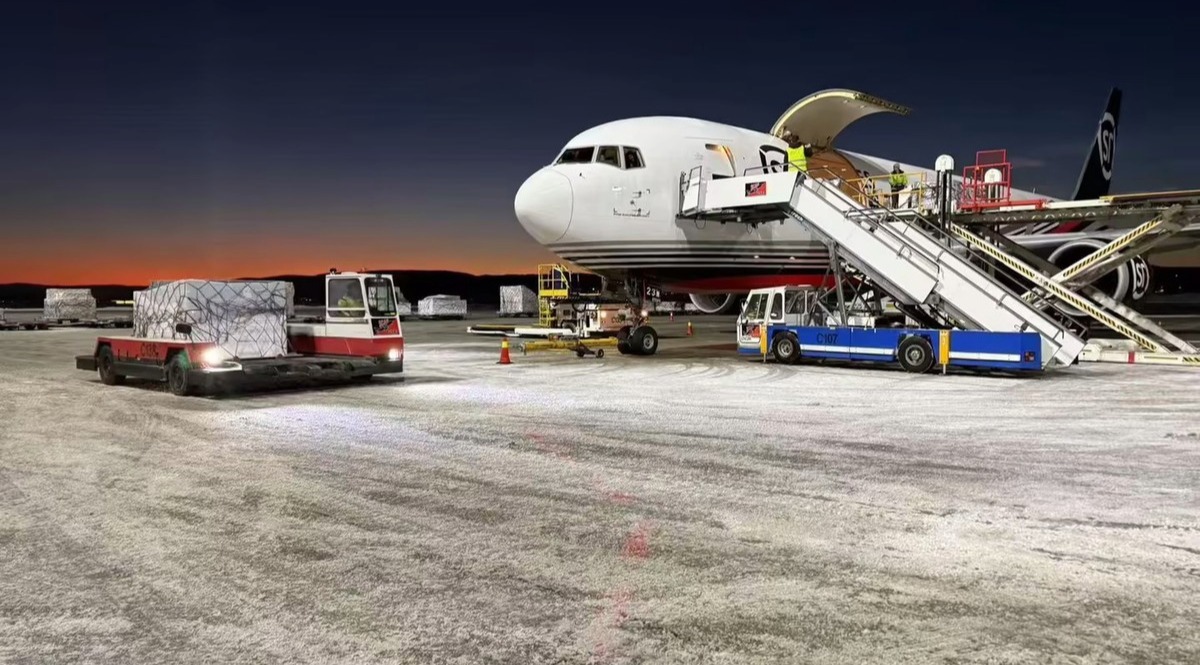
As Canada curtails salmon production at home and spends a record $1 billion on imports, shipments from China are surging despite the country having virtually no salmon industry of its own.
By Fabian Dawson
SeaWestNews
This month, a shipment of chilled Nordic salmon landed at Ezhou Huahu International Airport in central China, cleared customs, was trucked to a nearby processing plant, headed, deboned and packed, then flown to Vancouver, all within 36 hours.
Chinese authorities hailed the shipment as a first for Hubei province.
For Canada’s salmon farmers, particularly those in British Columbia, it tells a galling story of domestic production being curtailed while imported salmon travels halfway around the world to fill the gap.
The Carney government is still sitting on an activist-driven Trudeau-era plan to ban open-net salmon farming in B.C. by 2029, a move that would wipe out thousands of jobs and cripple a sustainable, homegrown food-production sector worth more than $1 billion a year.
At the same time, Canada spent more than $1 billion last year buying salmon from foreign suppliers, effectively replacing domestic production with fish shipped thousands of kilometres through increasingly complex global supply chains.
That includes $41.1 million worth of salmon from China, up 39 per cent from $29.5 million the year before, even though China has virtually no salmon fishery or farming industry of its own.
China has instead built a huge business processing other countries’ fish. Salmon comes in from abroad, is thawed, cut, packed or frozen again, then shipped back out to markets around the world.
Some of that fish comes from Alaska. Some comes from Norway, Iceland and Chile. A significant share also comes from Russia.
That is where the China salmon trade takes a darker turn, running straight into Canada’s sanctions policy.
Western countries, including Canada, imposed restrictions on Russian seafood after the invasion of Ukraine. Canada’s direct salmon imports from Russia have been exactly zero every year since 2022.
But Russia continues to pour salmon into Chinese processing plants just as Canadian imports of salmon from China are surging.
So, what is Ottawa doing to ensure Russian salmon processed in China is not being repackaged and sold into Canada through the back door?
A 2026 U.S. congressional investigation into China’s fishing industry found that most pink salmon processed there was Russian-caught.
Industry reporting has also documented Russian seafood being reprocessed in China and sold into the United States despite Washington’s own restrictions.
There is no evidence the Vancouver-bound shipment through China contained Russian salmon. Available information points to Iceland.
But the shipment shows exactly how the system works.
Fish can be caught or raised in one country, processed in China and then shipped onward to Canada.
As imports from China rise, the traceability gap becomes harder to ignore. So does the contradiction in Ottawa’s salmon policy.
Prime Minister Mark Carney has pledged to strengthen Canada’s food security and economic sovereignty.
Yet his government is contemplating another blow to domestic salmon production while Canada sends record amounts of money overseas for fish it could be producing at home.
“Canada is spending more than ever on imported salmon while deliberately reducing production at home,” said Brian Kingzett, executive director of the B.C. Salmon Farmers Association.
Increasing reliance on imported salmon also carries broader implications for food security, economic resilience, and climate policy, as imported salmon typically travels longer distances by ship or air, resulting in higher greenhouse gas emissions compared to locally produced Canadian salmon, he said.
That leaves Ottawa with a question it can no longer avoid.
How does Canada strengthen food security and economic sovereignty by producing less salmon at home destroying Canadian jobs and becoming more dependent on fish processed halfway around the world?
Main file image from Chinese state media shows an aircraft carrying 35 tons of Norwegian salmon arriving at Ezhou Huahu International Airport.