
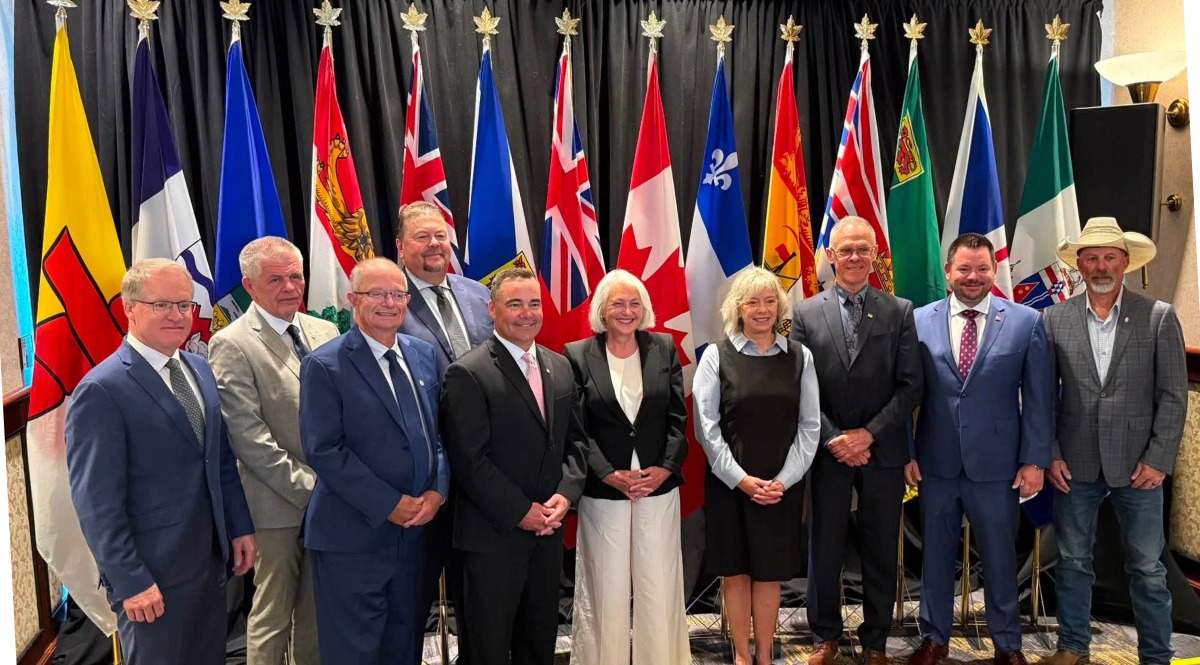
Province raises the future of salmon farming on Canada’s West Coast as a priority during national fisheries ministers meeting in Victoria.
By Fabian Dawson
SeaWestNews
British Columbia is pressing Ottawa for greater certainty over the future of salmon farming as the federal government’s 2029 deadline to end the sector’s ocean operations on the West Coast moves closer.
Randene Neill, B.C.’s Minister of Water, Land and Resource Stewardship said the issue was among the province’s priorities raised during this week’s meeting of federal, provincial and territorial fisheries and aquaculture ministers in Victoria.
“During our discussions, I highlighted B.C.’s ongoing priorities, including support for salmon recovery, watershed protection, recreational fishing data, invasive-mussel prevention, timely and effective permitting processes for major projects and greater certainty regarding the future of aquaculture and the transition of open-net pen operations,” Neill said in a statement.
Pressured by the anti-salmon farming lobby, the Trudeau Liberals announced the ban in 2024 despite decades of real-world data, extensive scientific reviews and findings from its own federal scientists that the salmon farms pose no more than a minimal risk to wild fish stocks.
Currently in B.C., every salmon farm operates under a formal partnership with a First Nation, generating about $134 million a year in direct economic benefits for Indigenous communities and supporting more than 1,000 Indigenous workers across the coast.
The broader sector generates about $1.17 billion a year in economic activity and supports roughly 4,560 full-time jobs and hundreds of vendors across the province’s salmon farming supply chain.
B.C.’s salmon farmers and their First Nations partners say a stable, evidence-based federal and provincial policy framework would allow the sector to more than double its impact, generating up to $2.5 billion annually in economic activity, $930 million in GDP and 9,000 Canadian jobs.
Neill’s comments came as fisheries ministers from across Canada met in Victoria this week to discuss trade, competitiveness, aquaculture, climate change and other issues affecting the seafood sector.
She said fisheries, aquaculture and seafood processing generate billions of dollars in annual revenue and thousands of jobs in B.C., which produces more than 100 seafood species and exports more than 190 seafood products internationally.
The future of salmon farming is particularly significant because salmon remains by far the largest component of B.C.’s aquaculture industry. Latest federal production figures show B.C. farmed salmon production stood at about 54,000 tonnes in 2024, worth more than $500 million at the farm gate.
Neill’s call for greater certainty comes almost a year after Federal Fisheries Minister Joanne Thompson said the long-promised plan that will decide the future of salmon farming in British Columbia was in the “final stages.”
To conclude this week’s meeting Thompson and Neill announced a new $106.5-million British Columbia Fisheries Fund aimed at strengthening the province’s fish and seafood sector.
The five-year fund will support innovation, infrastructure, scientific partnerships and market development and diversification.
The federal government will provide 60 per cent of the funding, with B.C. covering the remaining 40 per cent.
The fund will also continue work previously supported through the British Columbia Salmon Restoration and Innovation Fund, including projects focused on wild Pacific salmon and habitat restoration.
Neill said the renewed funding would support fisheries, seafood market diversification and watershed and ocean health.
“I will continue advocating for measures that support healthy ecosystems, sustainable fisheries and strong coastal economies,” Neill said.
British Columbia’s Minister of Water, Land and Resource Stewardship, Randene Neill, and the federal Minister of Fisheries, Joanne Thompson, co-chaired the annual meeting of the Canadian Council of Fisheries and Aquaculture Ministers (CCFAM) in Victoria this week.