
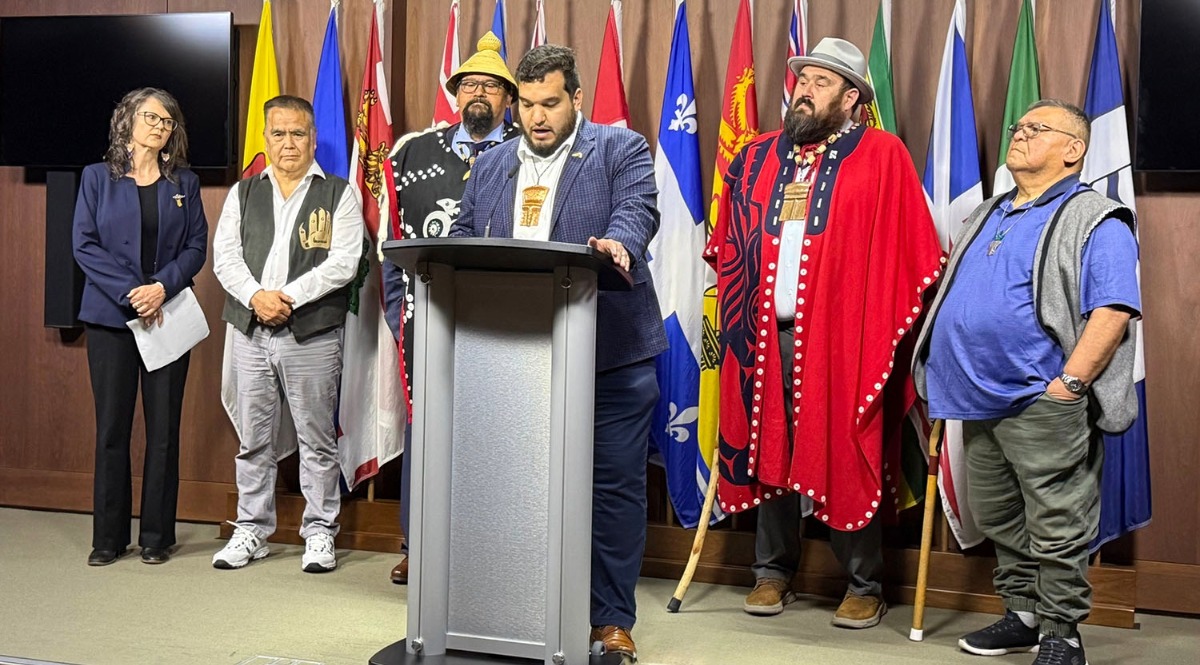
Activist financier, Tony Allard says a Trudeau-era plan to eliminate ocean salmon farming in British Columbia by 2029 advances reconciliation. Coastal First Nations that host the farms see something very different.
By Fabian Dawson
SeaWestNews
Tony Allard, the Vancouver-based investment executive who co-founded two groups campaigning against ocean salmon farming, says banning the industry in British Columbia is a path toward reconciliation.
But the coastal First Nations that host salmon farms, who have agreements with the companies operating them and rely on the sector for jobs, revenues and economic independence, see it as something else.
For those Nations, Allard’s vision carries a familiar message of “you can make your own decisions, as long as we approve of them.”
That is where his argument begins to look less like reconciliation and more like recolonization.
In his latestVancouver Sun opinion piece, Allard urges Premier David Eby to pressure Prime Minister Mark Carney into keeping Ottawa’s proposed 2029 ban on open-net salmon farming. He presents the policy as environmentally necessary, economically sound and consistent with reconciliation.
What he largely leaves out are the First Nations whose territories contain the farms that would be removed.
Every salmon farm operating in B.C. does so under an agreement with a host First Nation. The sector supports more than 1,000 Indigenous workers and generates about $134 million a year in direct economic benefits for First Nations communities. Across B.C., marine salmon aquaculture generates roughly $1.17 billion in annual economic activity and supports about 4,560 full-time jobs.
Those facts go directly to what reconciliation is supposed to mean and to a model increasingly embraced across Canada’s resource industries, where First Nations participate as partners, share in the economic benefits and have a direct say in what happens in their territories.
For decades, governments made economic decisions in Indigenous territories with little regard for the people living there. Today, Canada talks about Indigenous rights, consent and self-determination.
Yet on salmon farming, Allard is asking Ottawa to return to a model where government decides what constitutes social licence, heavily influenced by predominantly non-native, urban-based activist groups.
The Coalition of First Nations for Finfish Stewardship says protecting wild salmon does not require Ottawa to remove ocean aquaculture from the territories of Nations that have chosen to participate in it. Its members have invited Allard to visit their communities and examine the evidence. They say those invitations have produced little meaningful engagement.
First Nations are routinely described as rights holders, not stakeholders. Their authority is defended when they oppose or support pipelines, mines or logging. Why should that authority disappear when a coastal Nation supports salmon farming?
Allard also argues that removing salmon farms is helping wild salmon recover.
That claim has never been proven. Wild salmon returns are shaped by ocean conditions, habitat, predation, fishing pressure and other factors. Even groups such as Living Oceans Society and the Pacific Salmon Foundation, both of which have supported removing open-net farms, have acknowledged that the effect of farm removals on recent wild salmon returns is not conclusive.
The broader scientific record is also more complicated than Allard suggests. Ten federal risk assessments conducted through Fisheries and Oceans Canada and the Canadian Science Advisory Secretariat have concluded that salmon farms pose no more than minimal risk to wild Pacific salmon populations.
None of this means salmon farming should escape scrutiny. It means policy should reflect the full evidence.
The same standard should apply to Allard’s proposed alternative.
He wants B.C. to shift production onto land, despite government-commissioned studies concluding that land-based salmon farming is not commercially viable at the scale required to replace current ocean production.
Allard also makes no mention that entities he funds are seeking $2 billion in taxpayer support for a land-based salmon industry that would replace the marine farms he wants shut down, even after the First Nation presented as a pilot partner withdrew its consent.
Carney has promised to strengthen Canadian food security, yet Ottawa’s policy would reduce domestic salmon production and deepen reliance on imports. Canada spent more than $1 billion on imported salmon in 2025, including growing shipments from China, a major processing hub for Russian salmon that is subject to Canadian sanctions.
So, how does replacing salmon raised in Canadian waters, under Canadian regulations and in partnership with First Nations, with more imported fish strengthen food security, help consumers or advance reconciliation?
That question goes to the heart of Allard’s argument. His version of reconciliation would have Ottawa remove salmon farms from the traditional territories of First Nations that have chosen to support them.
He may call that reconciliation.
The Nations losing the right to decide whether salmon farming continues in their traditional territories see it for what it increasingly resembles. Recolonization.
(Main file image shows members of The Coalition of First Nations for Finfish Stewardship at a press conference.)